What accounting is (and how bookkeeping fits in)
Explain what accounting does, who uses the numbers, and where bookkeeping fits in.
- Principles:
- Economic entity
Accounting tells the money story of a business
Accounting is recording, classifying, summarizing and reporting a business's financial transactions.
A transaction is any money event that affects the business. Sending an invoice, paying rent and buying a mower are all transactions.
At the end, accounting turns hundreds of small events into a few clear reports. Those reports answer simple questions: Are we making money? What do we own? What do we owe?
Bookkeeping is the daily part
Bookkeeping is recording and organizing transactions. It is the everyday work: entering bills, sending invoices, sorting bank activity into the right accounts.
Accounting builds on that work. It checks the records, makes adjustments, prepares reports and helps people make decisions.
Good accounting depends on good bookkeeping. If the daily records are wrong, every report built on them is wrong too.
| Bookkeeping | Accounting |
|---|---|
| Records each transaction | Reviews and adjusts the records |
| Sorts activity into accounts | Prepares financial statements |
| Happens every day or week | Happens monthly, quarterly and yearly |
| Answers: what happened? | Answers: what does it mean? |
Who uses the numbers
Many people rely on a business's financial information. Each one asks a different question.
- Owners and managers: Can we afford a new truck? Which services earn the most?
- Lenders: Can this business repay a loan?
- Tax authorities: How much income did the business earn?
- Investors or partners: Is the business growing?
- Employees and vendors: Will this business pay on time?
Meet the sample business
All of the examples in this course use one sample business: Evergreen Landscaping LLC, a landscaping business in Vancouver, Washington. The screenshots show its books in Leah Books.
Its customers include Harbor View HOA, Columbia Dental Group and Riverside Church. Its vendors include Pacific Nursery Supply, Cascade Fuel Co. and Mill Plain Properties, its landlord.
Your own Leah Books has the same menus and screens, so you can follow along there.
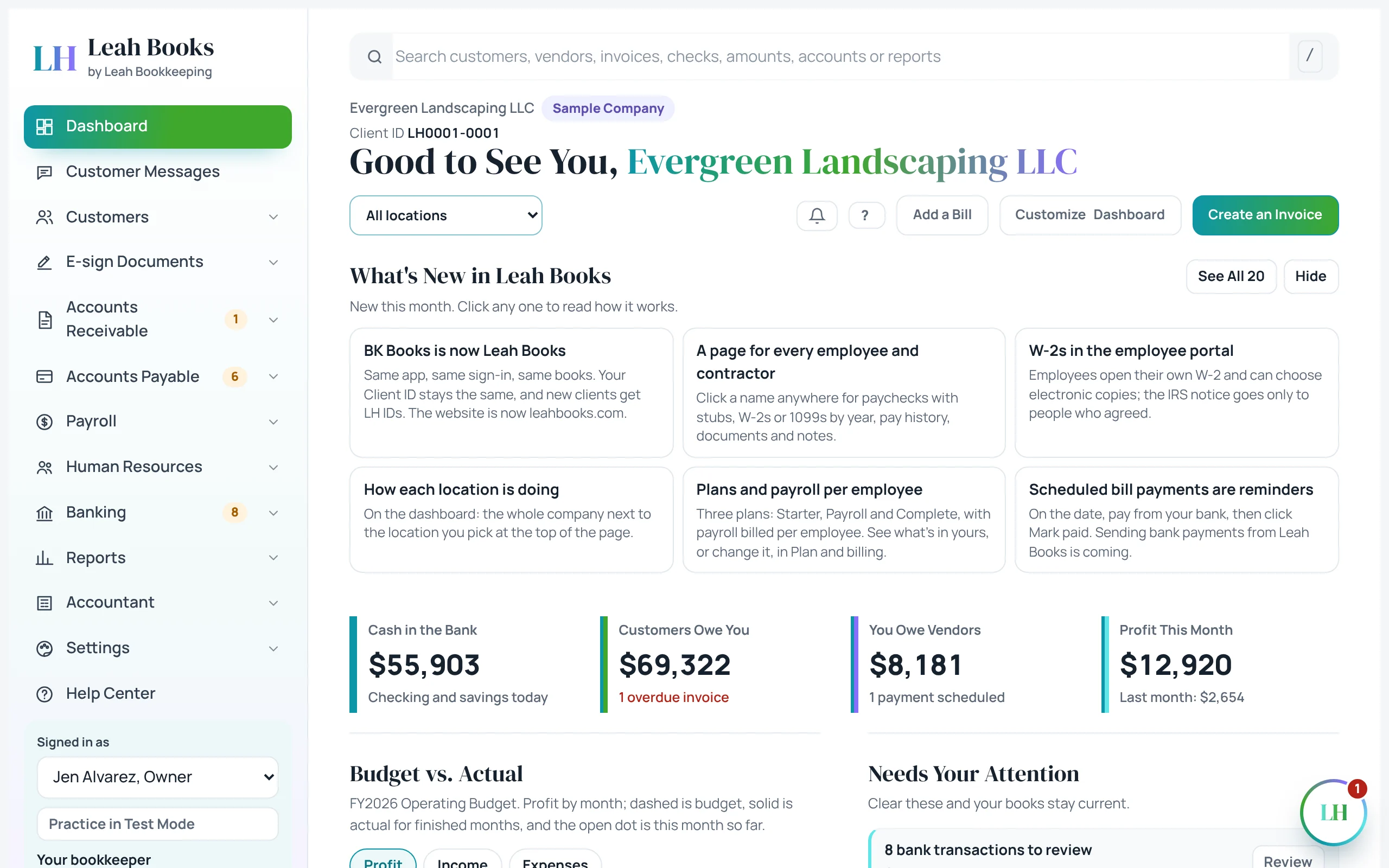 (opens the full-size screenshot)
The business is its own entity
The business entity idea says the business is separate from its owner. Evergreen Landscaping has its own bank account and its own books.
If the owner buys groceries with a personal card, that is not a business transaction. It stays out of the business books.
Keeping business and personal money apart is the first habit of clean books.
Try it in Leah Books
- Open your Leah Books and look at the Dashboard.
- Find what customers owe and what bills are coming due.
- Go to Customers > Customer profiles and open one of your customers. These are the people who pay the business.
- Go to Accounts Payable > Bills and open a bill from one of your vendors. This is money the business owes.
- Go to Reports > Profit and loss. This one report summarizes all the income and expense transactions for the period.
Key terms
- Accounting
- Recording, classifying, summarizing and reporting financial transactions.
- Bookkeeping
- Recording and organizing financial transactions day to day.
- Transaction
- A financial event that affects a business, like an invoice, a bill or a payment.
- Business entity
- The idea that a business is separate from its owner and keeps its own records.
- Financial statements
- Reports that summarize the books, such as the profit and loss and the balance sheet.
- Users of financial information
- Anyone who relies on the numbers: owners, lenders, tax authorities, investors and others.
Check what you learned
Pick an answer to see if it's right and why. Nothing is saved or sent.