Adjusting entries: accruals and deferrals
Record the four common month-end adjustments: accrued revenue, accrued expenses, prepaid expenses and unearned revenue.
- Principles:
- Revenue recognition
- Matching
- Accrual basis
Why adjust at all
Under the accrual basis, revenue is recorded when it is earned and expenses when they are incurred, not when cash moves. Most of the time an invoice or a bill handles that. Adjusting entries handle the rest at the end of a period.
Every adjusting entry touches one balance sheet account and one income statement account, and almost none of them touch cash. There are two families:
- Accruals: the revenue or expense happened, but nothing has been recorded yet. Cash comes later.
- Deferrals: cash already moved, but the revenue or expense belongs to later periods.
Accrued revenue
Evergreen finished $1,200 of irrigation work for Salmon Creek Office Park in the last week of October, but the job won't be billed until the project wraps up in November. The revenue was earned in October, so it is recorded in October.
| Account | Debit (Dr) | Credit (Cr) |
|---|---|---|
| Accounts Receivable | $1,200.00 | |
| Landscaping Services | $1,200.00 | |
| Total Balanced | $1,200.00 | $1,200.00 |
Memo: In Leah Books the simplest way is usually to date the invoice in the month the work was done. Use an entry like this only when you truly can't bill yet.
Are you Increasing or Decreasing?
| Debit | Credit |
|---|---|
| Asset | Liability |
| Draw | Equity |
| Expense | Revenue |
+ To increase an account, put it on its normal side.
Accounts Receivable goes up: press + and find Asset on the debit side.
Accrued expenses: wages
Evergreen's crew worked the last days of October, but that pay goes out on the next payday in November. The wages are an October expense, and Evergreen owes them, so it records a liability.
In November, a reversing entry on Nov 1 (debit Accrued Liabilities, credit Wages) clears the accrual so the full paycheck can be recorded normally without counting those days twice.
| Account | Debit (Dr) | Credit (Cr) |
|---|---|---|
| Wages | $1,850.00 | |
| Accrued Liabilities | $1,850.00 | |
| Total Balanced | $1,850.00 | $1,850.00 |
Memo: This is the Accrued wages template in Accountant > Manual journals.
Are you Increasing or Decreasing?
| Debit | Credit |
|---|---|
| Asset | Liability |
| Draw | Equity |
| Expense | Revenue |
+ To increase an account, put it on its normal side.
Wages goes up: press + and find Expense on the debit side.
 (opens the full-size screenshot)
Deferrals: prepaid insurance
Suppose Evergreen pays Evergreen Mutual Insurance $5,760 up front for a full year of coverage. On the day it pays, the coverage is something it owns: an asset called Prepaid Expenses. Each month, one month of coverage is used up and becomes an expense.
Monthly expense = Prepaid amount ÷ Months covered = $5,760 ÷ 12 = $480
| Account | Debit (Dr) | Credit (Cr) |
|---|---|---|
| Insurance | $480.00 | |
| Prepaid Expenses | $480.00 | |
| Total Balanced | $480.00 | $480.00 |
Memo: The payment itself was: debit Prepaid Expenses $5,760, credit Business Checking $5,760.
Are you Increasing or Decreasing?
| Debit | Credit |
|---|---|
| Liability | Asset |
| Equity | Draw |
| Revenue | Expense |
− To decrease an account, put it on the opposite side.
Prepaid Expenses goes down: press − and find Asset on the credit side.
Deferrals: unearned revenue
Maple Street Apartments pays $3,000 in advance for three months of grounds maintenance. Until the work is done, Evergreen owes the service, so the money is a liability, not income. Many textbooks call it Unearned Revenue; Leah Books uses an account called Customer Deposits for money received before the work is invoiced.
When the payment arrives: debit Business Checking $3,000, credit Customer Deposits $3,000. At the end of the first month, one third has been earned.
| Account | Debit (Dr) | Credit (Cr) |
|---|---|---|
| Customer Deposits | $1,000.00 | |
| Landscaping Services | $1,000.00 | |
| Total Balanced | $1,000.00 | $1,000.00 |
Are you Increasing or Decreasing?
| Debit | Credit |
|---|---|
| Liability | Asset |
| Equity | Draw |
| Revenue | Expense |
− To decrease an account, put it on the opposite side.
Customer Deposits goes down: press − and find Liability on the debit side.
 (opens the full-size screenshot)
Try it in Leah Books
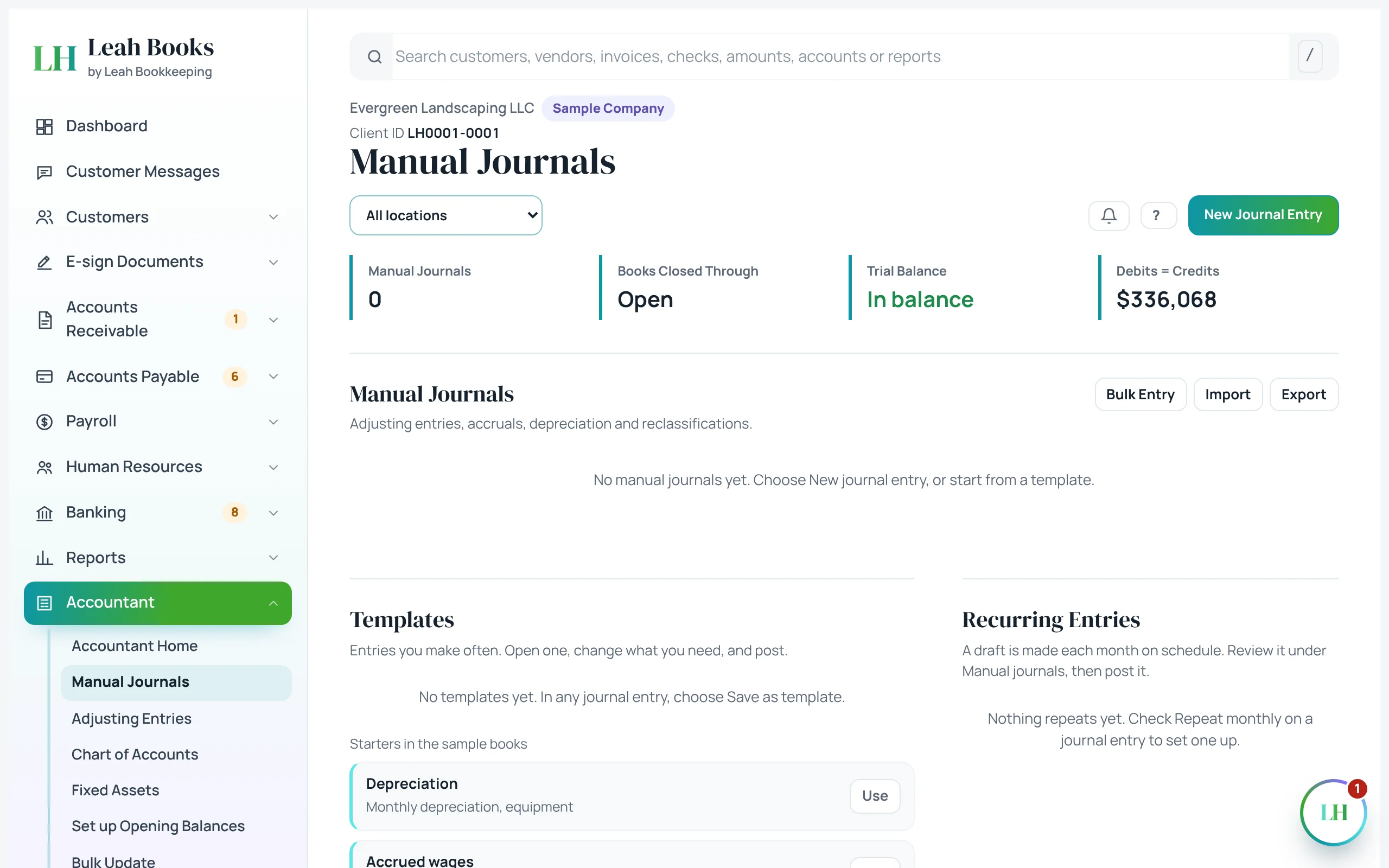
- Go to Accountant > Manual journals.
- Under Start from a template, click Use next to Accrued wages. Check that Wages is debited and Accrued Liabilities credited for $1,850.
- Tick Auto-reverse so Leah Books posts the reversing entry on the 1st of next month, then click Post.
- Use the Prepaid expense template ($5,760), post it, then use Expense a prepaid month ($480) and post that too.
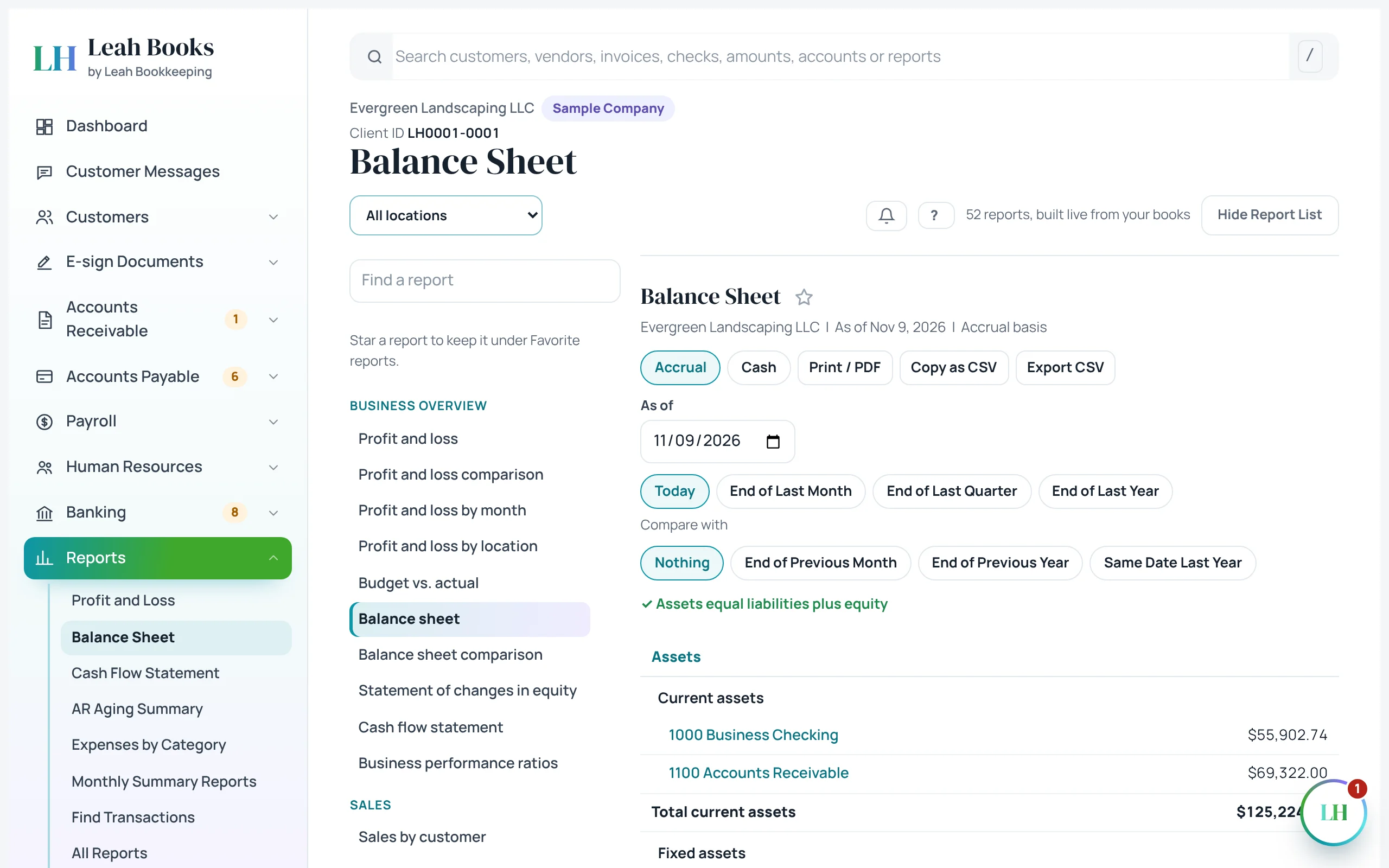
- Open Reports > Balance sheet. Prepaid Expenses is up by $5,280 ($5,760 − $480), and Accrued Liabilities is up by $1,850.
Key terms
- Accrual
- Revenue earned or an expense incurred that hasn't been recorded or paid yet.
- Deferral
- Cash received or paid before the revenue is earned or the expense is used up.
- Accrued expense
- An expense incurred but not yet paid, recorded with a liability, like wages owed at month end.
- Accrued revenue
- Revenue earned but not yet billed or received, recorded with a receivable.
- Prepaid expense
- A payment made in advance for something used over future periods; an asset until used.
- Unearned revenue
- Money received before the work is done; a liability until earned. Leah Books records it as Customer Deposits.
- Reversing entry
- An entry on the first day of a new period that undoes an accrual so the later payment isn't counted twice.
Check what you learned
Pick an answer to see if it's right and why. Nothing is saved or sent.