Cash basis vs. accrual basis
Read the same month on a cash basis and an accrual basis and explain why the numbers differ.
- Principles:
- Revenue recognition
- Matching
- Consistency
Two ways to decide when something counts
Accrual basis records revenue when it's earned and expenses when they're incurred. It doesn't wait for cash.
Cash basis records revenue when money comes in and expenses when money goes out.
Same business, same month, two different pictures. Neither is "wrong". They answer different questions.
Evergreen Landscaping's April
- Apr 1: Pays $2,200 April rent to Mill Plain Properties.
- Apr 4: Invoices Columbia Dental Group $2,400. They pay on Apr 20.
- Apr 9: Gets a $1,400 bill from Pacific Nursery Supply. Evergreen pays it on May 3.
- Apr 18: Invoices Harbor View HOA $3,600. They pay on May 6.
| April profit and loss | Accrual basis | Cash basis |
|---|---|---|
| Income | $6,000 | $2,400 |
| Cost of goods sold (plants) | $1,400 | $0 |
| Rent | $2,200 | $2,200 |
| Net income | $2,400 | $200 |
Net income = Revenue − Expenses
Why the numbers differ
- Accrual counts both invoices in April because the work was done in April.
- Cash counts only Columbia Dental's $2,400 because that's the only money that came in.
- Accrual counts the plants bill in April because the plants were used on April jobs. Cash waits until it's paid in May.
- Rent is the same both ways because it was paid in the same month it covered.
Which reports change
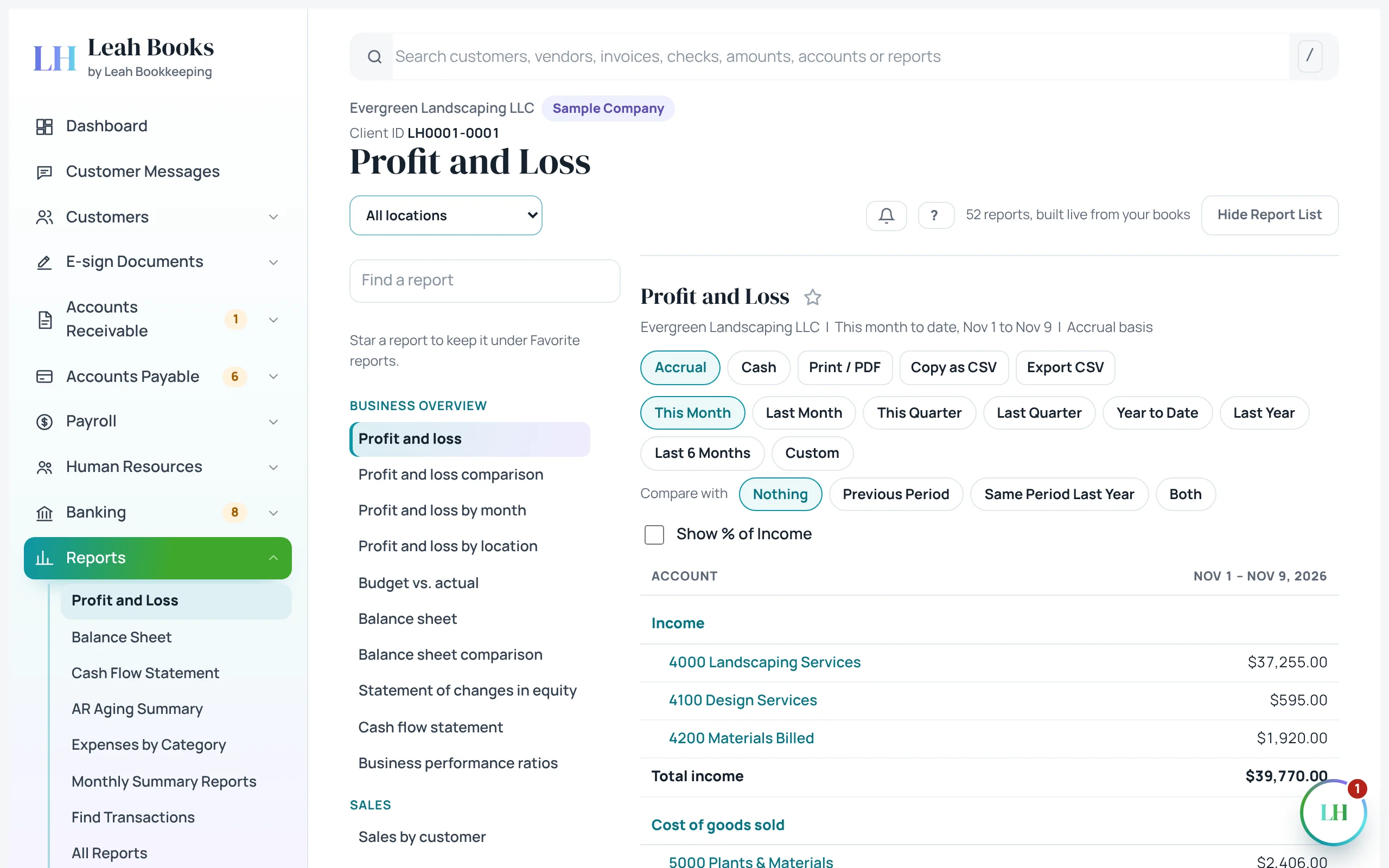
The profit and loss changes the most, as you just saw.
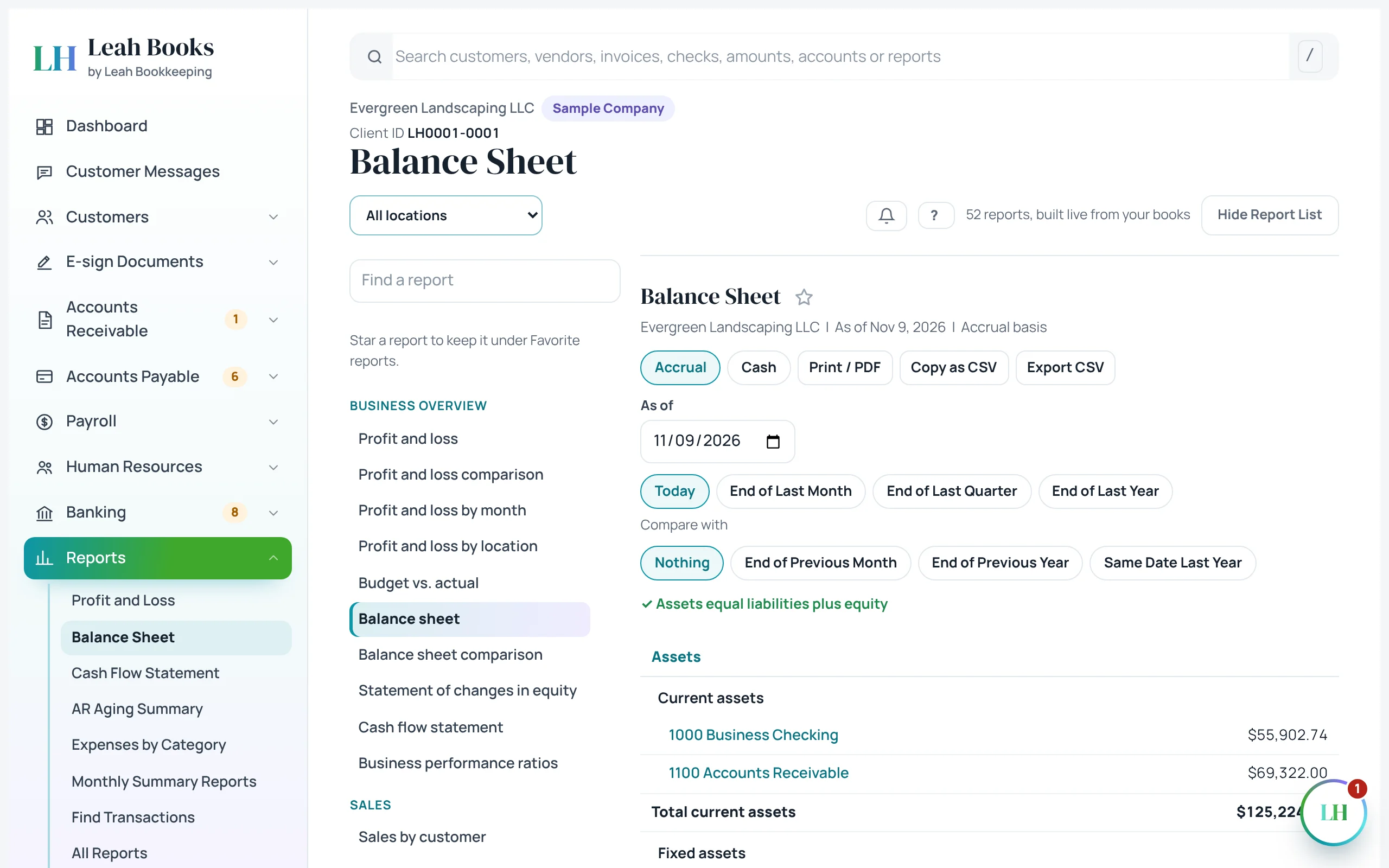
The balance sheet changes too. On April 30, accrual shows $3,600 in Accounts Receivable and $1,400 in Accounts Payable. Cash basis leaves those out, so equity is smaller.
Your bank balance is the same either way. Reports that list documents as they are, like the AR aging summary, also come out the same.
| April 30 balance sheet item | Accrual basis | Cash basis |
|---|---|---|
| Accounts Receivable | $3,600 | $0 |
| Accounts Payable | $1,400 | $0 |
| Cash in the bank | Same | Same |
 (opens the full-size screenshot)
Which should you use?
Accrual gives a truer picture of how the business performed each month. It follows the revenue recognition and matching principles.
Cash basis is simpler, and many small businesses file their taxes this way. Whether your business may use it depends on tax rules, which change. Check with a tax professional.
Leah Books keeps one set of books and can show reports either way. Pick a default in Settings > Business settings, and switch any report with the Accrual and Cash tabs.
 (opens the full-size screenshot)
Try it in Leah Books
- Go to Reports > Profit and loss and set the period to Last month. Write down total income.
- Click the Cash tab at the top of the report. Compare income now. The difference is invoices that weren't paid in that month, and payments for earlier invoices.
- Go to Reports > Balance sheet and switch between Accrual and Cash. Watch Accounts Receivable and Accounts Payable.
- Go to Settings > Business settings and look at the Accounting method choice. That sets the default for your reports.
Key terms
- Accrual basis
- Recording revenue when earned and expenses when incurred, regardless of when cash moves.
- Cash basis
- Recording revenue when cash is received and expenses when cash is paid.
- Accrual
- Revenue or an expense recorded before the cash moves.
- Accounts receivable (AR)
- Money customers owe the business.
- Accounts payable (AP)
- Money the business owes vendors.
- Net income
- Revenue minus expenses for a period.
Check what you learned
Pick an answer to see if it's right and why. Nothing is saved or sent.