The accounting principles (GAAP)
Name the main accounting principles and spot each one in a small-business example.
- Principles:
- Economic entity
- Going concern
- Monetary unit
- Time period
- Historical cost
- Revenue recognition
- Matching
- Full disclosure
- Consistency
- Materiality
- Conservatism
Why there are rules
GAAP stands for Generally Accepted Accounting Principles. These are the shared rules for financial reporting in the United States. The Financial Accounting Standards Board (FASB) sets them.
The rules mean a reader can trust that a balance sheet means the same thing from one business to the next.
Small businesses don't always have to follow every GAAP rule. Many keep cash-basis books for taxes. But these principles are the foundation of all good bookkeeping.
Principles about what you measure
These principles set the ground rules: whose books, for how long, and in what unit.
| Principle | What it means | Evergreen Landscaping example |
|---|---|---|
| Economic entity | The business is separate from its owner. | The owner's family vacation is not a business expense. |
| Going concern | Assume the business will keep operating. | Equipment is spread over its useful years, not treated as worthless today. |
| Monetary unit | Record everything in one currency, in dollars. | A happy customer is not recorded. A $3,600 invoice is. |
| Time period | Split the business's life into periods like months and years. | The profit and loss shows just this month, or just last year. |
| Historical cost | Record assets at what you paid for them. | Equipment stays at its purchase price even if it might sell for more. |
Principles about when you record
| Principle | What it means | Evergreen Landscaping example |
|---|---|---|
| Revenue recognition | Record revenue when it is earned, not when cash arrives. | Spring cleanup done in April counts as April revenue, even if Harbor View HOA pays in May. |
| Matching (expense recognition) | Record expenses in the same period as the revenue they help earn. | Plants used on an April job are an April cost. |
These two principles are the heart of accrual accounting. You'll compare accrual and cash basis in lesson 1.8.
Principles about how you report
| Principle | What it means | Evergreen Landscaping example |
|---|---|---|
| Full disclosure | Share anything a reader needs to understand the numbers. | Note a pending lawsuit over a damaged sprinkler system. |
| Consistency | Use the same methods from period to period. | Don't switch between cash and accrual every month. |
| Materiality | Focus on amounts big enough to change a decision. | A $12 stapler can be expensed right away instead of tracked as equipment. |
| Conservatism | When unsure, don't overstate assets or income. | If a customer probably won't pay, plan for the loss now. Record a gain only when it happens. |
Seeing the principles on the reports
The profit and loss always covers a period of time. That is the time period principle at work.
The balance sheet shows Equipment at what Evergreen paid for it. That is historical cost.
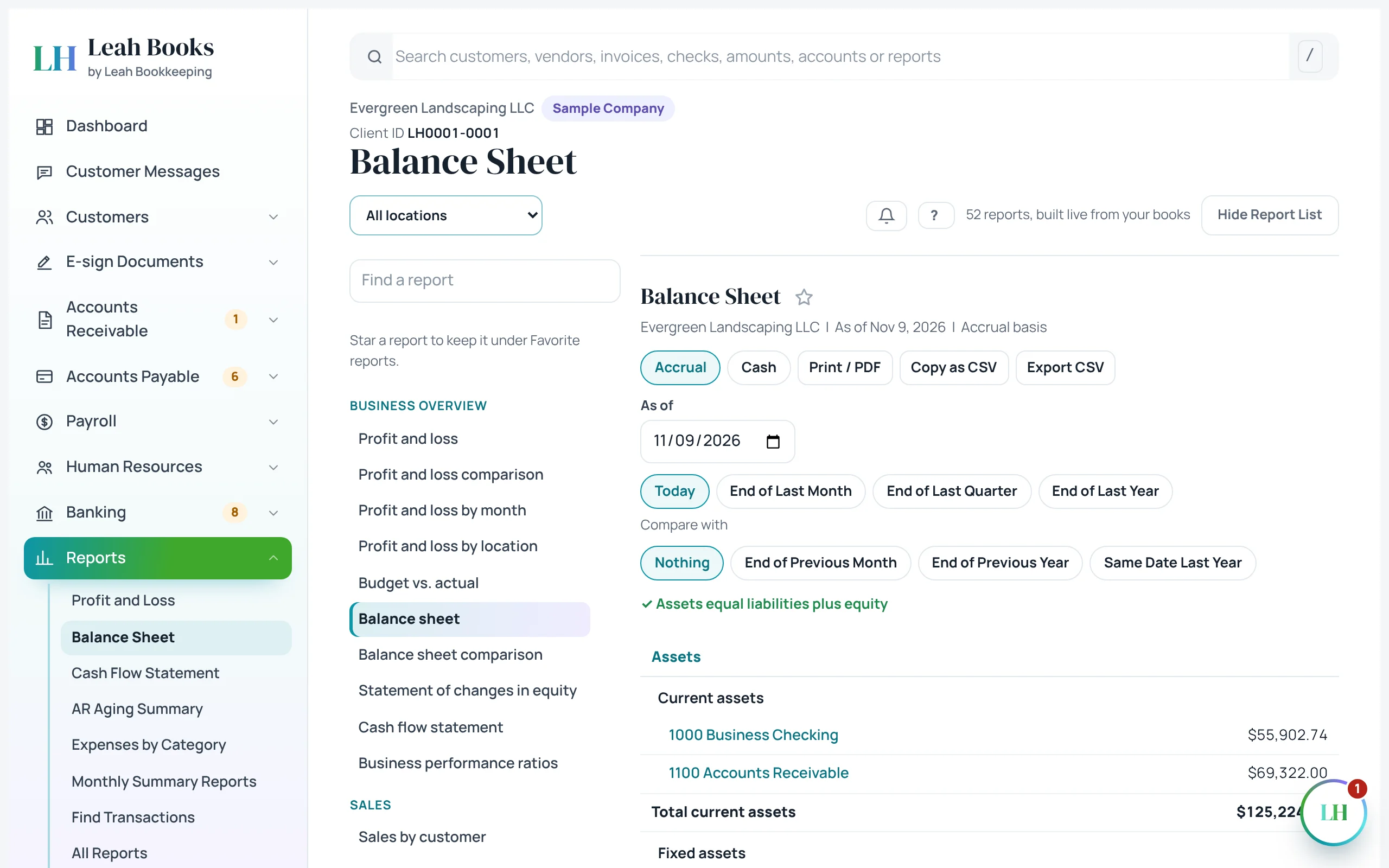 (opens the full-size screenshot)
Try it in Leah Books
- Go to Reports > Profit and loss. Change the period from This month to Last month. The time period principle decides which transactions show up.
- Go to Reports > Balance sheet. Find 1500 Equipment. It shows the amount the business paid, which is historical cost.
- Go to Settings > Business settings. Find the Accounting method choice (Accrual or Cash). Picking one and sticking with it is the consistency principle.
Key terms
- GAAP
- Generally Accepted Accounting Principles, the standard financial reporting rules in the US.
- FASB
- The Financial Accounting Standards Board, which sets US GAAP.
- Going concern
- The assumption that a business will keep operating.
- Historical cost
- Recording an asset at its original purchase cost.
- Revenue recognition
- Recording revenue when it is earned, regardless of when cash comes in.
- Matching principle
- Recording expenses in the same period as the revenue they help produce.
- Materiality
- Whether an amount is big enough to influence a financial decision.
- Conservatism
- When in doubt, choose the option that does not overstate assets or income.
Check what you learned
Pick an answer to see if it's right and why. Nothing is saved or sent.