The accounting cycle
Name the nine steps that take a business from its first transaction of the month to a clean, closed set of books.
- Principles:
- Periodicity (time period)
- Double-entry
- Matching
The same steps, every period
Accounting runs in a loop called the accounting cycle. The same steps repeat every month, quarter and year, so that each period's numbers stand on their own.
Our running example is Evergreen Landscaping LLC, the business in the Leah Books sample books. It cares for grounds in Vancouver, Washington, for customers like Harbor View HOA and Columbia Dental Group.
| Step | What happens |
|---|---|
| 1. Transactions | Something happens: a job is invoiced, a bill arrives, payroll is run. |
| 2. Journal | Each transaction is recorded as a journal entry, with debits equal to credits. |
| 3. Ledger | Entries are posted to each account in the general ledger. |
| 4. Unadjusted trial balance | Every account balance is listed to prove debits equal credits. |
| 5. Adjustments | Accruals, deferrals, depreciation and estimates are recorded. |
| 6. Adjusted trial balance | The balances are listed again, now including the adjustments. |
| 7. Financial statements | The profit and loss, balance sheet and cash flow statement are prepared. |
| 8. Closing | Revenue, expense and draw accounts are closed into retained earnings. |
| 9. Post-closing trial balance | Only balance sheet accounts remain, ready for the next period. |
Steps 1 to 3: recording
Most of the month is spent on the first three steps. In Leah Books you rarely type a journal entry for everyday work. When you create an invoice, enter a bill or run payroll, Leah Books writes the journal entry and posts it to the ledger for you.
For example, when Evergreen invoices Harbor View HOA for a month of grounds maintenance, this is the entry behind the invoice.
| Account | Debit (Dr) | Credit (Cr) |
|---|---|---|
| Accounts Receivable | $1,850.00 | |
| Landscaping Services | $1,850.00 | |
| Total Balanced | $1,850.00 | $1,850.00 |
Memo: Leah Books posts this automatically when the invoice is created.
Are you Increasing or Decreasing?
| Debit | Credit |
|---|---|
| Asset | Liability |
| Draw | Equity |
| Expense | Revenue |
+ To increase an account, put it on its normal side.
Accounts Receivable goes up: press + and find Asset on the debit side.
 (opens the full-size screenshot)
Steps 4 to 7: checking, adjusting, reporting
At month end, you check that the books balance, then add the entries that no invoice or bill creates on its own: wages earned but not yet paid, the month's share of insurance paid in advance, and depreciation. Lesson 3.3 covers these.
Only after the adjustments are in do the statements tell the truth about the month. The matching idea is the reason: expenses belong in the same period as the revenue they helped earn.
Adjusted balance = Unadjusted balance + Adjusting entries
Steps 8 and 9: closing
Closing resets the income and expense accounts to zero so the next year starts fresh, and moves the year's profit into retained earnings. Monthly, most businesses do a lighter close: they review, adjust and then lock the month so nothing dated in it can change.
The post-closing trial balance is the starting point for the next cycle. It holds only assets, liabilities and equity.
 (opens the full-size screenshot)
Try it in Leah Books
- Go to Accountant > Manual journals. Find the Trial balance box at the top and check that it says In balance.
- Go to Reports > All reports and open Trial balance in the Accountant group. Notice that the debit and credit columns have the same total.
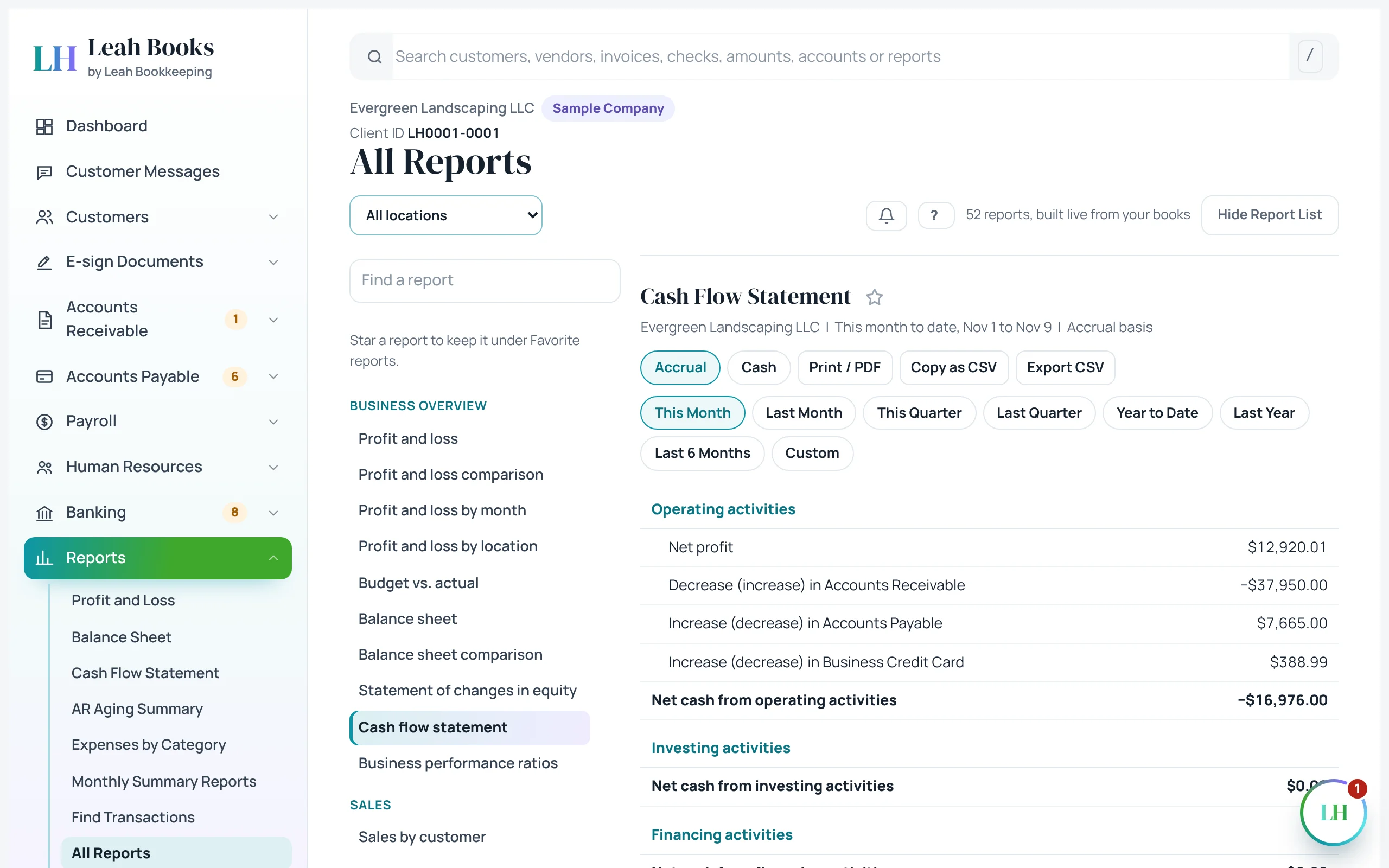
- Open Reports > Profit and loss, then Reports > Balance sheet. These are step 7 of the cycle.
- Open Accountant > Transaction locking to see where a finished month gets locked. Don't lock anything yet; you will in lesson 3.7.
Key terms
- Accounting cycle
- The repeating set of steps that takes transactions from recording to closed financial statements each period.
- Journal
- The record of transactions in date order, each written as debits and credits.
- General ledger
- The collection of every account and its activity and balance.
- Posting
- Copying each line of a journal entry to the account it affects in the ledger.
- Adjusting entry
- An entry made at the end of a period so revenue and expenses land in the period they belong to.
- Post-closing trial balance
- A trial balance after closing entries; it lists only balance sheet accounts.
Check what you learned
Pick an answer to see if it's right and why. Nothing is saved or sent.