Payroll accounting
Work from gross pay to net pay, record the paycheck and employer taxes, and track payroll liabilities until they're paid.
- Principles:
- Accrual basis
- Matching
From gross pay to net pay
Gross pay is what the employee earned. Net pay is what lands in their hands after withholdings. The difference isn't the business's money: it's held for the government or a benefit plan and has to be paid over.
Tanya Brooks, a landscaper at Evergreen, earns $26 an hour and worked 80 hours this pay period. She puts 3% of her pay into the company 401(k).
| Line | Amount |
|---|---|
| Gross pay (80 hours × $26) | 2,080.00 |
| Federal income tax withheld (from her W-4 and the IRS tables; example amount) | −140.00 |
| Social Security, employee share (6.2%) | −128.96 |
| Medicare, employee share (1.45%) | −30.16 |
| 401(k) contribution (3%) | −62.40 |
| Net pay | 1,718.48 |
Net pay = Gross pay − Employee taxes withheld − Employee deductions
Employee withholdings vs employer taxes
Some payroll taxes come out of the employee's pay; others are an extra cost the employer pays on top. Rates, wage bases and limits change, many of them every year, so always use current figures. The rates here are examples for learning, not tax advice; check with a tax professional.
- Withheld from the employee: federal income tax, the employee's share of Social Security and Medicare, state income tax where there is one, some state programs, and deductions like 401(k) and health premiums.
- Paid by the employer: a matching share of Social Security and Medicare, federal unemployment (FUTA), state unemployment, and in some states workers' comp or other programs.
- Washington, where Evergreen works, has no state income tax, but it has other state payroll programs. They're left out here to keep the math simple.
The payroll entries
The first entry records the paycheck. Wages expense is the full gross pay. Cash goes down only by net pay; the rest becomes liabilities.
| Account | Debit (Dr) | Credit (Cr) |
|---|---|---|
| Wages | $2,080.00 | |
| Business Checking | $1,718.48 | |
| Federal Payroll Taxes Payable | $299.12 | |
| Payroll Deductions Payable | $62.40 | |
| Total Balanced | $2,080.00 | $2,080.00 |
Memo: Federal: $140.00 income tax + $128.96 Social Security + $30.16 Medicare = $299.12.
Are you Increasing or Decreasing?
| Debit | Credit |
|---|---|
| Liability | Asset |
| Equity | Draw |
| Revenue | Expense |
− To decrease an account, put it on the opposite side.
Business Checking goes down: press − and find Asset on the credit side.
 (opens the full-size screenshot)
Employer payroll taxes
The second entry records the employer's own taxes on the same wages. In this example: Social Security match $128.96, Medicare match $30.16, FUTA at an example net rate of 0.6% (after the usual credit for state unemployment tax) = $12.48, and state unemployment at an example rate of 1.2% = $24.96. States assign each employer its own unemployment rate, and FUTA applies only to the first part of each employee's wages for the year.
| Account | Debit (Dr) | Credit (Cr) |
|---|---|---|
| Payroll Taxes | $196.56 | |
| Federal Payroll Taxes Payable | $171.60 | |
| State Payroll Taxes Payable | $24.96 | |
| Total Balanced | $196.56 | $196.56 |
Memo: Federal: $128.96 + $30.16 + $12.48 = $171.60. Leah Books posts the paycheck and employer taxes together as one entry.
Are you Increasing or Decreasing?
| Debit | Credit |
|---|---|
| Asset | Liability |
| Draw | Equity |
| Expense | Revenue |
+ To increase an account, put it on its normal side.
Payroll Taxes goes up: press + and find Expense on the debit side.
Payroll liabilities and paying them
The payable accounts stay on the balance sheet until the money is sent to the IRS, the state and the 401(k) plan. Federal Payroll Taxes Payable now holds $299.12 + $171.60 = $470.72.
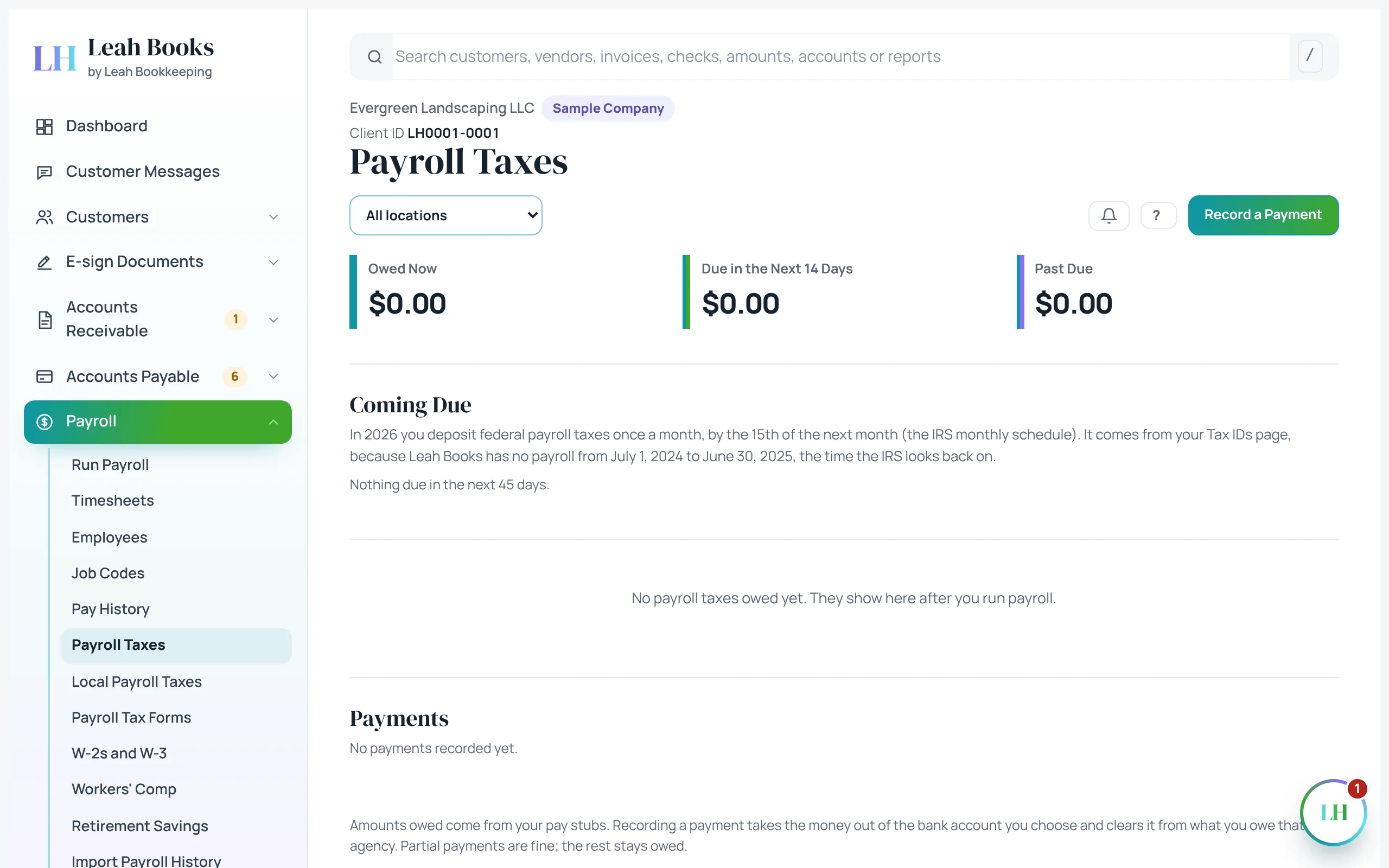
Leah Books calculates payroll and shows what each agency is owed and when, but it doesn't file payroll taxes or send the payments for you, and it doesn't do direct deposit. You pay each agency yourself, then record the payment in Payroll > Payroll taxes.
| Account | Debit (Dr) | Credit (Cr) |
|---|---|---|
| Federal Payroll Taxes Payable | $470.72 | |
| Business Checking | $470.72 | |
| Total Balanced | $470.72 | $470.72 |
Are you Increasing or Decreasing?
| Debit | Credit |
|---|---|
| Liability | Asset |
| Equity | Draw |
| Revenue | Expense |
− To decrease an account, put it on the opposite side.
Federal Payroll Taxes Payable goes down: press − and find Liability on the debit side.
 (opens the full-size screenshot)
Try it in Leah Books
- Go to Payroll > Run payroll. (You'll need payroll turned on and at least one employee.)
- Enter hours for an employee and look at their gross pay, each tax, any deductions and their net pay. Then click Submit payroll.
- Go to Payroll > Pay history and open the pay run you just submitted.
- Go to Payroll > Payroll taxes and see the new amounts owed to the IRS and the state.
- Go to Reports > All reports and open Journal report to see the payroll entry: Wages and Payroll Taxes debited, cash and the payroll liabilities credited.
Key terms
- Gross pay
- Total pay earned before any taxes or deductions.
- Net pay
- Pay after employee taxes and deductions; what the employee actually receives.
- Withholding
- Tax taken out of an employee's pay that the employer must send to the government.
- Employer payroll taxes
- Taxes the employer pays on top of wages, like its share of Social Security and Medicare, and unemployment taxes.
- FICA
- Social Security and Medicare taxes, paid by both the employee and the employer.
- FUTA
- Federal unemployment tax, paid only by the employer.
- Payroll liabilities
- Amounts withheld or owed from payroll that haven't been paid to the agencies or plans yet.
Check what you learned
Pick an answer to see if it's right and why. Nothing is saved or sent.