The full cycle: one month and year-end, start to finish
You'll follow one company through a whole month, from the first invoice to the locked books, and then through the year-end close, in the order a bookkeeper does it.
- Principles:
- Accrual basis
- Matching
- Time period
- Consistency
During the month
Every day or week, record what happens: send invoices, record payments, enter and pay bills, snap receipts, bring in the bank and card transactions and categorize them, and run payroll on its schedule.
- Invoice customers and record their payments
- Enter, approve and pay bills
- Record receipts and card charges
- Upload statements and categorize bank lines
- Run payroll and pay the payroll taxes
Month-end close
A few days after the month ends, close it in order. Each step depends on the one before.
| Step | What to do |
|---|---|
| 1. Finish the records | Every bank line categorized, every bill and receipt in |
| 2. Reconcile | Bank and card accounts, then every balance sheet account |
| 3. Adjust | Accruals, deferrals, depreciation, reclasses |
| 4. Trial balance | Debits equal credits; balances make sense |
| 5. Statements | Profit and loss, balance sheet, cash flow |
| 6. Review | Compare with last month and the budget |
| 7. Lock | Lock the month so nothing in it can change |
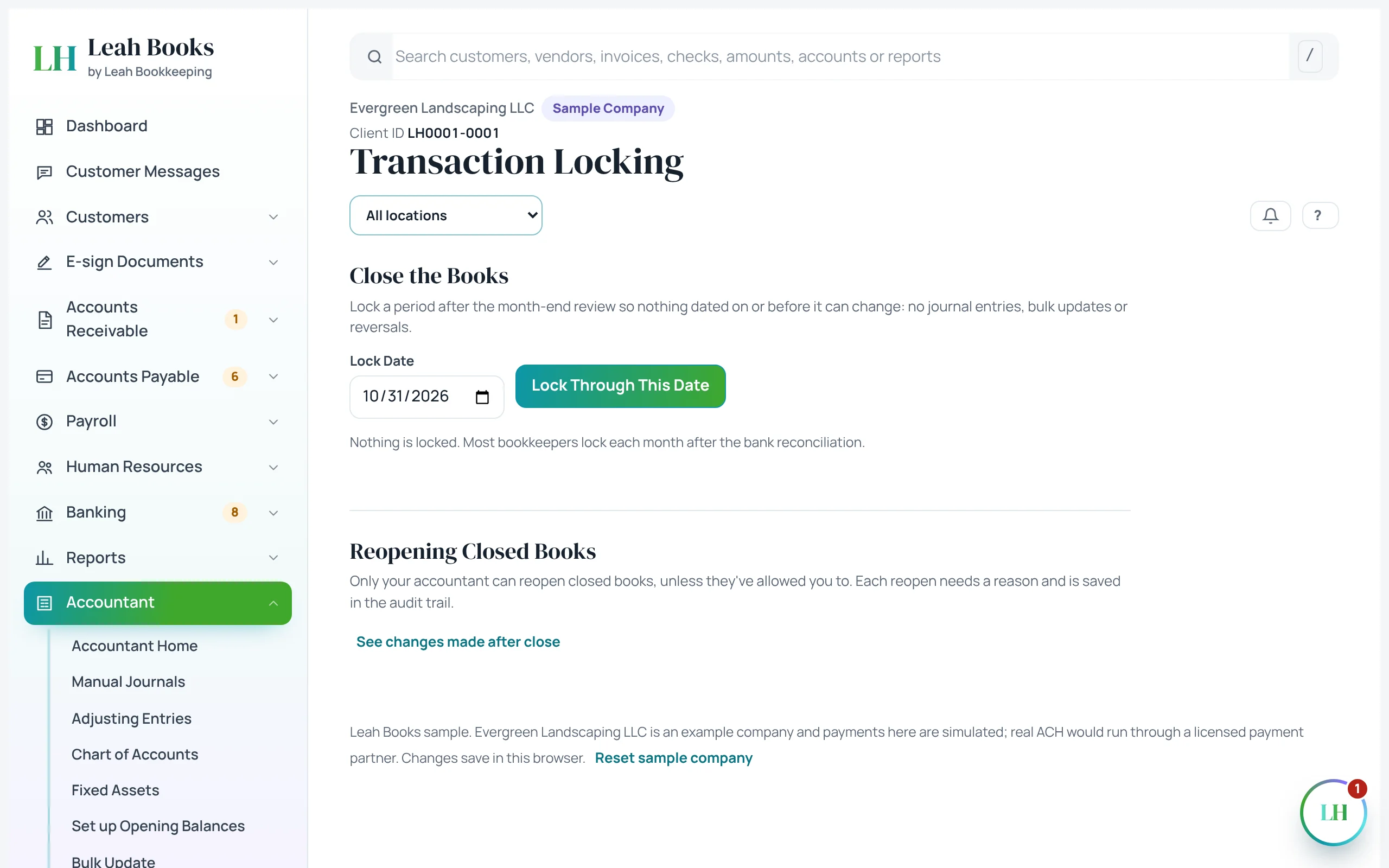 (opens the full-size screenshot)
Year-end close
After December's month-end close, finish the year: count inventory if you keep it, post the last depreciation and accruals, review the year's statements, and send the year's forms: W-2s for employees and 1099s for contractors by their deadlines.
Income and expense accounts then close into retained earnings, so the new year starts at zero. Leah Books does this for you when the new fiscal year starts. Owner's draws close into equity with one entry.
| Account | Debit (Dr) | Credit (Cr) |
|---|---|---|
| Retained Earnings | $20,000.00 | |
| Owner's Draw | $20,000.00 | |
| Total Balanced | $20,000.00 | $20,000.00 |
Are you Increasing or Decreasing?
| Debit | Credit |
|---|---|
| Liability | Asset |
| Equity | Draw |
| Revenue | Expense |
− To decrease an account, put it on the opposite side.
Retained Earnings goes down: press − and find Equity on the debit side.
Lock the year and hand off
Lock the year through December 31 so nothing changes after the tax return is based on it. Give your tax preparer the year-end package: the statements, the trial balance, the fixed asset register and the 1099 and payroll forms. Leah Books doesn't file your income tax return; your tax preparer does.
Try it in Leah Books
- Send an invoice, record a payment, enter a bill and record a receipt.
- Go to Banking > Upload a statement and click Try a sample statement. Categorize the lines, then reconcile your checking account.
- Post the month's depreciation in Accountant > Manual journals, then open the trial balance and the statements.
- Go to Accountant > Transaction locking and lock the month.
- Go to Accountant > Year-end close and walk through the checklist.
Key terms
- Month-end close
- The ordered steps that finish, check and lock a month.
- Year-end close
- Finishing the year: final adjustments, forms, closing entries and locking the year.
- Closing entries
- Entries that move the year's income, expenses and draws into retained earnings.
- Year-end package
- The reports and forms your tax preparer needs.
- Lock date
- The date the books are closed through; nothing on or before it can change.
Check what you learned
Pick an answer to see if it's right and why. Nothing is saved or sent.