Sales and invoices
You'll know when a sale counts as revenue, what an invoice does to the books, and how payment terms set the due date.
- Principles:
- Revenue recognition
- Accrual basis
- Double-entry
When a sale counts
Under the accrual basis, you count revenue when you earn it: when you've done the work or handed over the goods. Not when the money shows up.
Say Evergreen Landscaping LLC mows Harbor View HOA's grounds in March and the HOA pays in April. That's March revenue. The April payment just settles what they already owe.
This is the revenue recognition principle. It keeps each month's profit tied to the work done that month.
What goes on an invoice
An invoice is the bill you send a customer. It's also the source document for the sale in your books.
- The customer's name and billing address
- An invoice number (Evergreen's look like INV-1040) and the invoice date
- Lines: what you did or sold, quantity, rate and the income account each line goes to
- Payment terms and the due date
- Any discount or sales tax, and the total
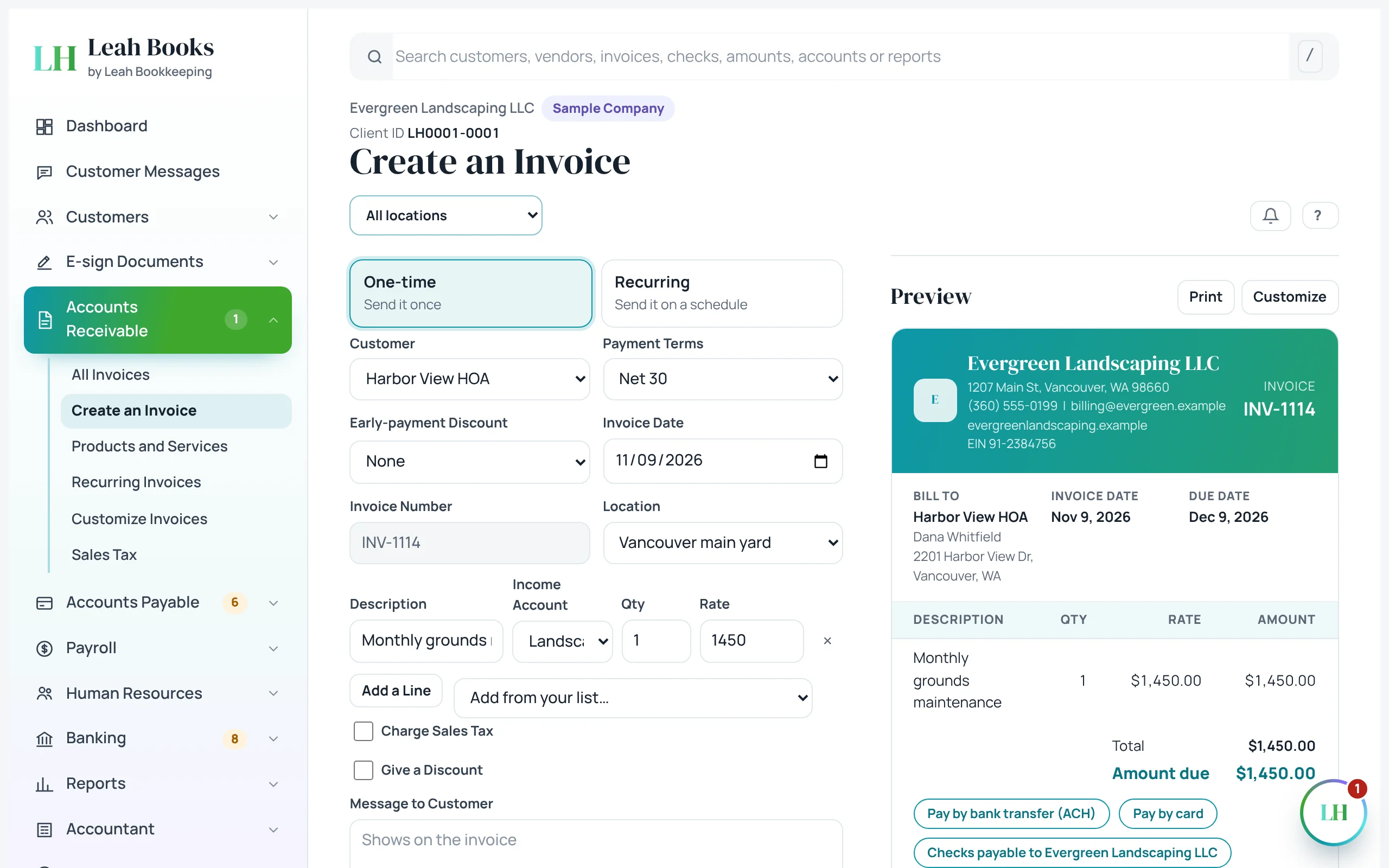 (opens the full-size screenshot)
What an invoice does to the books
Sending an invoice records two things at once: the customer now owes you money, and you've earned revenue.
Here Evergreen bills Columbia Dental Group for monthly grounds maintenance ($1,450) plus 4 yards of bark mulch at $78 a yard ($312). Each line goes to its own income account.
| Account | Debit (Dr) | Credit (Cr) |
|---|---|---|
| Accounts Receivable | $1,762.00 | |
| Landscaping Services | $1,450.00 | |
| Materials Billed | $312.00 | |
| Total Balanced | $1,762.00 | $1,762.00 |
Memo: INV, Net 30. No cash has moved yet.
Are you Increasing or Decreasing?
| Debit | Credit |
|---|---|
| Asset | Liability |
| Draw | Equity |
| Expense | Revenue |
+ To increase an account, put it on its normal side.
Accounts Receivable goes up: press + and find Asset on the debit side.
Accounts receivable
Accounts receivable (AR) is the money customers owe you for invoices they haven't paid yet. It's an asset, so it has a normal debit balance.
On the Leah Books dashboard, AR is the "Customers owe you" number. Each invoice shows a status: Open, Partly paid, Overdue or Paid.
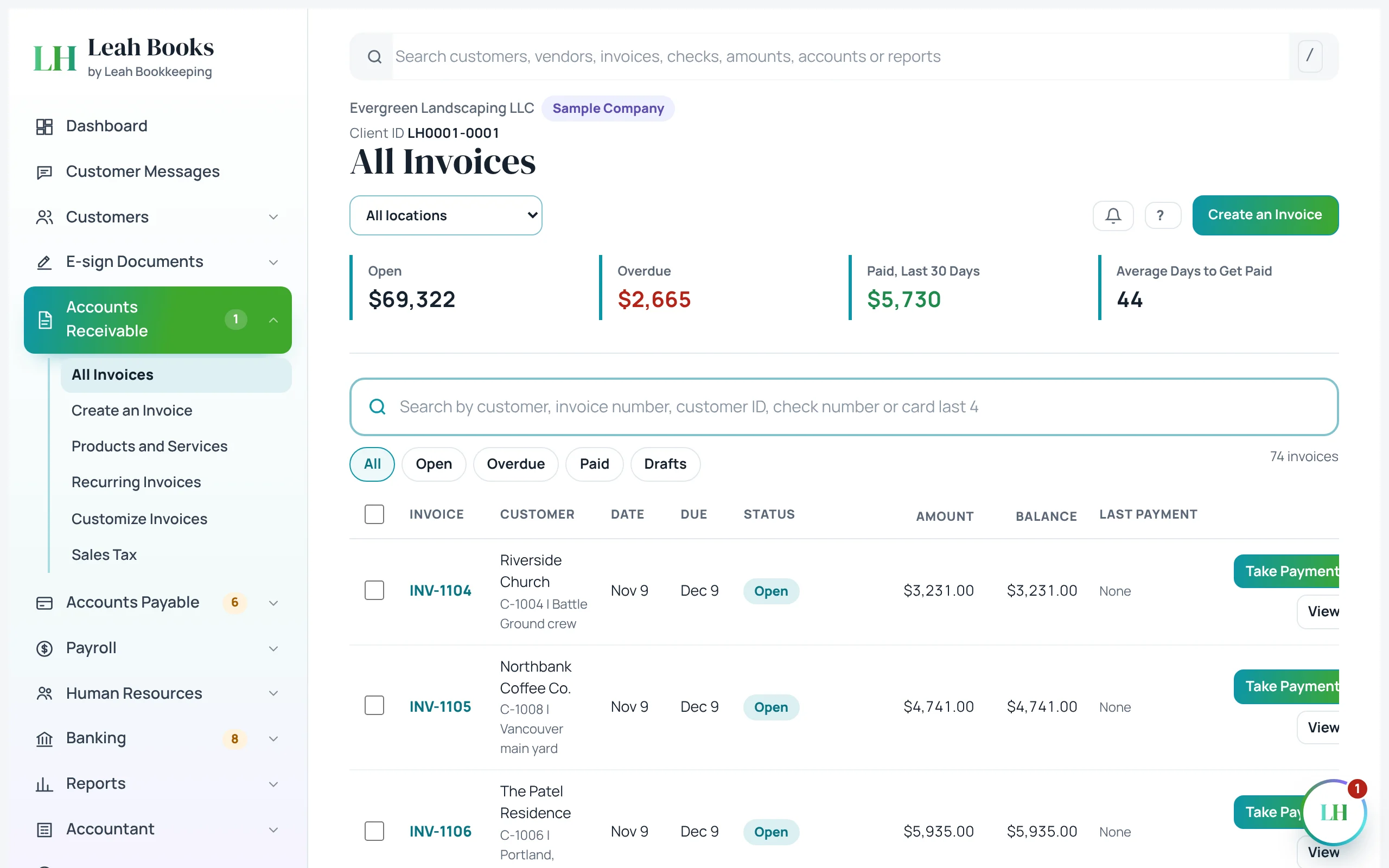 (opens the full-size screenshot)
Payment terms
Terms tell the customer when payment is due. Net 30 means the full amount is due 30 days after the invoice date. Evergreen's sample customers are all on Net 30.
Pick terms you can live with. Longer terms can win work, but you wait longer for cash.
| Terms | Due |
|---|---|
| Due on receipt | As soon as the customer gets it |
| Net 7 | 7 days after the invoice date |
| Net 15 | 15 days after the invoice date |
| Net 30 | 30 days after the invoice date |
| Net 45 / Net 60 | 45 or 60 days after the invoice date |
Due date = Invoice date + the number of days in the terms
Try it in Leah Books
- Go to Accounts Receivable > All invoices and look at the status column. Find one Open, one Paid and one Overdue invoice.
- Go to Accounts Receivable > Create an invoice. Pick one of your customers and notice the terms and due date fill in.
- Add a line or two for work you do, then click Save as draft (or Send invoice).
- Open Reports > Balance sheet and find Accounts Receivable under current assets.
Key terms
- Revenue
- Money the business has earned by doing work or selling goods, whether or not it has been paid yet.
- Revenue recognition
- The rule that revenue is recorded when it's earned, not when cash comes in.
- Invoice
- A bill sent to a customer listing what they bought, what it costs and when it's due.
- Accounts receivable (AR)
- Money customers owe the business for invoices they haven't paid. An asset.
- Payment terms
- The agreement on when an invoice must be paid, like Net 30.
- Net 30
- Payment terms meaning the full amount is due 30 days after the invoice date.
- Accrual basis
- Bookkeeping that records revenue when earned and expenses when incurred, not when cash moves.
Check what you learned
Pick an answer to see if it's right and why. Nothing is saved or sent.