Debits and credits
Use the debit and credit rules to record any basic transaction so it balances.
- Principles:
- Double-entry
Debit means left, credit means right
A debit is an entry on the left side of an account. A credit is an entry on the right side. That's all the words mean.
Debit doesn't mean money in. Credit doesn't mean money out. Whether a debit makes an account go up or down depends on the account type.
The golden rule: in every entry, total debits must equal total credits.
Total debits = Total credits
DC DEALER: the cheat sheet
Remember DC DEALER from lesson 1.4: Debit, Credit, then Draw, Equity, Asset, Liability, Expense, Revenue. Draw a T and put each pair across it: Asset, Draw and Expense on the debit side, Liability, Equity and Revenue on the credit side.
To increase an account, use its own side of the T. Cash goes up with a debit. Accounts Payable goes up with a credit.
To decrease it, flip to the other side. Cash goes down with a credit. Accounts Payable goes down with a debit.
Keep it handy. For every entry, find each account on the T, decide if it goes up or down, and you have your debit and your credit.
Accounting cheat sheet
DC DEALER: the debits and credits cheat sheet
One memory trick for debits and credits. Learn it once and every journal entry makes sense.
- DDebit
- CCredit
- DDraw
- EEquity
- AAsset
- LLiability
- EExpense
- RRevenue
Are you Increasing or Decreasing?
| Debit | Credit |
|---|---|
| Asset | Liability |
| Draw | Equity |
| Expense | Revenue |
+ To increase an account, put it on its normal side.
The rules table
The same rules as a table, with the two contra types added.
| Account type | Normal balance | Increase with | Decrease with |
|---|---|---|---|
| Assets | Debit | Debit | Credit |
| Expenses | Debit | Debit | Credit |
| Owner's Draw | Debit | Debit | Credit |
| Liabilities | Credit | Credit | Debit |
| Equity | Credit | Credit | Debit |
| Revenue | Credit | Credit | Debit |
| Contra assets | Credit | Credit | Debit |
| Contra revenue | Debit | Debit | Credit |
T-accounts: a quick sketch
A T-account is a simple drawing of one account. Debits go on the left of the T. Credits go on the right.
Here is 1000 Business Checking for a few days. Cash is an asset, so debits add and credits subtract.
| Debit (left) | Credit (right) |
|---|---|
| Owner invests $28,500 | Rent to Mill Plain Properties $2,200 |
| Harbor View HOA pays $3,600 | Pay Pacific Nursery Supply $1,400 |
| Total debits $32,100 | Total credits $3,600 |
| Balance $28,500 (debit) |
Use the T for every entry
Here's the method. Use it for every transaction until it's automatic:
- What happened? Say it in plain words.
- Which accounts? Name each account and find its type on the T: Asset, Liability, Equity, Draw, Expense or Revenue.
- Increasing or decreasing? Press + or −. Increasing keeps the account on its own side. Decreasing flips it to the other side.
- Read off the side. Debit or credit.
- Write the entry with the amounts, and check that total debits equal total credits.
- Record it in Leah Books and find it in the ledger.
Example 1: The owner puts money in
Jen Alvarez, the owner, puts $5,000 of her own money into the business checking account.
Two accounts change. Business Checking is an asset, and it's increasing: press +, and Asset sits on the debit side. Owner's Investment is equity, and it's increasing too: Equity sits on the credit side.
Debit $5,000, credit $5,000. Debits equal credits.
| Account | Type on the T | Increasing or decreasing? | Side |
|---|---|---|---|
| 1000 Business Checking | Asset | Increasing | Debit |
| 3000 Owner's Investment | Equity | Increasing | Credit |
| Account | Debit (Dr) | Credit (Cr) |
|---|---|---|
| 1000 Business Checking | $5,000.00 | |
| 3000 Owner's Investment | $5,000.00 | |
| Total Balanced | $5,000.00 | $5,000.00 |
Are you Increasing or Decreasing?
| Debit | Credit |
|---|---|
| Asset | Liability |
| Draw | Equity |
| Expense | Revenue |
+ To increase an account, put it on its normal side.
Business Checking goes up: press + and find Asset on the debit side.
Example 2: Buy supplies with cash
Evergreen buys $180 of mulch and fertilizer from Pacific Nursery Supply and pays right away from Business Checking.
Plants & Materials is an expense (a cost of the jobs), and it's increasing: +, Expense is on the debit side. Business Checking is an asset, and it's decreasing: press − and Asset flips to the credit side.
| Account | Type on the T | Increasing or decreasing? | Side |
|---|---|---|---|
| 5000 Plants & Materials | Expense | Increasing | Debit |
| 1000 Business Checking | Asset | Decreasing | Credit |
| Account | Debit (Dr) | Credit (Cr) |
|---|---|---|
| 5000 Plants & Materials | $180.00 | |
| 1000 Business Checking | $180.00 | |
| Total Balanced | $180.00 | $180.00 |
Are you Increasing or Decreasing?
| Debit | Credit |
|---|---|
| Liability | Asset |
| Equity | Draw |
| Revenue | Expense |
− To decrease an account, put it on the opposite side.
Business Checking goes down: press − and find Asset on the credit side.
Example 3: Buy equipment on credit
Evergreen buys a $1,500 leaf blower and hedge trimmer from Westside Equipment Rental. The bill is due in 30 days, so no cash moves yet.
Equipment is an asset, and it's increasing: +, debit. Accounts Payable, what the business owes, is a liability, and it's increasing: +, Liability is on the credit side.
| Account | Type on the T | Increasing or decreasing? | Side |
|---|---|---|---|
| 1500 Equipment | Asset | Increasing | Debit |
| 2000 Accounts Payable | Liability | Increasing | Credit |
| Account | Debit (Dr) | Credit (Cr) |
|---|---|---|
| 1500 Equipment | $1,500.00 | |
| 2000 Accounts Payable | $1,500.00 | |
| Total Balanced | $1,500.00 | $1,500.00 |
Are you Increasing or Decreasing?
| Debit | Credit |
|---|---|
| Asset | Liability |
| Draw | Equity |
| Expense | Revenue |
+ To increase an account, put it on its normal side.
Equipment goes up: press + and find Asset on the debit side.
Example 4: Pay that bill
Thirty days later, Evergreen pays the $1,500 bill from Business Checking.
Pause and try it. Which two accounts change? Is each one increasing or decreasing, and which side does each go on?
Show the answer
Accounts Payable is a liability, and it's decreasing (the business owes less): press − and Liability flips to the debit side. Business Checking is an asset, and it's decreasing: −, credit. The equipment isn't touched again; it was recorded when it was bought.
| Account | Type on the T | Increasing or decreasing? | Side |
|---|---|---|---|
| 2000 Accounts Payable | Liability | Decreasing | Debit |
| 1000 Business Checking | Asset | Decreasing | Credit |
| Account | Debit (Dr) | Credit (Cr) |
|---|---|---|
| 2000 Accounts Payable | $1,500.00 | |
| 1000 Business Checking | $1,500.00 | |
| Total Balanced | $1,500.00 | $1,500.00 |
Are you Increasing or Decreasing?
| Debit | Credit |
|---|---|
| Liability | Asset |
| Equity | Draw |
| Revenue | Expense |
− To decrease an account, put it on the opposite side.
Accounts Payable goes down: press − and find Liability on the debit side.
Example 5: A purchase on the business credit card
A crew fills up a truck for $60 at Cascade Fuel Co. with the business credit card.
Fuel is an expense, increasing: +, debit. Business Credit Card is a liability (the business owes the card company), increasing: +, credit.
A credit here means the business owes more. It doesn't mean money came in.
| Account | Type on the T | Increasing or decreasing? | Side |
|---|---|---|---|
| 6000 Fuel | Expense | Increasing | Debit |
| 2100 Business Credit Card | Liability | Increasing | Credit |
| Account | Debit (Dr) | Credit (Cr) |
|---|---|---|
| 6000 Fuel | $60.00 | |
| 2100 Business Credit Card | $60.00 | |
| Total Balanced | $60.00 | $60.00 |
Are you Increasing or Decreasing?
| Debit | Credit |
|---|---|
| Asset | Liability |
| Draw | Equity |
| Expense | Revenue |
+ To increase an account, put it on its normal side.
Fuel goes up: press + and find Expense on the debit side.
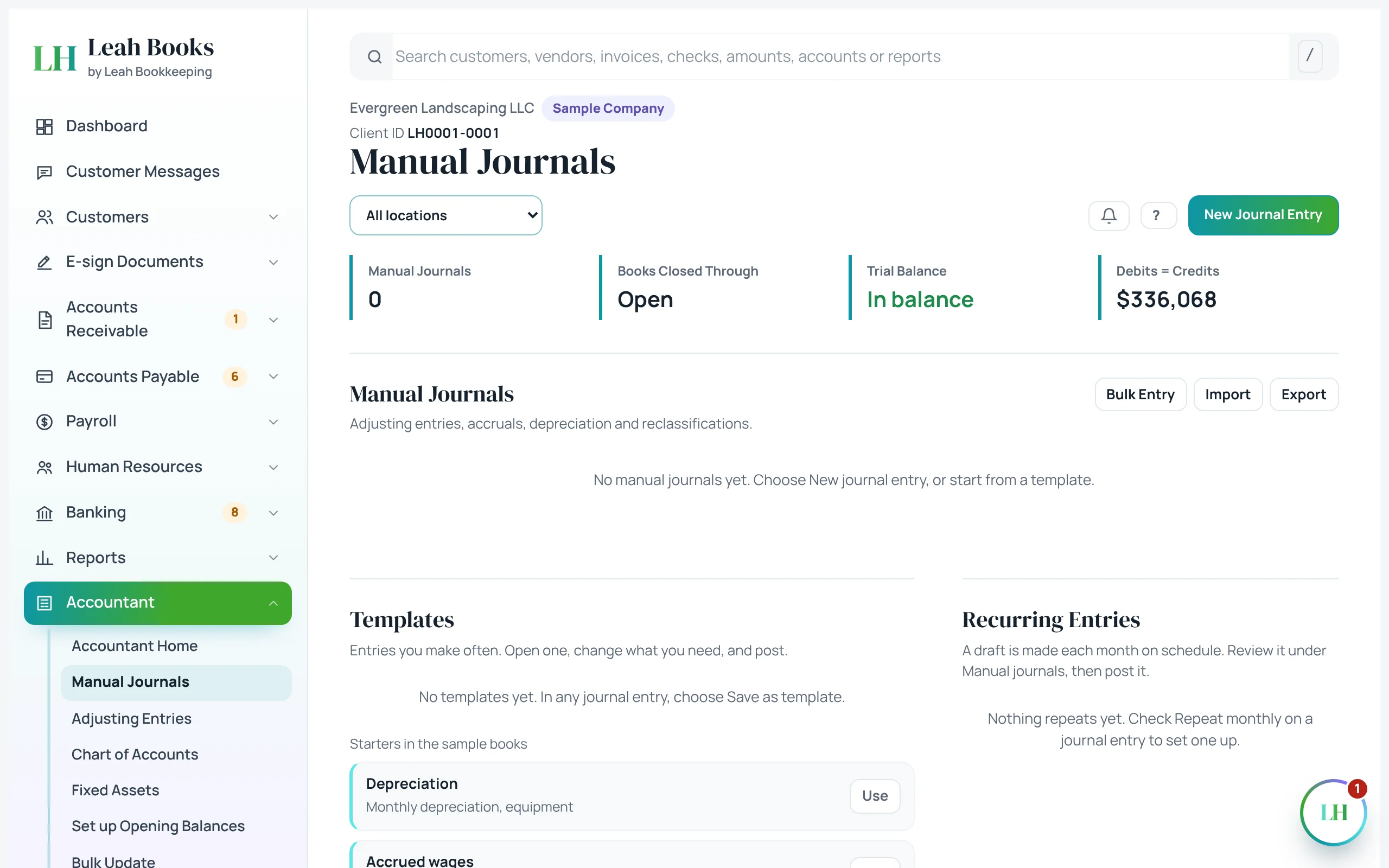 (opens the full-size screenshot)
Try it in Leah Books
- Go to Accountant > Manual journals and click New journal entry.
- Pick 6300 Rent and type 100 in Debit. Leave the second line blank. Notice the "Out of balance by $100.00" warning.
- Pick 1000 Business Checking on the second line and type 100 in Credit. The warning changes to "Balanced". Click Cancel so nothing posts.
- Under Start from a template, click Use next to Owner's draw. Look at which account is debited and which is credited, then click Cancel.
Key terms
- Debit (Dr)
- An entry on the left side of an account.
- Credit (Cr)
- An entry on the right side of an account.
- T-account
- A simple T-shaped sketch of one account, debits on the left and credits on the right.
- Balanced entry
- An entry whose total debits equal its total credits.
- Trial balance
- A list of account balances used to check that total debits equal total credits.
Check what you learned
Pick an answer to see if it's right and why. Nothing is saved or sent.