The statement of cash flows
Build a statement of cash flows with the indirect method, starting from net income, and explain why profit and cash are different.
- Principles:
- Accrual basis
- Full disclosure
- Consistency
Three kinds of cash flow
The statement of cash flows explains how cash changed between two balance sheets. US GAAP sorts every cash movement into three groups.
- Operating activities: cash from running the business, such as collecting from customers and paying vendors, wages, rent and interest.
- Investing activities: buying or selling long-term assets such as equipment, vehicles or investments.
- Financing activities: cash from or to lenders and owners, such as loan proceeds, loan principal payments, owner contributions and owner's draws or dividends.
Net change in cash = Operating + Investing + Financing
The indirect method
GAAP allows two ways to show operating cash. The direct method lists cash received and cash paid. The indirect method starts with net income and adjusts it. Most businesses use the indirect method, and Leah Books does too.
The adjustments do two things. First, they add back non-cash expenses like depreciation, which lowered net income but used no cash this year. Second, they adjust for changes in working capital:
- An increase in a current asset (like accounts receivable) uses cash: you earned revenue you haven't collected yet. Subtract it.
- A decrease in a current asset (like prepaid expenses) frees cash. Add it.
- An increase in a current liability (like accounts payable) saves cash: you recorded the expense but haven't paid yet. Add it.
- A decrease in a current liability uses cash. Subtract it.
| Account | Debit (Dr) | Credit (Cr) |
|---|---|---|
| 6960 Depreciation | $8,400.00 | |
| 1510 Accumulated Depreciation | $8,400.00 | |
| Total Balanced | $8,400.00 | $8,400.00 |
Memo: No cash line: this lowers net income without spending cash, so the cash flow statement adds it back.
Are you Increasing or Decreasing?
| Debit | Credit |
|---|---|
| Asset | Liability |
| Draw | Equity |
| Expense | Revenue |
+ To increase an account, put it on its normal side.
Depreciation goes up: press + and find Expense on the debit side.
Worked example: Evergreen's year
Every number below comes from the income statement in lesson 4.1 and the two balance sheets in lesson 4.2. Cash means Business Checking plus Savings: $40,000 at the start and $54,000 at the end.
During the year Evergreen bought $18,000 of equipment, put into service in late December, so this year's $8,400 of depreciation is all on the original equipment. It borrowed $15,000 from the bank (deposited to checking), paid the dealer $18,000, and later repaid $3,000 of loan principal.
| Statement of cash flows, year ended Dec 31 | Amount |
|---|---|
| Operating activities | |
| Net income | $44,000 |
| Depreciation (non-cash) | $8,400 |
| Increase in Accounts Receivable ($32,000 → $40,000) | ($8,000) |
| Decrease in Prepaid Expenses ($3,000 → $2,400) | $600 |
| Increase in Accounts Payable ($12,000 → $15,000) | $3,000 |
| Increase in Business Credit Card ($2,000 → $2,500) | $500 |
| Increase in Sales Tax Payable ($1,500 → $1,800) | $300 |
| Increase in Accrued Liabilities ($3,500 → $4,700) | $1,200 |
| Net cash from operating activities | $50,000 |
| Investing activities | |
| Purchase of equipment | ($18,000) |
| Net cash from investing activities | ($18,000) |
| Financing activities | |
| Proceeds from equipment loan | $15,000 |
| Repayment of loan principal | ($3,000) |
| Owner's draws | ($30,000) |
| Net cash from financing activities | ($18,000) |
| Net change in cash ($50,000 − $18,000 − $18,000) | $14,000 |
| Cash at start of year | $40,000 |
| Cash at end of year | $54,000 |
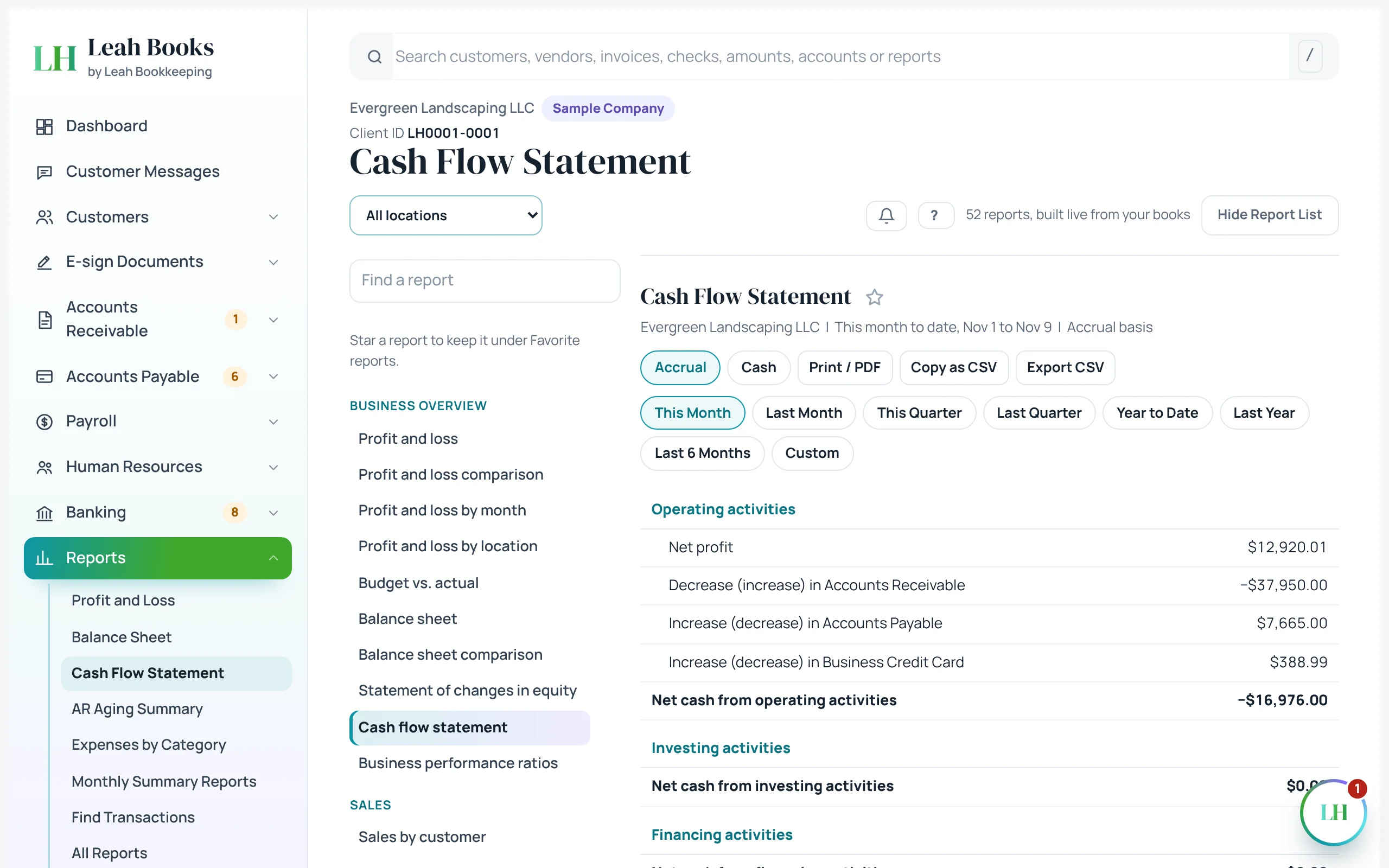 (opens the full-size screenshot)
Why profit is not cash
Evergreen earned $44,000 but its cash grew only $14,000. Nothing is wrong. The statement shows exactly why:
- Depreciation of $8,400 reduced profit but cost no cash this year (the cash went out when the equipment was bought).
- Customers owe $8,000 more than a year ago, so some revenue is still sitting in receivables.
- The $18,000 equipment purchase used cash but is not an expense; it becomes depreciation over the coming years.
- Loan proceeds brought in cash but are not income. Principal payments use cash but are not expenses (only the $1,600 of interest is).
- The owner took $30,000 in draws, which use cash but never appear on the P&L.
Classification details worth knowing
Under US GAAP, interest paid is an operating cash flow, even though the loan itself is financing. Dividends or owner's draws paid are financing.
If an asset is bought with a loan and no cash passes through the business (the lender pays the seller directly), it is a non-cash investing and financing activity. It is disclosed in a note rather than shown as cash in and out.
Try it in Leah Books
- Go to Reports > Cash flow statement.
- Choose the period Last 6 months and find Net profit at the top of Operating activities.
- Look for the Depreciation and amortization (non-cash) line and the Decrease (increase) in Accounts Receivable line, and explain each sign.
- Read the note under the report that confirms cash at end of period ties to the cash accounts.
- Open Reports > Balance sheet and confirm Business Checking plus Savings equals Cash at end of period.
Key terms
- Statement of cash flows
- A statement that explains the change in cash, sorted into operating, investing and financing activities.
- Indirect method
- Shows operating cash flow by starting with net income and adjusting for non-cash items and working-capital changes.
- Direct method
- Shows operating cash flow as cash received from customers minus cash paid for operating costs.
- Non-cash expense
- An expense, like depreciation, that lowers net income without using cash in the period.
- Operating activities
- Cash flows from the main revenue-producing work of the business.
- Investing activities
- Cash flows from buying and selling long-term assets and investments.
- Financing activities
- Cash flows with lenders and owners, such as borrowing, repaying principal and draws.
Check what you learned
Pick an answer to see if it's right and why. Nothing is saved or sent.