Bills and accounts payable
You'll record vendor bills, pay them, take early-payment discounts, use vendor credits and write checks.
- Principles:
- Accrual basis
- Matching
- Double-entry
Two ways to record a cost
Some costs you pay on the spot. Others arrive as a bill you'll pay later. The expense is the same; the timing of the cash is different.
| What happened | Debit | Credit |
|---|---|---|
| Paid right away (check, debit card, ACH) | The expense | Business Checking |
| Got a bill to pay later | The expense | Accounts Payable |
| Later, paid that bill | Accounts Payable | Business Checking |
Entering a bill
A bill is a vendor's request for payment. When you enter it, you record the expense now, because that's when you got the goods or service. This is accrual bookkeeping and the matching idea: costs land in the same period as the work they helped with.
Accounts payable (AP) is what you owe vendors. It's a liability with a normal credit balance.
| Account | Debit (Dr) | Credit (Cr) |
|---|---|---|
| Plants & Materials | $2,150.00 | |
| Accounts Payable | $2,150.00 | |
| Total Balanced | $2,150.00 | $2,150.00 |
Memo: Due in 21 days.
Are you Increasing or Decreasing?
| Debit | Credit |
|---|---|
| Asset | Liability |
| Draw | Equity |
| Expense | Revenue |
+ To increase an account, put it on its normal side.
Plants & Materials goes up: press + and find Expense on the debit side.
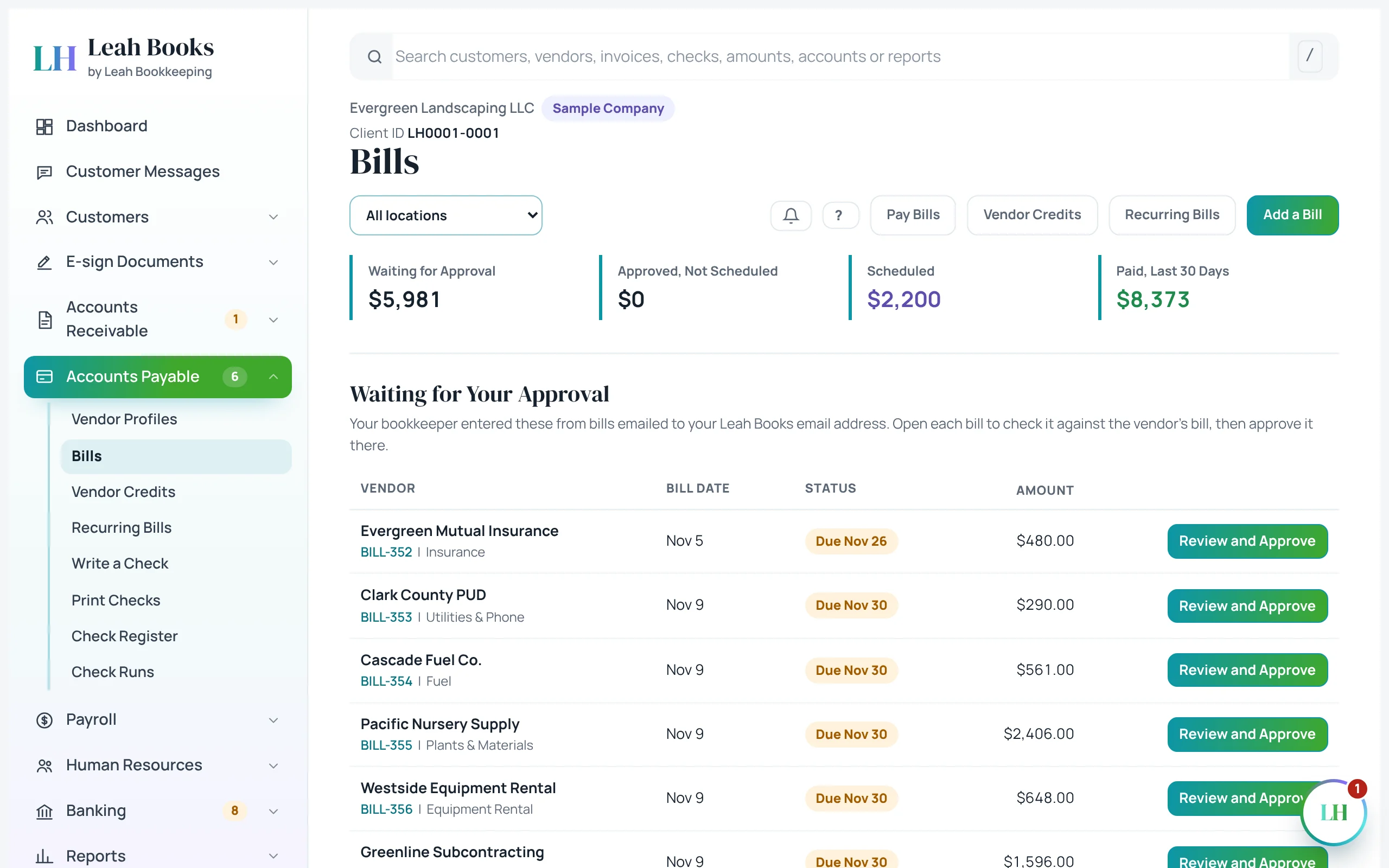 (opens the full-size screenshot)
Paying the bill
Paying a bill doesn't create a new expense. You already recorded it. Paying just lowers what you owe and lowers cash.
You can pay one bill, several bills from the same vendor at once, or part of a bill.
| Account | Debit (Dr) | Credit (Cr) |
|---|---|---|
| Accounts Payable | $2,150.00 | |
| Business Checking | $2,150.00 | |
| Total Balanced | $2,150.00 | $2,150.00 |
Are you Increasing or Decreasing?
| Debit | Credit |
|---|---|
| Liability | Asset |
| Equity | Draw |
| Revenue | Expense |
− To decrease an account, put it on the opposite side.
Accounts Payable goes down: press − and find Liability on the debit side.
Terms and early-payment discounts
Vendors set terms too. In the sample books, Mill Plain Properties wants rent within 5 days, and most other vendors give 21 days.
Some vendors offer a discount for paying early. 2/10 net 30 means: take 2% off if you pay within 10 days, otherwise pay the full amount within 30. Skipping a 2/10 net 30 discount to keep the cash 20 more days works out to roughly 37% a year, so it's usually worth taking if you have the cash.
Below, Evergreen pays a $1,000 materials bill within 10 days and pays $980. The $20 saved lowers the cost of the materials. (Some businesses use a separate discounts account instead; either way, the entry balances.)
Discount = Bill amount × Discount % ($1,000 × 2% = $20)
| Account | Debit (Dr) | Credit (Cr) |
|---|---|---|
| Accounts Payable | $1,000.00 | |
| Business Checking | $980.00 | |
| Plants & Materials | $20.00 | |
| Total Balanced | $1,000.00 | $1,000.00 |
Memo: 2/10 net 30, paid on day 6.
Are you Increasing or Decreasing?
| Debit | Credit |
|---|---|
| Liability | Asset |
| Equity | Draw |
| Revenue | Expense |
− To decrease an account, put it on the opposite side.
Accounts Payable goes down: press − and find Liability on the debit side.
Vendor credits
A vendor credit is money a vendor owes you back: for a return, a refund or a billing mistake. It lowers what you owe them.
If Evergreen returned $180 of damaged stone to Lewis River Stoneworks, the credit would debit Accounts Payable $180 and credit Plants & Materials $180. Using the credit on their next bill doesn't move any money; it just lowers what's owed on that bill.
Writing a check
A check can pay a bill you entered, or pay for something on the spot. When it pays on the spot, pick the expense category on the check itself.
A written check is already in your books, even before it clears the bank. When it shows up on the bank statement, you match it instead of adding it again.
| Account | Debit (Dr) | Credit (Cr) |
|---|---|---|
| Equipment Rental | $350.00 | |
| Business Checking | $350.00 | |
| Total Balanced | $350.00 | $350.00 |
Memo: Check #1204
Are you Increasing or Decreasing?
| Debit | Credit |
|---|---|
| Liability | Asset |
| Equity | Draw |
| Revenue | Expense |
− To decrease an account, put it on the opposite side.
Business Checking goes down: press − and find Asset on the credit side.
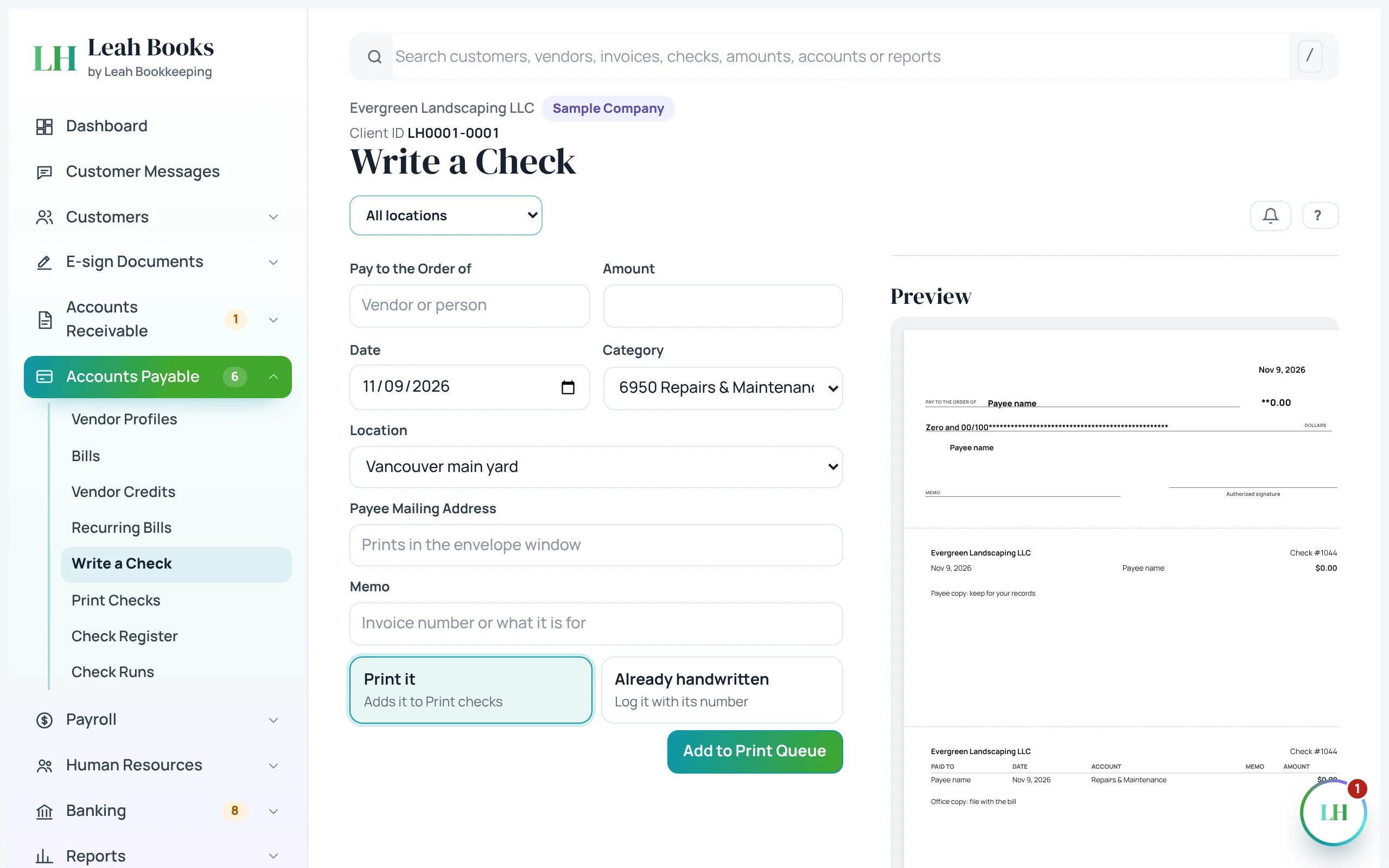 (opens the full-size screenshot)
Try it in Leah Books
- Go to Accounts Payable > Bills and find a bill waiting for approval. If you have none, click Add a bill and enter one.
- Click Review and approve, then Approve it.
- Click Pay bills, pick that vendor, tick the bill, choose how you paid and click Record payment.
- Go to Accounts Payable > Write a check. Fill in a payee, amount and category and see how the check is set up.
- Open Accounts Payable > Check register to see the checks the business has written.
Key terms
- Bill
- A vendor's request for payment for goods or services you received.
- Accounts payable (AP)
- Money the business owes vendors for bills it hasn't paid yet. A liability.
- Vendor
- A business or person you buy goods or services from.
- Early-payment discount
- A price cut a vendor offers for paying before the full due date.
- 2/10 net 30
- Terms meaning 2% off if paid within 10 days; otherwise the full amount is due in 30 days.
- Vendor credit
- An amount a vendor owes you back, used to lower what you owe on their bills.
- Check
- A written order telling your bank to pay someone from your account.
Check what you learned
Pick an answer to see if it's right and why. Nothing is saved or sent.