Closing entries and retained earnings
Close revenue, expense and draw accounts into retained earnings, and lock a finished period so it can't change.
- Principles:
- Periodicity (time period)
Temporary and permanent accounts
Permanent accounts (assets, liabilities and equity) carry their balances from one year to the next. Your bank balance doesn't reset on January 1.
Temporary accounts (revenue, expenses and owner's draw) measure one year at a time. At year end they're closed to zero, and their net effect moves into equity. That's what lets next year's profit and loss start from nothing.
The four closing entries
Textbooks often use a temporary account called Income Summary to collect revenue and expenses. Here is a simplified year for Evergreen: $210,000 of revenue, $168,000 of expenses, net income of $42,000, and $30,000 of owner's draws. Evergreen is an LLC, so the sample books close to Retained Earnings; a sole proprietorship in a textbook may close to Owner's Capital instead.
| Account | Debit (Dr) | Credit (Cr) |
|---|---|---|
| Landscaping Services | $180,000.00 | |
| Design Services | $12,000.00 | |
| Materials Billed | $18,000.00 | |
| Income Summary | $210,000.00 | |
| Total Balanced | $210,000.00 | $210,000.00 |
Are you Increasing or Decreasing?
| Debit | Credit |
|---|---|
| Liability | Asset |
| Equity | Draw |
| Revenue | Expense |
− To decrease an account, put it on the opposite side.
Landscaping Services goes down: press − and find Revenue on the debit side.
Closing expenses
Each expense account is credited for its balance, bringing it to zero.
| Account | Debit (Dr) | Credit (Cr) |
|---|---|---|
| Income Summary | $168,000.00 | |
| Plants & Materials | $40,000.00 | |
| Subcontractors | $22,000.00 | |
| Wages | $60,000.00 | |
| Rent | $26,400.00 | |
| Insurance | $5,760.00 | |
| All other expense accounts (each closed separately) | $13,840.00 | |
| Total Balanced | $168,000.00 | $168,000.00 |
Are you Increasing or Decreasing?
| Debit | Credit |
|---|---|
| Liability | Asset |
| Equity | Draw |
| Revenue | Expense |
− To decrease an account, put it on the opposite side.
Plants & Materials goes down: press − and find Expense on the credit side.
Net income and draws
Income Summary now has a $42,000 credit balance: the year's net income. The third entry moves it to Retained Earnings. The fourth closes Owner's Draw, which has a normal debit balance, directly to Retained Earnings. Draws are not an expense, so they never go through Income Summary.
| Account | Debit (Dr) | Credit (Cr) |
|---|---|---|
| Income Summary | $42,000.00 | |
| Retained Earnings | $42,000.00 | |
| Total Balanced | $42,000.00 | $42,000.00 |
Memo: 4. Then close draws: debit Retained Earnings $30,000, credit Owner's Draw $30,000.
Are you Increasing or Decreasing?
| Debit | Credit |
|---|---|
| Asset | Liability |
| Draw | Equity |
| Expense | Revenue |
+ To increase an account, put it on its normal side.
Retained Earnings goes up: press + and find Equity on the credit side.
Ending retained earnings = Beginning retained earnings + Net income − Draws (or dividends)
How Leah Books handles closing
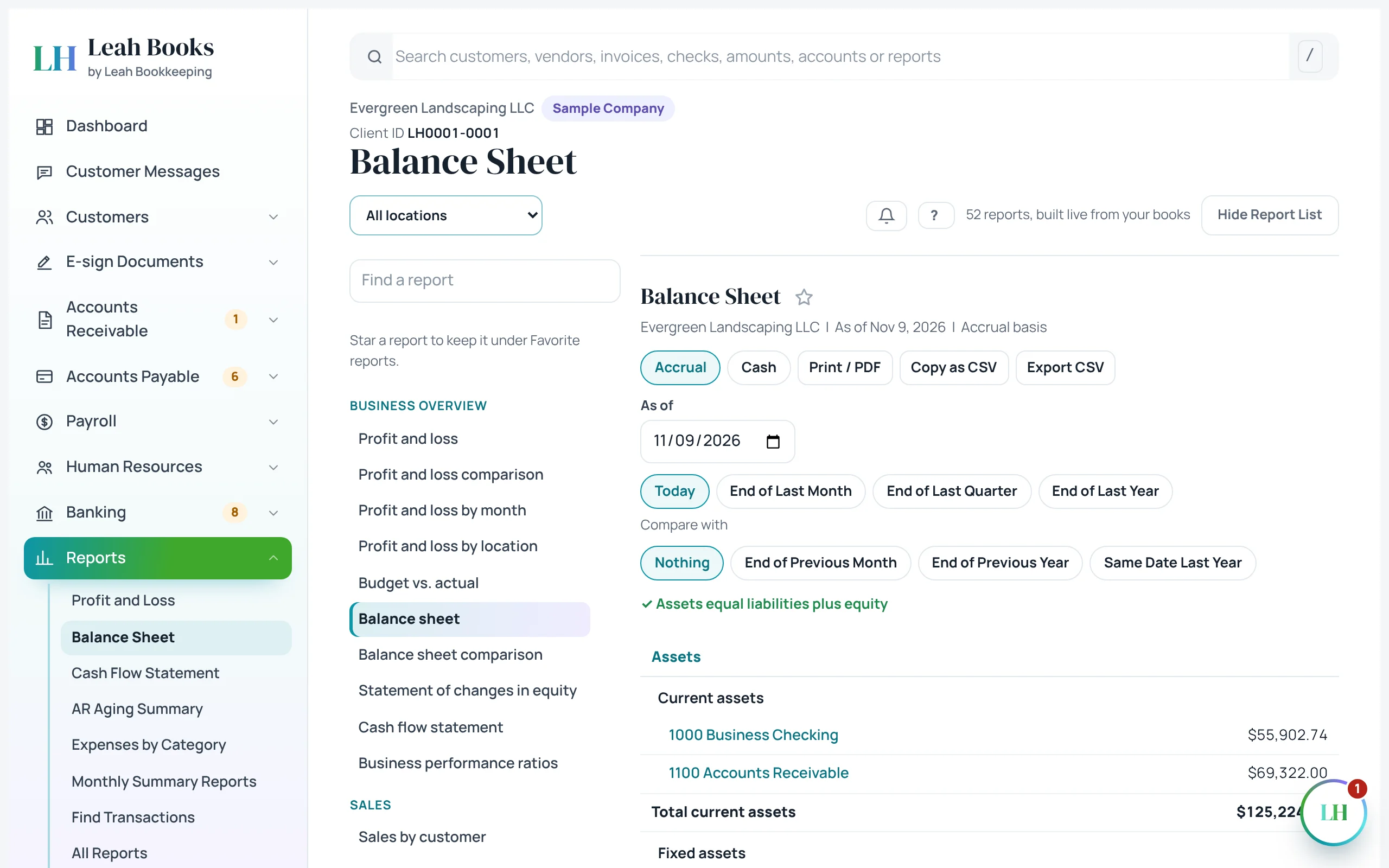
Leah Books doesn't make you type closing entries. Reports treat each fiscal year as closed: the trial balance shows income and expenses for the current fiscal year only, and earlier years roll into Retained Earnings. The balance sheet shows Retained earnings (prior years) and Net income, year to date as separate lines.
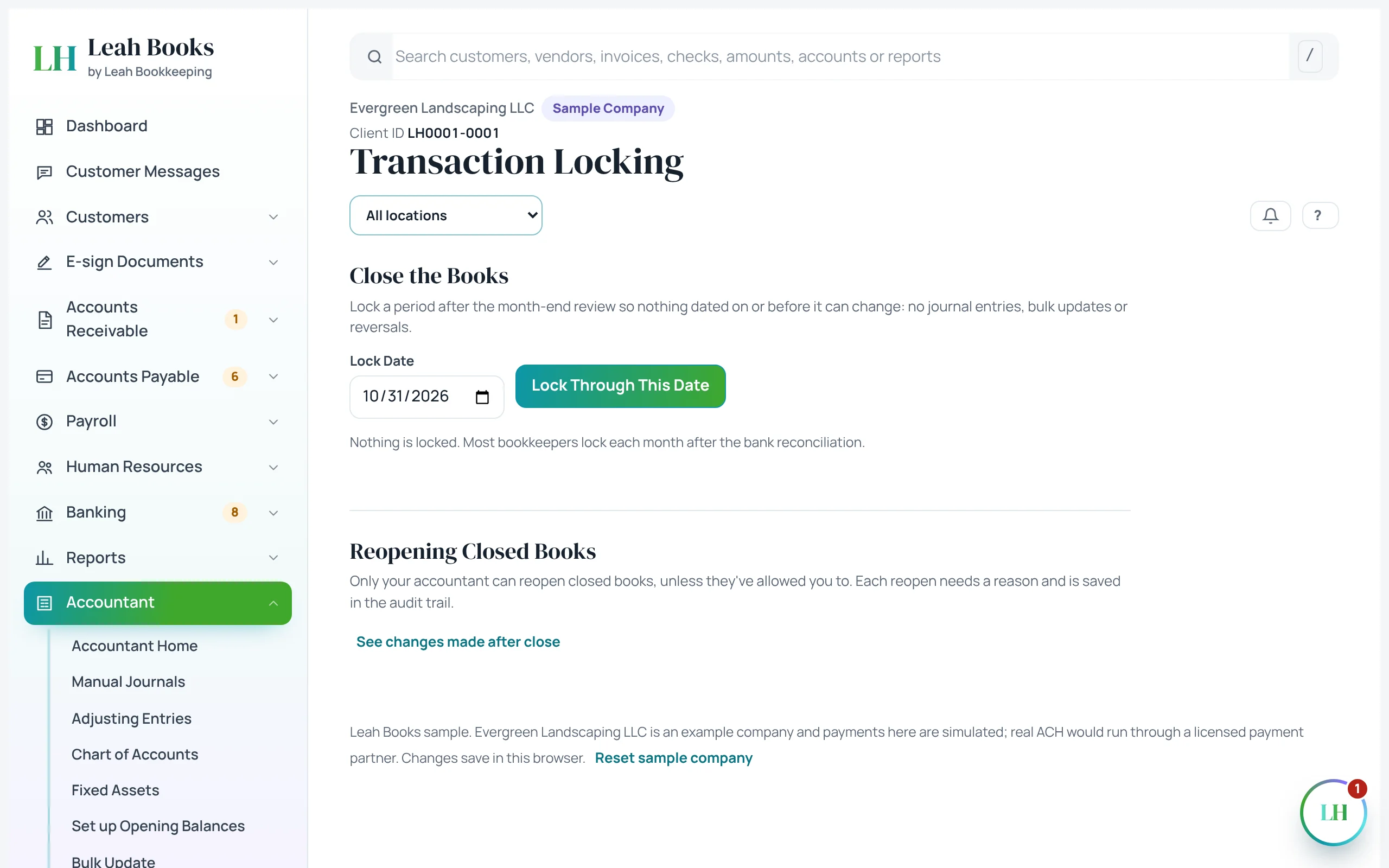
What you do need is to lock the period once it's reviewed. Accountant > Transaction locking blocks any change dated on or before the lock date: no new journal entries, bulk updates or reversals. Accountant > Year-end close adds a checklist and locks the books through year end.
 (opens the full-size screenshot)
Where to see it
The equity section of the balance sheet is where closing shows up: prior years' profits, this year's net income and the owner's draws.
 (opens the full-size screenshot)
Try it in Leah Books
- Open Reports > Balance sheet and find the Equity section.
- Go to Accountant > Manual journals and use the Owner's draw template ($2,500: debit Owner's Draw, credit Business Checking). Post it and see equity go down on the balance sheet, while net income stays the same.
- Go to Accountant > Transaction locking, choose the last day of last month as the lock date and click Lock through this date.
- Back in Accountant > Manual journals, try to post a new journal entry dated inside the locked month. Leah Books blocks it.
- Open Accountant > Year-end close and read through the checklist. Don't close a year while practicing unless you mean to.
Key terms
- Temporary account
- An account closed to zero at year end: revenue, expenses and owner's draw.
- Permanent account
- An account whose balance carries forward: assets, liabilities and equity.
- Closing entries
- Year-end entries that bring temporary accounts to zero and move net income and draws into equity.
- Income Summary
- A temporary account used during closing to collect revenue and expenses before net income moves to equity.
- Retained earnings
- The business's accumulated profits that haven't been paid out to owners.
- Owner's draw
- Money the owner takes out of the business; it lowers equity and has a normal debit balance.
- Lock date
- The date on or before which no transaction can be added or changed in Leah Books.
Check what you learned
Pick an answer to see if it's right and why. Nothing is saved or sent.