Budgeting and variance analysis
Compare actual results with a budget, label variances favorable or unfavorable, and use a flexible budget to separate volume from performance.
- Principles:
- Consistency
- Materiality
What a budget is for
A budget is a plan in numbers: expected revenue and expenses for each month. It helps you set targets, plan cash and spot problems early.
Variance analysis compares what happened (actual) with the plan (budget). The goal isn't to assign blame. It is to find out why results differed and what to do next.
Variance = Actual − Budget
Favorable or unfavorable
A variance is favorable (F) when it helps profit and unfavorable (U) when it hurts profit.
- Revenue above budget is favorable; revenue below budget is unfavorable.
- An expense below budget is favorable; an expense above budget is unfavorable.
- A favorable variance isn't always good news. Spending less on materials because you did fewer jobs is favorable on paper but signals a sales problem.
Evergreen's April: budget vs. actual
Evergreen budgeted 100 maintenance jobs in April at an average of $400. Each job uses about $100 of plants and materials and $60 of subcontractor help (variable costs). Crew wages, rent and insurance are fixed for the month. Evergreen actually completed 90 jobs at an average of $420.
| April | Budget (100 jobs) | Actual (90 jobs) | Variance |
|---|---|---|---|
| Revenue | $40,000 | $37,800 | $2,200 U |
| Plants & Materials | $10,000 | $9,450 | $550 F |
| Subcontractors | $6,000 | $5,700 | $300 F |
| Wages | $8,000 | $8,400 | $400 U |
| Rent | $2,200 | $2,200 | $0 |
| Insurance | $480 | $480 | $0 |
| Net income | $13,320 | $11,570 | $1,750 U |
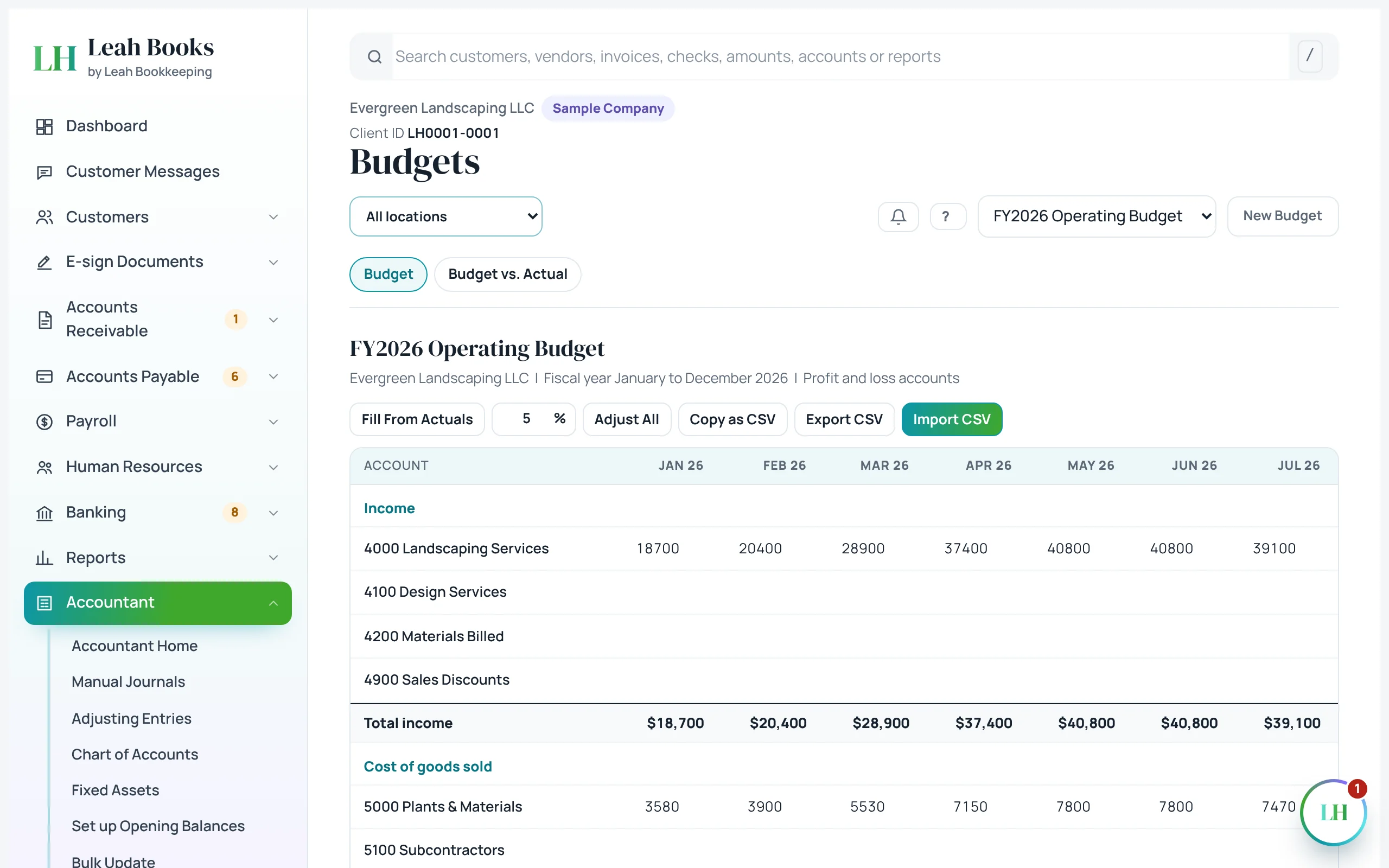 (opens the full-size screenshot)
The flexible budget
The comparison above is a static budget: it was set for 100 jobs, but only 90 happened. Comparing costs for 90 jobs with a budget for 100 is apples to oranges.
A flexible budget recalculates the plan at the actual activity level, using budgeted prices and costs: revenue 90 × $400 = $36,000, materials 90 × $100 = $9,000, subcontractors 90 × $60 = $5,400. Fixed costs stay the same.
| April | Flexible budget (90 jobs) | Actual (90 jobs) | Variance |
|---|---|---|---|
| Revenue | $36,000 | $37,800 | $1,800 F |
| Plants & Materials | $9,000 | $9,450 | $450 U |
| Subcontractors | $5,400 | $5,700 | $300 U |
| Wages | $8,000 | $8,400 | $400 U |
| Rent | $2,200 | $2,200 | $0 |
| Insurance | $480 | $480 | $0 |
| Net income | $10,920 | $11,570 | $650 F |
Splitting the total variance
The flexible budget splits the $1,750 unfavorable total into two clear stories:
The sales-volume variance is flexible budget minus static budget: $10,920 − $13,320 = $2,400 U. Ten fewer jobs cost Evergreen $2,400 of profit.
The flexible-budget variance is actual minus flexible budget: $650 F. At the volume it actually did, Evergreen charged more per job ($1,800 F) but spent more per job on materials and subcontractors and paid $400 more in wages. Together: $2,400 U + $650 F = $1,750 U.
Leah Books budgets are fixed monthly amounts, so the Budget vs. actual tab shows the static comparison. You can build a flexible budget yourself, or create a second budget with New budget.
Total variance = Sales-volume variance (Flexible − Static) + Flexible-budget variance (Actual − Flexible)
Try it in Leah Books
- Go to Accountant > Budgets.
- Look at the budget grid, or click New budget and use Fill from actuals if you don't have one yet.
- Open the Budget vs. actual tab and choose Last month.
- Pick the largest variance in red and decide whether it comes from volume (fewer or more jobs) or from price and spending.
- Click New budget, use Fill from actuals, and then Adjust all by 5% to see a quick growth plan.
Key terms
- Budget
- A plan that sets expected revenue and expenses for future periods.
- Variance
- The difference between an actual result and the budgeted amount.
- Favorable variance
- A difference that increases profit compared with the budget.
- Unfavorable variance
- A difference that decreases profit compared with the budget.
- Static budget
- A budget prepared for one planned level of activity.
- Flexible budget
- A budget recalculated for the actual level of activity using budgeted rates.
- Sales-volume variance
- Flexible budget minus static budget; the effect of selling more or fewer units than planned.
Check what you learned
Pick an answer to see if it's right and why. Nothing is saved or sent.