The five account types and normal balances
Sort any account into one of the five types and know its normal balance.
- Principles:
- Double-entry
Five buckets for every transaction
Every account in the books belongs to one of five types. Three of them live on the balance sheet. Two live on the profit and loss.
| Type | Meaning | Evergreen Landscaping examples | Report |
|---|---|---|---|
| Assets | What the business owns or controls | Business Checking, Accounts Receivable, Equipment | Balance sheet |
| Liabilities | What the business owes | Accounts Payable, Business Credit Card, Sales Tax Payable | Balance sheet |
| Equity | The owner's stake | Owner's Investment, Owner's Draw, Retained Earnings | Balance sheet |
| Revenue (income) | Money earned from the business's work | Landscaping Services, Design Services, Materials Billed | Profit and loss |
| Expenses | Costs of running the business | Fuel, Rent, Insurance, Wages | Profit and loss |
Cost of goods sold is a kind of expense
Leah Books lists Cost of goods sold in its own section. These are direct costs of each job, like Plants & Materials and Subcontractors.
They are still expenses. Keeping them separate lets the profit and loss show gross profit: revenue minus the direct costs of the work.
Gross profit = Revenue − Cost of goods sold
Normal balances
Each type has a normal balance. It's the side, debit or credit, where the account usually carries its balance. It's also the side that makes the account go up.
Assets, expenses and Owner's Draw are debit-normal. Liabilities, equity and revenue are credit-normal. Owner's Draw is the one equity account that's debit-normal, because it lowers equity. Contra accounts, below, are the other exception.
| Account type | Normal balance |
|---|---|
| Assets | Debit |
| Expenses (including cost of goods sold) | Debit |
| Owner's Draw | Debit |
| Liabilities | Credit |
| Equity | Credit |
| Revenue | Credit |
A memory trick: DC DEALER
Say DC DEALER. The first two letters are the two sides: Debit and Credit. The other six are the account types, in pairs: Draw and Equity, Asset and Liability, Expense and Revenue.
Draw the T. In each pair, the first word goes on the debit side and the second goes on the credit side. That's each account's normal balance: Asset, Draw and Expense on the left, Liability, Equity and Revenue on the right.
Accounting cheat sheet
DC DEALER: the debits and credits cheat sheet
One memory trick for debits and credits. Learn it once and every journal entry makes sense.
- DDebit
- CCredit
- DDraw
- EEquity
- AAsset
- LLiability
- EExpense
- RRevenue
Are you Increasing or Decreasing?
| Debit | Credit |
|---|---|
| Asset | Liability |
| Draw | Equity |
| Expense | Revenue |
+ To increase an account, put it on its normal side.
Contra accounts
A contra account sits inside a type but has the opposite normal balance. It reduces the account it's paired with.
You'll meet these more in later levels. For now, just know they exist.
| Contra account | Type it sits in | Normal balance | What it does |
|---|---|---|---|
| 1510 Accumulated Depreciation | Assets (contra asset) | Credit | Reduces Equipment to show its book value |
| 4900 Sales Discounts | Revenue (contra revenue) | Debit | Reduces income for discounts given to customers |
See the types in the chart of accounts
Leah Books color-codes each type and puts it in its own numbered section.
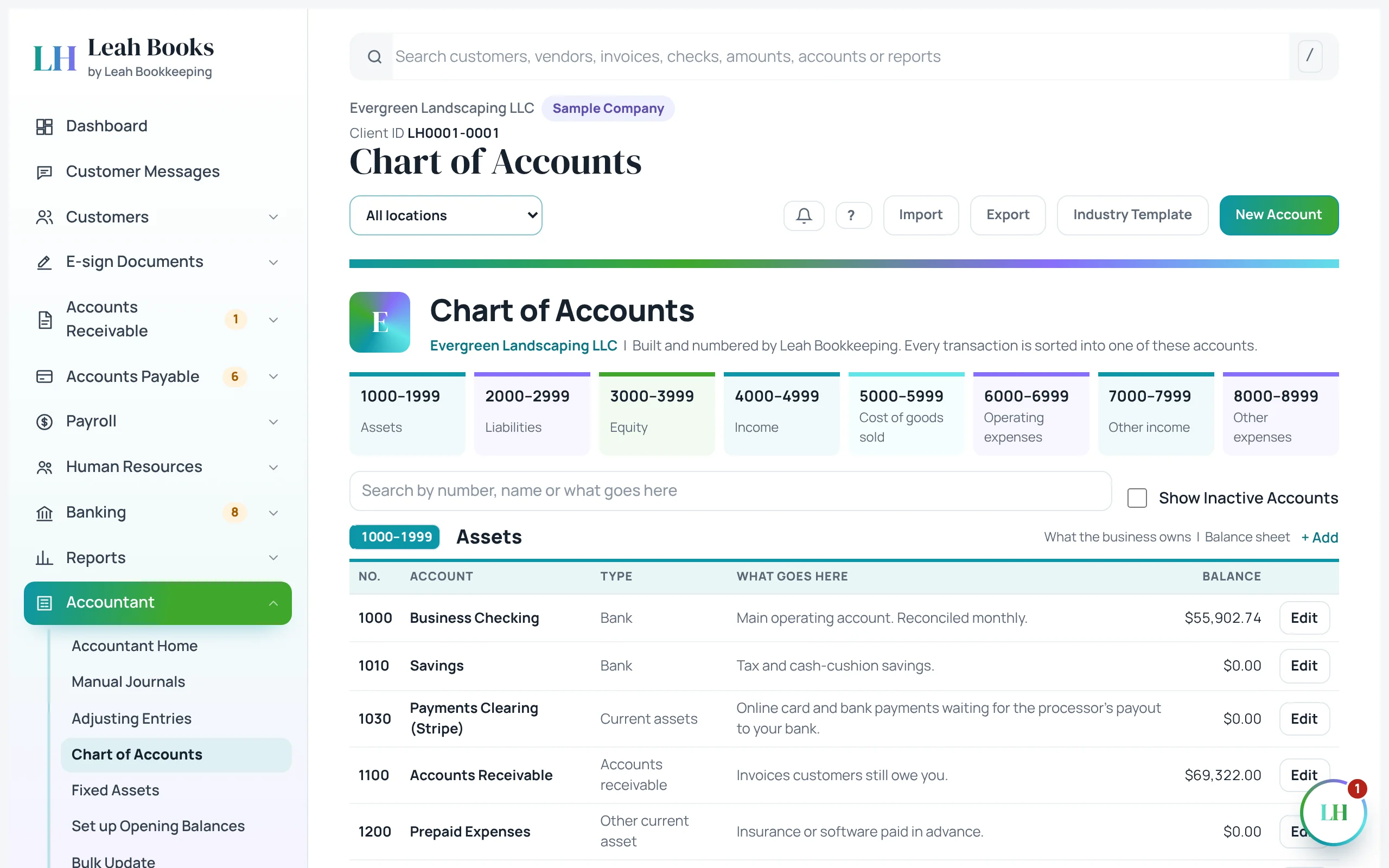 (opens the full-size screenshot)
Try it in Leah Books
- Go to Accountant > Chart of accounts. Find one account of each type: an asset, a liability, an equity account, an income account and an expense.
- In the Assets section, find 1510 Accumulated Depreciation. It's a contra asset that will reduce Equipment.
- In the Income section, find 4900 Sales Discounts. It's a contra revenue account.
- Go to Reports > Profit and loss. Notice it lists only income, cost of goods sold and expenses. The other three types are on Reports > Balance sheet.
Key terms
- Account type
- One of the five categories every account belongs to: assets, liabilities, equity, revenue or expenses.
- Revenue
- Income earned through business operations, like service income.
- Expense
- A cost incurred to operate the business, like rent or fuel.
- Cost of goods sold (COGS)
- Direct costs of the goods or services sold, like plants used on a job.
- Gross profit
- Revenue minus cost of goods sold.
- Normal balance
- The side, debit or credit, that increases an account and where its balance usually sits.
- Contra account
- An account with the opposite normal balance of its type that reduces a related account.
- Owner's draw
- Money or assets the owner takes out of the business. It lowers equity.
Check what you learned
Pick an answer to see if it's right and why. Nothing is saved or sent.