Owner's equity, retained earnings and how the statements connect
Prepare a statement of owner's equity and a retained earnings statement, and trace how the four financial statements link to each other.
- Principles:
- Economic entity
- Periodicity
- Full disclosure
The fourth statement
The statement of owner's equity (for a sole proprietorship or single-owner LLC) explains why equity changed during the period. Corporations prepare a statement of retained earnings or a broader statement of stockholders' equity. Leah Books calls its version the Statement of changes in equity.
Equity goes up with owner investments and net income. It goes down with draws (or dividends) and net losses.
Ending equity = Beginning equity + Owner investments + Net income − Draws
Evergreen's statement of owner's equity
Using the numbers from lessons 4.1 and 4.2:
| Statement of owner's equity, year ended Dec 31 | Amount |
|---|---|
| Owner's equity, beginning of year | $86,000 |
| Add: owner investments | $0 |
| Add: net income | $44,000 |
| Less: owner's draws | ($30,000) |
| Owner's equity, end of year | $100,000 |
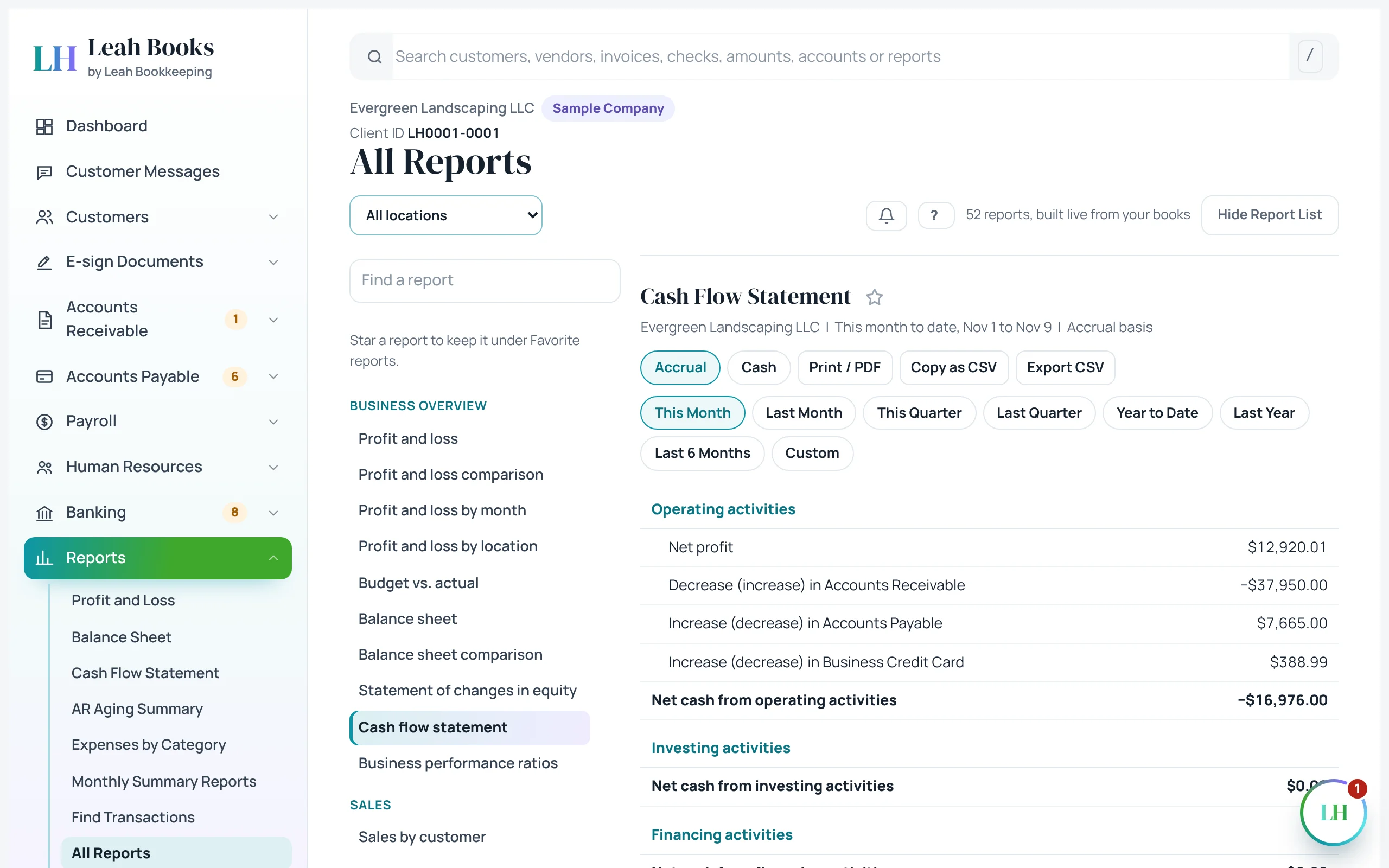 (opens the full-size screenshot)
The retained earnings view
A corporation keeps contributed capital (stock) separate from retained earnings and reports the retained earnings piece on its own. The same idea works for Evergreen if we treat Owner's Investment as contributed capital:
| Statement of retained earnings | Amount |
|---|---|
| Retained earnings, beginning of year | $15,500 |
| Add: net income | $44,000 |
| Less: owner's draws (dividends for a corporation) | ($30,000) |
| Retained earnings, end of year | $29,500 |
| Owner's Investment (unchanged) | $70,500 |
| Total equity ($70,500 + $29,500) | $100,000 |
Closing the year
At year end, the temporary accounts (income, expenses and draws) are closed so the next year starts at zero. Net income flows into retained earnings, and draws are closed against it.
Leah Books moves prior years' net income into Retained earnings (prior years) on the balance sheet for you. Owner's Draw keeps a running balance until you post a closing entry in Accountant > Manual journals, like this one:
| Account | Debit (Dr) | Credit (Cr) |
|---|---|---|
| 3900 Retained Earnings | $30,000.00 | |
| 3100 Owner's Draw | $30,000.00 | |
| Total Balanced | $30,000.00 | $30,000.00 |
Memo: After this entry Owner's Draw is zero and retained earnings reflect the year's distributions.
Are you Increasing or Decreasing?
| Debit | Credit |
|---|---|
| Liability | Asset |
| Equity | Draw |
| Revenue | Expense |
− To decrease an account, put it on the opposite side.
Retained Earnings goes down: press − and find Equity on the debit side.
How the four statements connect
Each statement hands a number to the next. If one link doesn't match, something is misposted.
- Income statement → equity statement: net income of $44,000 is added to equity.
- Equity statement → balance sheet: ending equity of $100,000 is the equity total on the balance sheet.
- Balance sheet → cash flow statement: changes in balance-sheet accounts drive the cash flow adjustments, investing and financing lines.
- Cash flow statement → balance sheet: ending cash of $54,000 equals Business Checking plus Savings on the balance sheet.
- Income statement → cash flow statement: the indirect method starts from the same $44,000 of net income.
Try it in Leah Books
- Go to Reports > Profit and loss with the period Year to date. Write down Net profit.
- Go to Reports > Balance sheet and find Net income, year to date in the equity section. It should match.
- Go to Reports > All reports and open Statement of changes in equity under Business overview, with the period Year to date.
- Go to Reports > Cash flow statement for the same period and confirm Cash at end of period matches the cash accounts on the balance sheet.
Key terms
- Statement of owner's equity
- Shows how owner's equity changed through investments, net income and draws.
- Statement of retained earnings
- Shows beginning retained earnings plus net income minus dividends or draws.
- Temporary accounts
- Revenue, expense and draw or dividend accounts that are closed to zero at year end.
- Permanent accounts
- Asset, liability and equity accounts whose balances carry into the next period.
- Closing entry
- A year-end journal entry that moves temporary account balances into retained earnings or capital.
- Articulation
- The way the financial statements link, with figures from one feeding into another.
Check what you learned
Pick an answer to see if it's right and why. Nothing is saved or sent.