Year-end and tax basics
Know which year-end forms a small business prepares, why book income and taxable income differ, and how entity type changes the tax return.
- Principles:
- Economic entity
- Periodicity
- Full disclosure
General education only
This lesson explains concepts. It is not tax advice. Tax laws, thresholds, rates and due dates change, sometimes every year, and they differ by state. Before you file anything, check the current IRS and state instructions or work with a tax professional.
1099-NEC for contractors
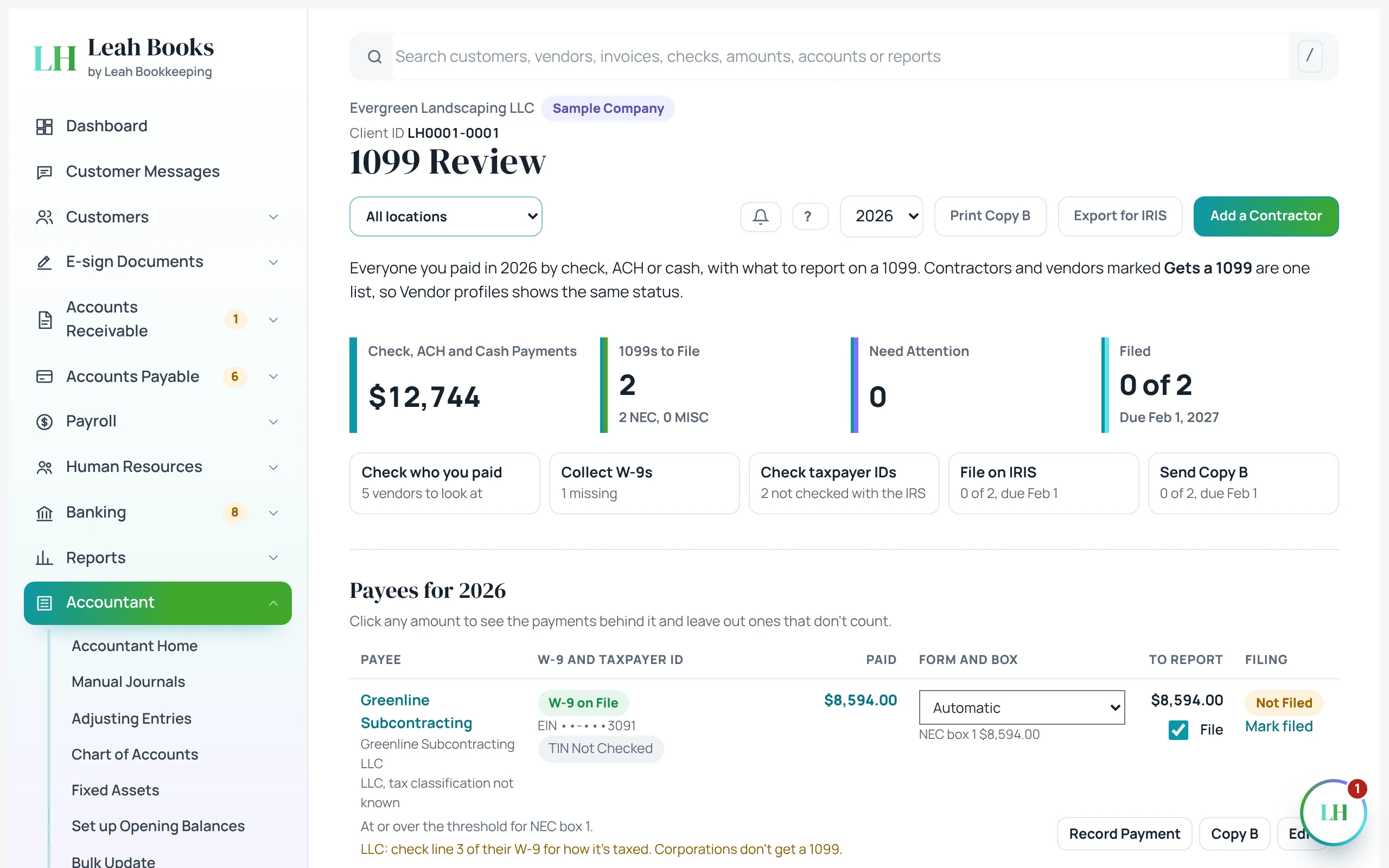
When a business pays an independent contractor for services, it may need to file Form 1099-NEC (nonemployee compensation) with the IRS and send a copy to the contractor. Evergreen's payments to Greenline Subcontracting are the kind of payment that is reviewed for a 1099-NEC.
Collect a Form W-9 from each contractor before you pay them, so you have their legal name, tax ID and tax classification. Payments to most corporations are generally not reported, though there are exceptions such as attorneys.
A 1099-NEC is required only once payments to a contractor reach a dollar threshold for the year. The threshold was $600 for payments made before 2026. For payments made in 2026, the IRS says it is $2,000, and for payments after 2026 that amount is adjusted for inflation (IRS: "Am I required to file a Form 1099 or other information return?" and Publication 1099). Check the IRS instructions for the year you are filing. Payments made by credit card or through a payment app are generally reported by the card company or app on Form 1099-K, not by you on a 1099-NEC.
 (opens the full-size screenshot)
W-2s and payroll year-end forms
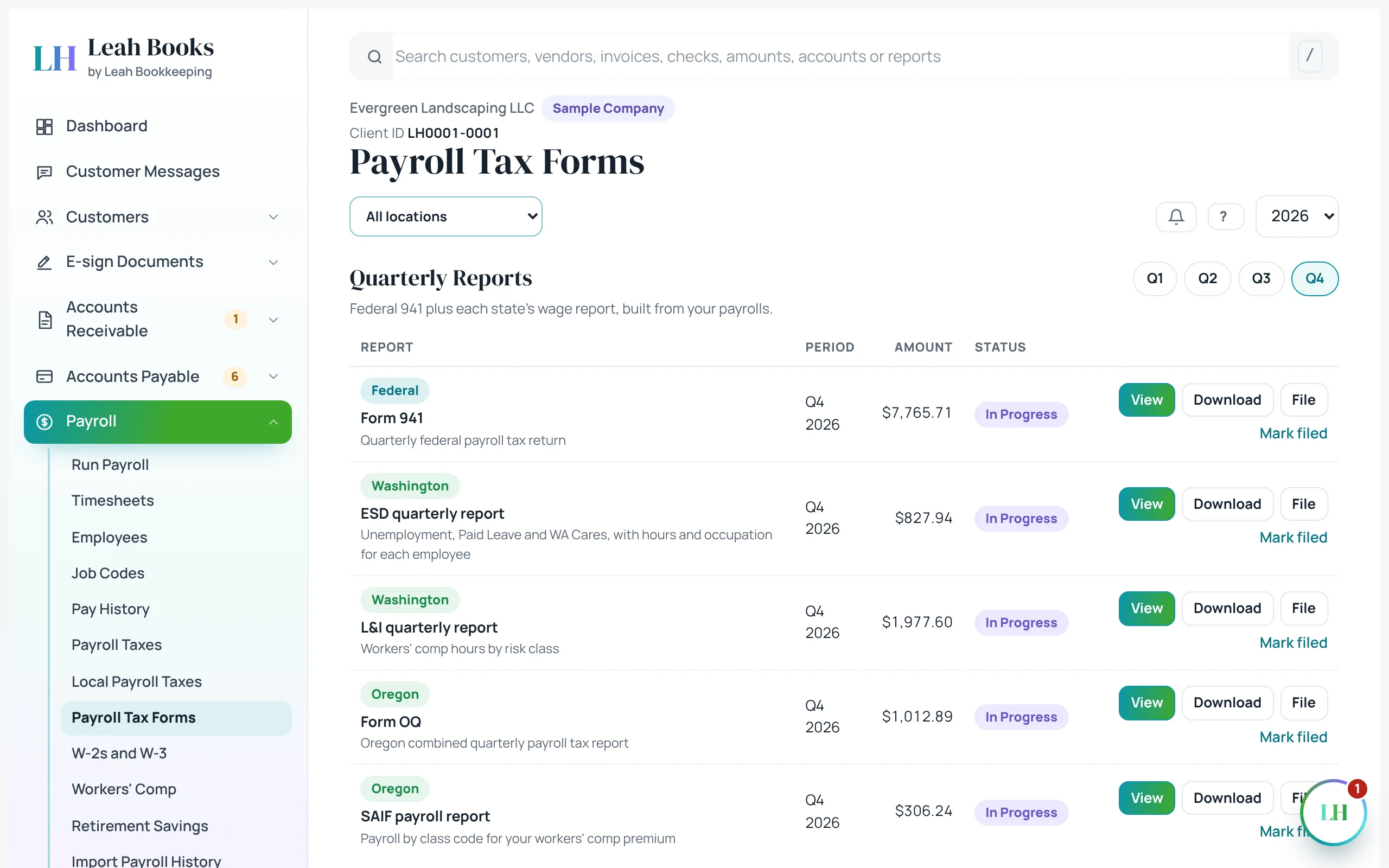
Employees get a Form W-2 showing their wages and the taxes withheld. The employer sends copies to the Social Security Administration with a Form W-3 summary. Employers also file Form 940 for federal unemployment tax each year, and, for most employers, Form 941 each quarter for withheld income tax and Social Security and Medicare taxes (some very small employers file Form 944 once a year instead). States have their own wage reports.
Leah Books works out these amounts from your payrolls and links to the agency's filing site. It does not file payroll taxes for you; you or your tax professional file and pay them.
 (opens the full-size screenshot)
Book income vs. taxable income
Your books follow GAAP so the statements show economic reality. The tax return follows the tax code, which has its own goals. The two often give different numbers.
Temporary differences reverse over time. Depreciation is the classic example: tax rules may allow faster write-offs than the straight-line depreciation in the books, so taxable income is lower now and higher later.
Permanent differences never reverse. Examples include business meals that are only partly deductible, and fines and penalties, which generally aren't deductible at all.
| Illustration only (assumed figures) | Amount |
|---|---|
| Evergreen's book net income | $44,000 |
| Add: part of the $600 of meals assumed not deductible (50%) | $300 |
| Less: extra tax depreciation, assuming $18,000 for tax vs. $8,400 in the books | ($9,600) |
| Taxable business income in this illustration | $34,700 |
Entity type decides the return
The same business can be taxed in different ways depending on its legal form and the elections it makes. An LLC like Evergreen is taxed by default as a sole proprietorship if it has one owner, or as a partnership if it has more than one. An LLC can also elect to be taxed as an S corporation or a C corporation.
| Entity (for tax) | Federal return | Who pays income tax | Equity on the balance sheet |
|---|---|---|---|
| Sole proprietorship or single-member LLC | Schedule C with the owner's Form 1040 (plus Schedule SE for self-employment tax) | The owner | Owner's capital (investment) and draws |
| Partnership or multi-member LLC | Form 1065, with a Schedule K-1 for each partner | The partners, on their own returns | Each partner's capital account |
| S corporation | Form 1120-S, with a Schedule K-1 for each shareholder | The shareholders, on their own returns | Stock, retained earnings and distributions |
| C corporation | Form 1120 | The corporation, then shareholders on dividends | Stock and retained earnings; income tax expense on the P&L |
A year-end checklist
- Reconcile every bank and credit card account through December 31 (Banking > Reconcile).
- Review open invoices and bills in the aging reports and clean up anything that is stale.
- Record year-end adjustments such as depreciation and accruals in Accountant > Manual journals.
- Review contractors in Accountant > 1099 review and payroll forms in Payroll > Payroll tax forms.
- Lock the closed year in Accountant > Transaction locking so filed numbers don't change.
- Give your tax professional the P&L, balance sheet and trial balance for the year.
Try it in Leah Books
- Go to Accountant > 1099 review. Pick a Tax year and look at the contractors, the amounts paid and the W-9 status.
- Go to Payroll > Run payroll and submit a payroll, so the forms have amounts. Then go to Payroll > Payroll tax forms, click the Q1 to Q4 tabs and scroll to Year end to find the W-2s, W-3 and Form 940.
- Click View on one form to see the amounts Leah Books worked out from the payrolls.
- Go to Accountant > Chart of accounts and find 6900 Meals and 6960 Depreciation, two accounts where book and tax amounts often differ.
- Go to Accountant > Transaction locking to see how you would lock a closed year.
Key terms
- Form 1099-NEC
- An IRS information return that reports nonemployee compensation paid to an independent contractor.
- Form W-9
- A form a contractor gives the payer with their legal name, tax ID and tax classification.
- Form W-2
- An annual statement of an employee's wages and taxes withheld.
- Temporary difference
- A book-tax difference that reverses in later years, such as faster tax depreciation.
- Permanent difference
- A book-tax difference that never reverses, such as a non-deductible penalty.
- Pass-through entity
- A business whose income is taxed on the owners' returns rather than at the business level.
- Schedule K-1
- A form that reports each partner's or S corporation shareholder's share of income, deductions and credits.
Check what you learned
Pick an answer to see if it's right and why. Nothing is saved or sent.