Journal entries and the general ledger
Follow a transaction from a journal entry to the general ledger and the reports.
- Principles:
- Double-entry
- Full disclosure
The journal: one entry per transaction
A journal entry is the formal record of one transaction. It has a date, the accounts, the debits and credits, and a short note.
The general journal lists entries in date order. It answers: what happened, and when?
The ledger: one page per account
The general ledger is the master record of every account. It takes each line of each entry and files it under its account. Moving the lines there is called posting.
The ledger answers a different question: what happened to this one account?
- 1. Transaction: something happens, like sending an invoice.
- 2. Journal entry: record it with balanced debits and credits.
- 3. Post: each line goes to its account in the general ledger.
- 4. Trial balance: check that all debits still equal all credits.
- 5. Reports: the balances flow into the profit and loss and balance sheet.
Leah Books writes most entries for you
You don't type a journal entry for every invoice or bill. When you send an invoice or enter a bill, Leah Books creates and posts the entry.
Here's what happens when Evergreen invoices Harbor View HOA for $3,000 of grounds maintenance plus $600 of materials.
| Account | Debit (Dr) | Credit (Cr) |
|---|---|---|
| 1100 Accounts Receivable | $3,600.00 | |
| 4000 Landscaping Services | $3,000.00 | |
| 4200 Materials Billed | $600.00 | |
| Total Balanced | $3,600.00 | $3,600.00 |
Memo: Created by Leah Books when the invoice is sent
Are you Increasing or Decreasing?
| Debit | Credit |
|---|---|
| Asset | Liability |
| Draw | Equity |
| Expense | Revenue |
+ To increase an account, put it on its normal side.
Accounts Receivable goes up: press + and find Asset on the debit side.
A bill works the same way
Entering a bill from Pacific Nursery Supply posts the expense and the amount owed.
| Account | Debit (Dr) | Credit (Cr) |
|---|---|---|
| 5000 Plants & Materials | $1,400.00 | |
| 2000 Accounts Payable | $1,400.00 | |
| Total Balanced | $1,400.00 | $1,400.00 |
Memo: Created by Leah Books when the bill is entered
Are you Increasing or Decreasing?
| Debit | Credit |
|---|---|
| Asset | Liability |
| Draw | Equity |
| Expense | Revenue |
+ To increase an account, put it on its normal side.
Plants & Materials goes up: press + and find Expense on the debit side.
Manual journals for everything else
Some entries don't come from an invoice, bill or bank transaction. Depreciation, accrued wages and fixing a miscategorized expense are common ones.
You record those in Accountant > Manual journals. Templates fill in the usual accounts. Leah Books won't post the entry until it balances.
| Account | Debit (Dr) | Credit (Cr) |
|---|---|---|
| 6960 Depreciation | $700.00 | |
| 1510 Accumulated Depreciation | $700.00 | |
| Total Balanced | $700.00 | $700.00 |
Memo: From the Depreciation template
Are you Increasing or Decreasing?
| Debit | Credit |
|---|---|
| Asset | Liability |
| Draw | Equity |
| Expense | Revenue |
+ To increase an account, put it on its normal side.
Depreciation goes up: press + and find Expense on the debit side.
 (opens the full-size screenshot)
Every entry leaves a trail
A ledger for Accounts Receivable shows each posting and a running balance. Here's the Harbor View HOA invoice and its payment.
| Date | Description | Debit | Credit | Balance |
|---|---|---|---|---|
| Apr 18 | Invoice to Harbor View HOA | $3,600 | $3,600 | |
| May 6 | Payment from Harbor View HOA | $3,600 | $0 |
 (opens the full-size screenshot)
More practice with the T: invoices, payments and draws
Use the same steps as lesson 1.6: what happened, which accounts, increasing or decreasing, read off the side, write the entry, record it.
Example 6: Send an invoice
Evergreen sends Harbor View HOA an $800 invoice for a spring cleanup. The customer will pay later.
Accounts Receivable, what customers owe, is an asset, and it's increasing: +, debit. Landscaping Services is revenue, increasing: +, Revenue is on the credit side. Leah Books makes this entry for you when you send the invoice.
| Account | Type on the T | Increasing or decreasing? | Side |
|---|---|---|---|
| 1100 Accounts Receivable | Asset | Increasing | Debit |
| 4000 Landscaping Services | Revenue | Increasing | Credit |
| Account | Debit (Dr) | Credit (Cr) |
|---|---|---|
| 1100 Accounts Receivable | $800.00 | |
| 4000 Landscaping Services | $800.00 | |
| Total Balanced | $800.00 | $800.00 |
Are you Increasing or Decreasing?
| Debit | Credit |
|---|---|
| Asset | Liability |
| Draw | Equity |
| Expense | Revenue |
+ To increase an account, put it on its normal side.
Accounts Receivable goes up: press + and find Asset on the debit side.
Example 7: Get paid
Harbor View HOA pays the $800 invoice, and it's deposited in Business Checking.
Business Checking is an asset, increasing: +, debit. Accounts Receivable is an asset too, and it's decreasing (the customer owes nothing now): −, it flips to the credit side. Revenue isn't touched again; the invoice already counted it.
| Account | Type on the T | Increasing or decreasing? | Side |
|---|---|---|---|
| 1000 Business Checking | Asset | Increasing | Debit |
| 1100 Accounts Receivable | Asset | Decreasing | Credit |
| Account | Debit (Dr) | Credit (Cr) |
|---|---|---|
| 1000 Business Checking | $800.00 | |
| 1100 Accounts Receivable | $800.00 | |
| Total Balanced | $800.00 | $800.00 |
Are you Increasing or Decreasing?
| Debit | Credit |
|---|---|
| Liability | Asset |
| Equity | Draw |
| Revenue | Expense |
− To decrease an account, put it on the opposite side.
Accounts Receivable goes down: press − and find Asset on the credit side.
Example 8: The owner takes money out
Jen takes $1,000 out of the business for herself.
Pause and try it. Which two accounts change, and which side does each go on?
Show the answer
Owner's Draw is increasing: +, and Draw sits on the debit side. Business Checking, an asset, is decreasing: −, credit. A draw isn't an expense, so it doesn't touch the profit and loss.
| Account | Type on the T | Increasing or decreasing? | Side |
|---|---|---|---|
| 3100 Owner's Draw | Draw | Increasing | Debit |
| 1000 Business Checking | Asset | Decreasing | Credit |
| Account | Debit (Dr) | Credit (Cr) |
|---|---|---|
| 3100 Owner's Draw | $1,000.00 | |
| 1000 Business Checking | $1,000.00 | |
| Total Balanced | $1,000.00 | $1,000.00 |
Are you Increasing or Decreasing?
| Debit | Credit |
|---|---|
| Liability | Asset |
| Equity | Draw |
| Revenue | Expense |
− To decrease an account, put it on the opposite side.
Business Checking goes down: press − and find Asset on the credit side.
Try it in Leah Books
- Go to Accountant > Manual journals. Under Start from a template, click Use next to Depreciation.
- Check that the debits and credits match and it shows Balanced. Click Post entry.
- In the Accountant reports box on the same page, open General ledger. Find your entry under 6960 Depreciation and under 1510 Accumulated Depreciation.
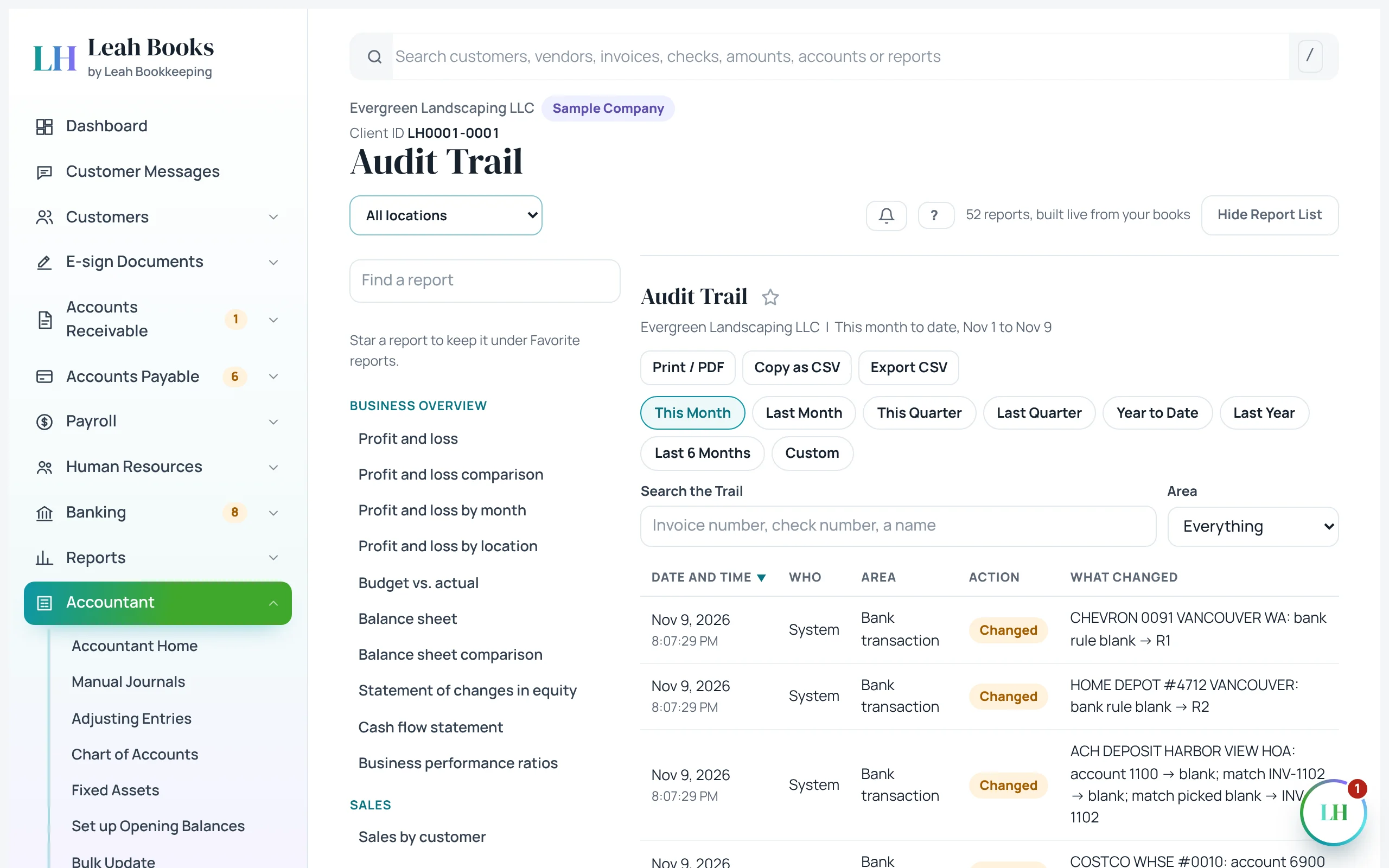
- Go to Accountant > Audit trail and find the change you just made.
Key terms
- Journal entry (JE)
- A formal record of one transaction using debits and credits.
- General journal
- The list of journal entries in date order.
- General ledger (GL)
- The master record of every account and its transactions.
- Posting
- Moving the lines of a journal entry into the general ledger accounts.
- Manual journal
- A journal entry you type yourself, for things like depreciation or a correction.
- Adjusting entry
- An entry made at period end to correct or update account balances.
- Audit trail
- A record showing how each transaction was recorded and changed.
Check what you learned
Pick an answer to see if it's right and why. Nothing is saved or sent.