Accruals and deferrals in depth, with reversing entries
You'll record accrued revenue, accrued expenses, prepaid expenses and unearned revenue, and use reversing entries so nothing counts twice.
- Principles:
- Matching
- Revenue recognition
- Accrual basis
Four kinds of timing differences
On the accrual basis, income counts when it's earned and costs when they're incurred. When the cash comes at a different time, a month-end entry moves the amount into the right month. That's the matching principle.
| Cash comes later | Cash came first | |
|---|---|---|
| Income | Accrued revenue (an asset) | Unearned revenue (a liability) |
| Expense | Accrued expense (a liability) | Prepaid expense (an asset) |
Accrued revenue
Evergreen finishes a $4,500 patio on October 29, but the invoice goes out November 3. The income belongs to October, so on October 31 it's recorded as an unbilled receivable.
| Account | Debit (Dr) | Credit (Cr) |
|---|---|---|
| Unbilled Receivables | $4,500.00 | |
| Sales | $4,500.00 | |
| Total Balanced | $4,500.00 | $4,500.00 |
Are you Increasing or Decreasing?
| Debit | Credit |
|---|---|
| Asset | Liability |
| Draw | Equity |
| Expense | Revenue |
+ To increase an account, put it on its normal side.
Unbilled Receivables goes up: press + and find Asset on the debit side.
Accrued expenses
October's electric bill won't come until November 12, estimated at $640. October used the power, so October gets the cost, held in Accrued Liabilities until the bill arrives.
| Account | Debit (Dr) | Credit (Cr) |
|---|---|---|
| Utilities | $640.00 | |
| Accrued Liabilities | $640.00 | |
| Total Balanced | $640.00 | $640.00 |
Are you Increasing or Decreasing?
| Debit | Credit |
|---|---|
| Asset | Liability |
| Draw | Equity |
| Expense | Revenue |
+ To increase an account, put it on its normal side.
Utilities goes up: press + and find Expense on the debit side.
Reversing entries
A reversing entry is the exact opposite of an accrual, dated the first day of the next month. Then the real bill or invoice can be entered the normal way, and the reversal cancels it out, so the amount counts once, in the month it belonged to.
In Leah Books, check Auto-reverse on the journal entry and it posts the reversal on the date you pick.
| Account | Debit (Dr) | Credit (Cr) |
|---|---|---|
| Accrued Liabilities | $640.00 | |
| Utilities | $640.00 | |
| Total Balanced | $640.00 | $640.00 |
Are you Increasing or Decreasing?
| Debit | Credit |
|---|---|
| Liability | Asset |
| Equity | Draw |
| Revenue | Expense |
− To decrease an account, put it on the opposite side.
Accrued Liabilities goes down: press − and find Liability on the debit side.
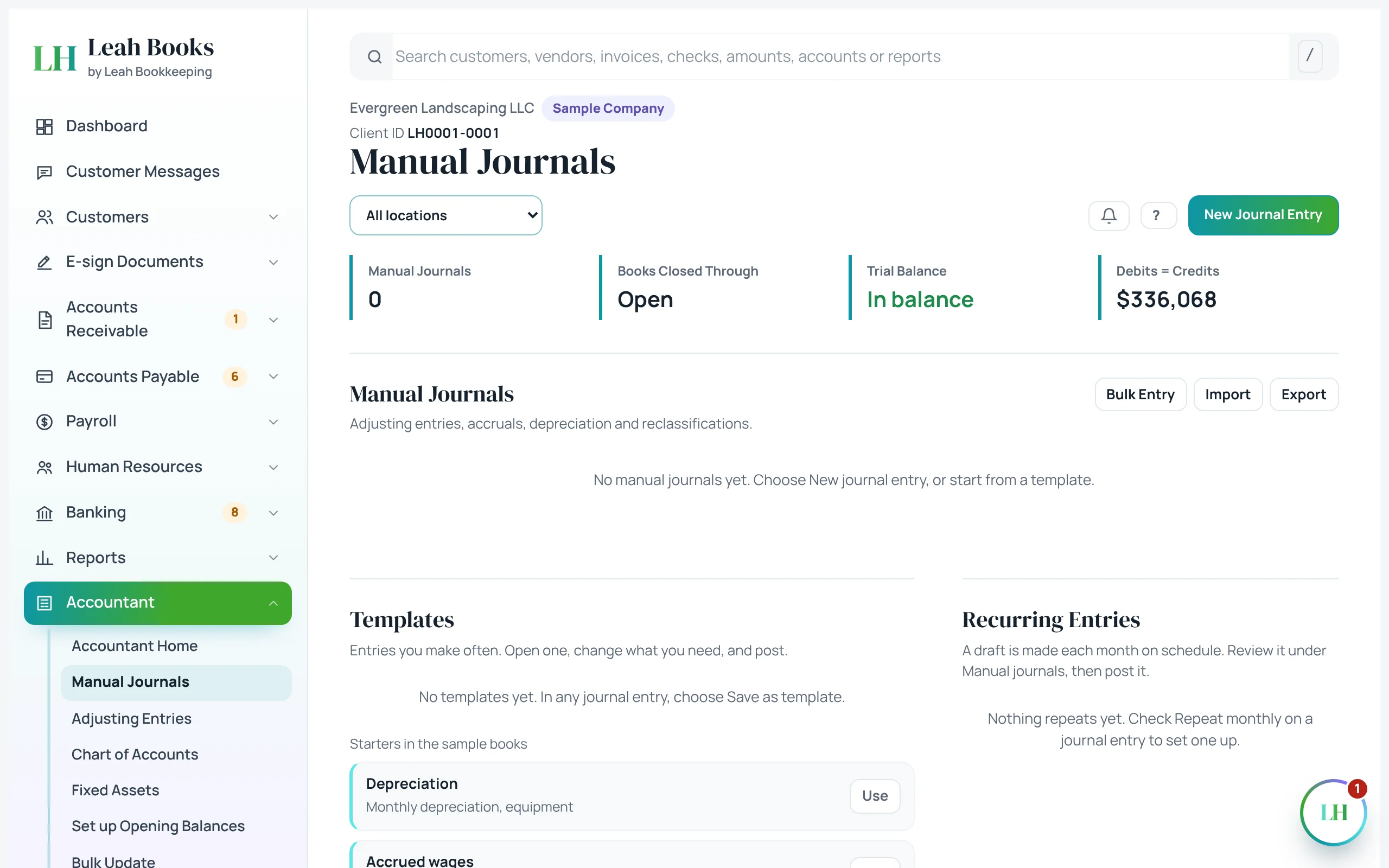 (opens the full-size screenshot)
Prepaid expenses
Paying a year of insurance up front buys an asset: coverage you haven't used yet. Each month, one month's share becomes expense.
Monthly expense = Amount paid ÷ Months covered = $5,760 ÷ 12 = $480
| Account | Debit (Dr) | Credit (Cr) |
|---|---|---|
| Insurance | $480.00 | |
| Prepaid Expenses | $480.00 | |
| Total Balanced | $480.00 | $480.00 |
Are you Increasing or Decreasing?
| Debit | Credit |
|---|---|
| Liability | Asset |
| Equity | Draw |
| Revenue | Expense |
− To decrease an account, put it on the opposite side.
Prepaid Expenses goes down: press − and find Asset on the credit side.
Unearned revenue
A customer prepays $1,800 for six months of maintenance. That's a liability until each month's work is done, then $300 a month moves to income.
| Account | Debit (Dr) | Credit (Cr) |
|---|---|---|
| Customer Credits (deposits) | $300.00 | |
| Sales | $300.00 | |
| Total Balanced | $300.00 | $300.00 |
Are you Increasing or Decreasing?
| Debit | Credit |
|---|---|
| Liability | Asset |
| Equity | Draw |
| Revenue | Expense |
− To decrease an account, put it on the opposite side.
Customer Credits (deposits) goes down: press − and find Liability on the debit side.
Try it in Leah Books
- Go to Accountant > Manual journals and click New journal entry. Date it the last day of last month.
- Debit 6800 Utilities 640 and credit 2300 Accrued Liabilities 640. Check Auto-reverse and post it.
- Open Reports > Profit and loss for October, then for November, and see where the reversal lands.
- Go to Accountant > Account reconciliations and open Prepaid schedules to see how a prepaid expense is spread.
Key terms
- Accrual
- An entry that records income earned or an expense incurred before the cash moves.
- Deferral
- An entry that holds cash received or paid until it's earned or used.
- Accrued revenue
- Income earned but not billed yet. An asset.
- Accrued expense
- A cost incurred but not billed or paid yet. A liability.
- Reversing entry
- The opposite of an accrual, posted on the first day of the next period.
- Matching principle
- Expenses are recorded in the same period as the revenue they help earn.
Check what you learned
Pick an answer to see if it's right and why. Nothing is saved or sent.