The chart of accounts
Read a chart of accounts, understand its numbering and add an account in the right place.
- Principles:
- Consistency
The list of every account
The chart of accounts is the organized list of every account a business uses. Every transaction lands in at least two of these accounts.
Think of it as the table of contents for the books. A good chart is short enough to use and detailed enough to answer real questions.
How the numbers work
Leah Books gives each account a four-digit number. The first digit tells you the section. In the sample books, Business Checking is 1000 and Fuel is 6000.
| Numbers | Section | What goes here | Report |
|---|---|---|---|
| 1000–1999 | Assets | What the business owns | Balance sheet |
| 2000–2999 | Liabilities | What the business owes | Balance sheet |
| 3000–3999 | Equity | The owner's stake | Balance sheet |
| 4000–4999 | Income | Money you earn | Profit and loss |
| 5000–5999 | Cost of goods sold | Direct costs of each job | Profit and loss |
| 6000–6999 | Operating expenses | Costs of running the business | Profit and loss |
- The numbers leave gaps on purpose. You can add 6560 between 6550 and 6600 later without renumbering anything.
- Once an account has transactions, Leah Books locks its number. You can still rename it or make it inactive.
Current vs. long-term
Assets and liabilities are split by timing. Current means within about one year. Long-term (or noncurrent) means longer than that.
The balance sheet lists current items first. That makes it easy to see whether the business can cover its short-term bills.
| Group | Sample accounts |
|---|---|
| Cash | 1000 Business Checking, 1010 Savings |
| Other current assets | 1100 Accounts Receivable, 1200 Prepaid Expenses |
| Fixed (long-term) assets | 1500 Equipment, 1510 Accumulated Depreciation |
| Current liabilities | 2000 Accounts Payable, 2100 Business Credit Card, 2200 Sales Tax Payable, 2300 Accrued Liabilities |
| Long-term liabilities | None in the sample yet. A truck loan paid over five years would go here. |
Working capital = Current assets − Current liabilities
How Leah Books lays it out
Each section has a colored range chip, like 6000–6999. Every account shows its number, name, type, a one-line "What goes here" note and its current balance.
You can search by number, name or note. You can also show inactive accounts, which keep their history but leave the pick lists.
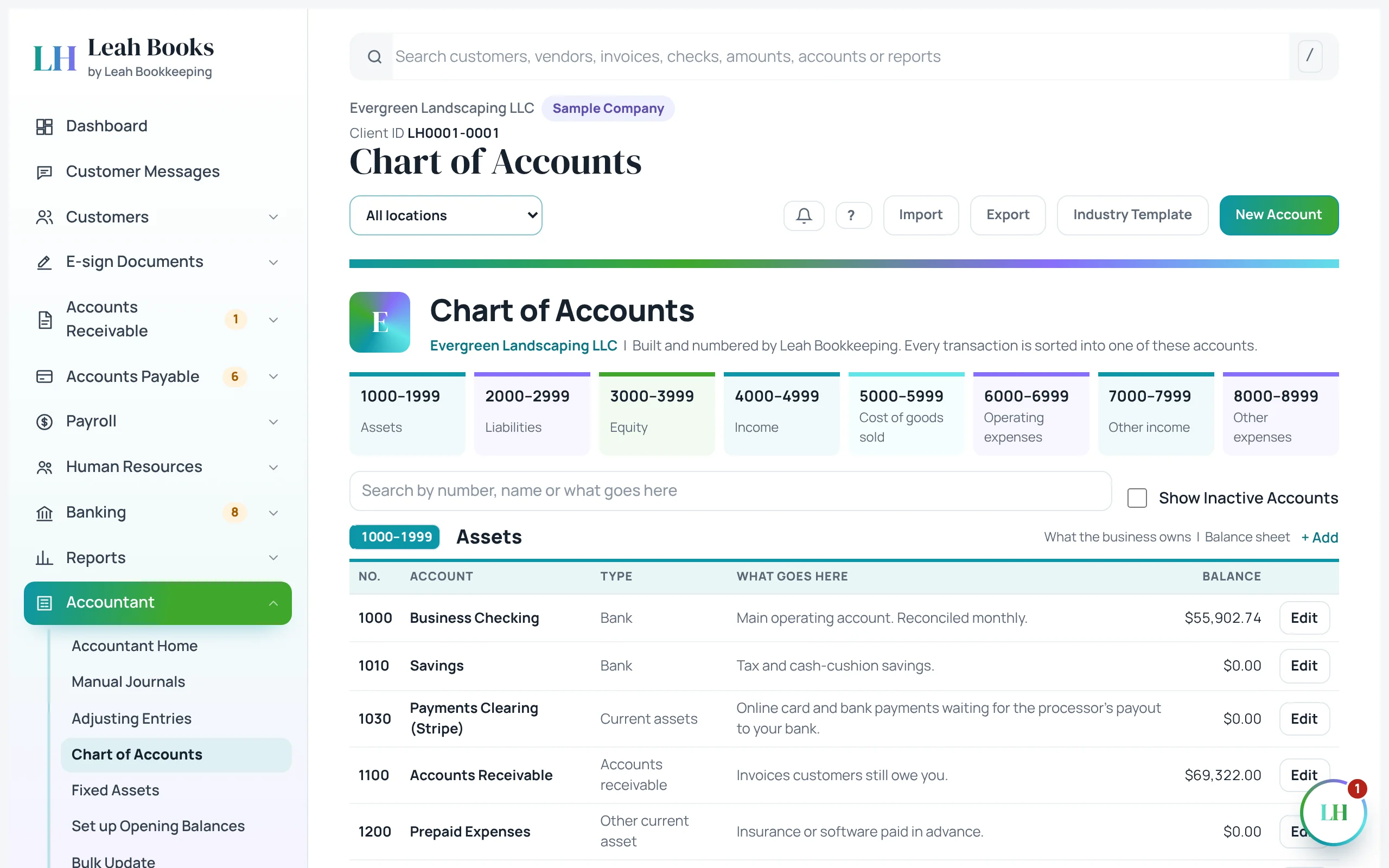 (opens the full-size screenshot)
Try it in Leah Books
- Go to Accountant > Chart of accounts. Click the 6000–6999 chip to jump to operating expenses.
- Type "fuel" in the search box. Find 6000 Fuel and read its "What goes here" note.
- Click New account. Pick the Operating expenses section and notice Leah Books suggests the next free number.
- Name it Truck Repairs and click Add account. Then find it in the 6000s.
Key terms
- Chart of accounts (COA)
- The organized list of accounts a business uses.
- Account number
- A code that places an account in its section, like 1000s for assets.
- Current asset
- An asset expected to become cash or be used up within about one year.
- Fixed asset
- A long-term physical asset used in the business, like a mower or truck.
- Current liability
- An obligation due within about one year, like a vendor bill.
- Long-term liability
- An obligation due beyond one year, like a multi-year loan.
- Working capital
- Current assets minus current liabilities.
- Inactive account
- An account hidden from pick lists that keeps its past transactions.
Check what you learned
Pick an answer to see if it's right and why. Nothing is saved or sent.