Sales tax
You'll record sales tax you collect as a liability, tell taxable from non-taxable sales, and record paying the tax to the state.
- Principles:
- Revenue recognition
Sales tax isn't your money
When you charge sales tax, you're collecting it for the state (and often the city or county). You hold it until you pay it over.
So sales tax you collect is not income. It's a liability called Sales Tax Payable.
Rates and rules vary a lot. Each state sets its own, many add local taxes on top, and a few states have no statewide sales tax at all. Always check with your state's department of revenue or a tax professional.
Recording a taxable sale
The invoice total includes the tax, but only the price of the work is revenue. The tax goes to Sales Tax Payable.
Example, using a made-up 8.5% rate just to show the math: Evergreen bills Northbank Coffee Co. $1,200 for work that's taxable where it happened.
Sales tax = Taxable amount × Tax rate ($1,200 × 8.5% = $102)
| Account | Debit (Dr) | Credit (Cr) |
|---|---|---|
| Accounts Receivable | $1,302.00 | |
| Landscaping Services | $1,200.00 | |
| Sales Tax Payable | $102.00 | |
| Total Balanced | $1,302.00 | $1,302.00 |
Memo: 8.5% is an example rate, not a real one.
Are you Increasing or Decreasing?
| Debit | Credit |
|---|---|
| Asset | Liability |
| Draw | Equity |
| Expense | Revenue |
+ To increase an account, put it on its normal side.
Accounts Receivable goes up: press + and find Asset on the debit side.
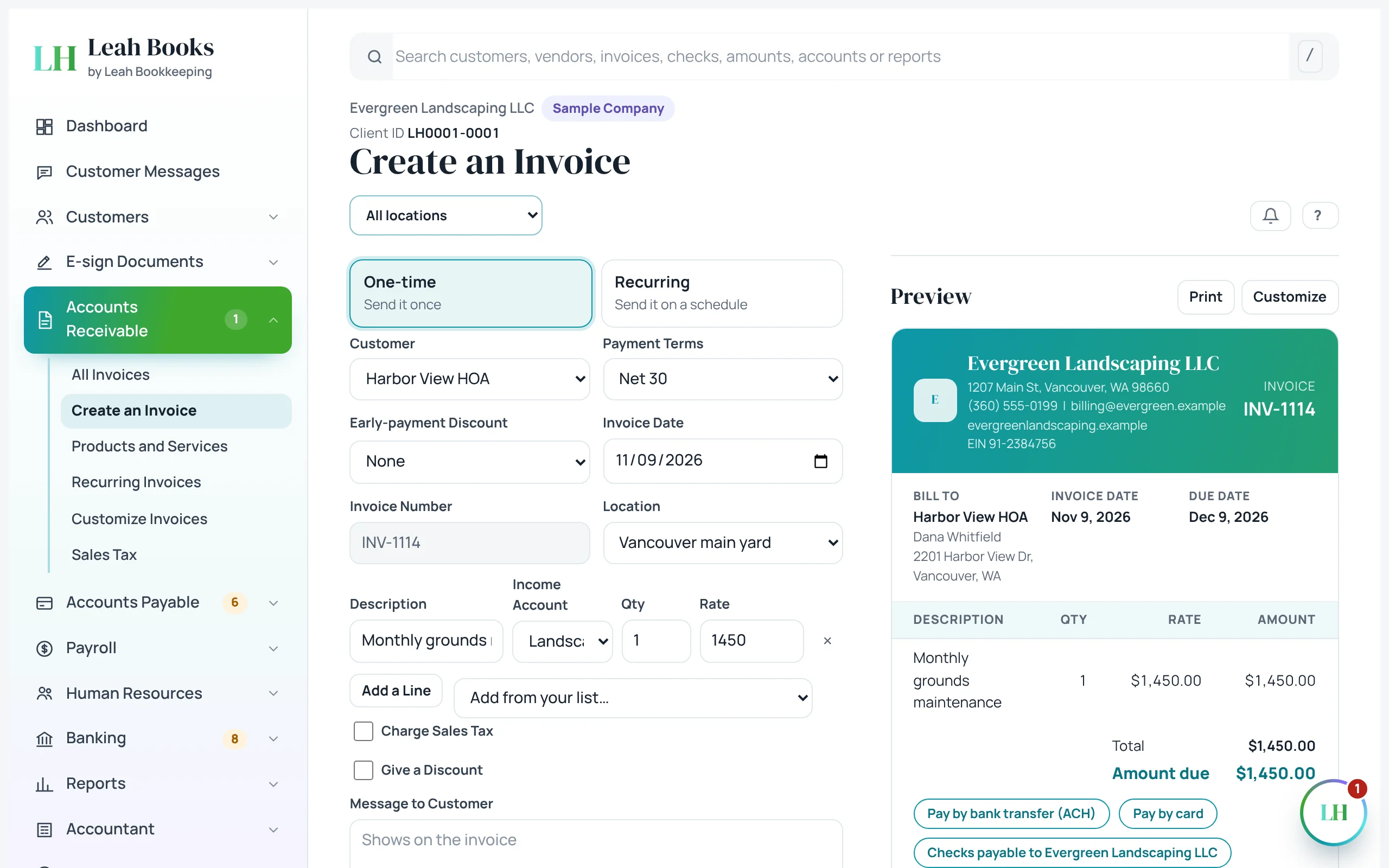 (opens the full-size screenshot)
Taxable and non-taxable
Whether a sale is taxed depends on the state, what you sold and who bought it. Things that commonly matter:
- Goods vs. services: most states tax goods; states differ a lot on which services are taxed.
- Where the sale happens: many states tax at the rate for the job site or delivery address.
- Exempt customers: for example, a business buying to resell may give you a resale or exemption certificate. Keep a copy.
- Nonprofits and governments: some are exempt in some states and not in others. Don't assume; ask for the certificate.
Paying (remitting) the tax
The state tells you how often to file: monthly, quarterly or yearly. You file a return and pay what you collected for that period.
Paying the tax is not an expense. It just clears the liability.
| Account | Debit (Dr) | Credit (Cr) |
|---|---|---|
| Sales Tax Payable | $102.00 | |
| Business Checking | $102.00 | |
| Total Balanced | $102.00 | $102.00 |
Are you Increasing or Decreasing?
| Debit | Credit |
|---|---|
| Liability | Asset |
| Equity | Draw |
| Revenue | Expense |
− To decrease an account, put it on the opposite side.
Sales Tax Payable goes down: press − and find Liability on the debit side.
Sales tax in Leah Books
Accounts Receivable > Sales tax has tabs for Returns and payments, Locations and rates, Exempt customers and Settings. In the sample books it's set up for Washington, where Evergreen is based. For your own state, check its rules.
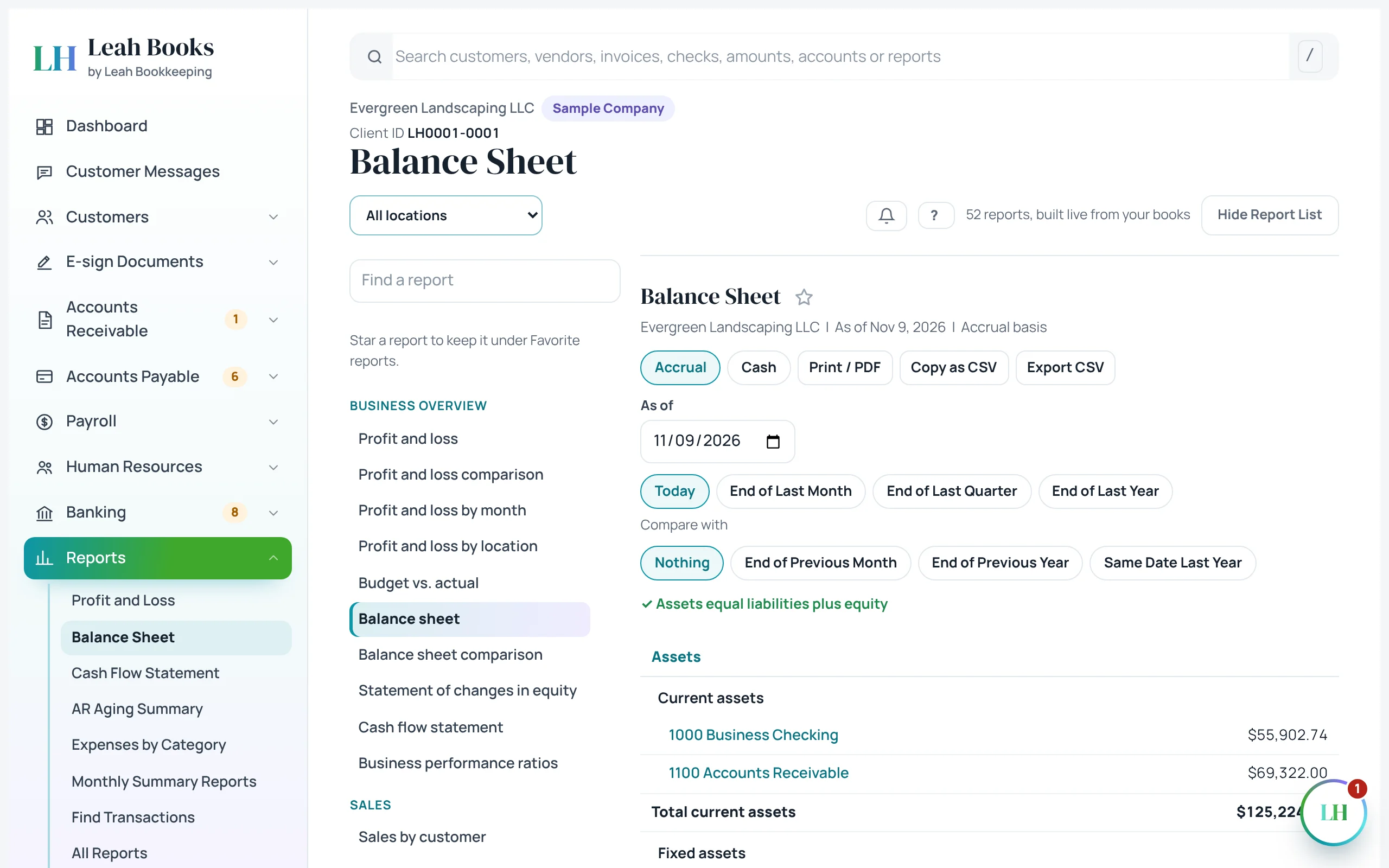
When you pay, use Record a payment on that page. It posts against Sales Tax Payable and the bank. Sales Tax Payable shows on the balance sheet under current liabilities.
 (opens the full-size screenshot)
Try it in Leah Books
- Go to Accounts Receivable > Create an invoice and pick one of your customers.
- Add a line, tick Charge sales tax, and watch the tax appear as its own amount below the lines.
- Go to Accounts Receivable > Sales tax and look through the Returns and payments, Locations and rates and Exempt customers tabs.
- Open Reports > Balance sheet and find Sales Tax Payable under current liabilities.
Key terms
- Sales tax
- A tax on sales that the seller collects from the customer and pays to the state or local government.
- Sales Tax Payable
- The liability account for sales tax you've collected but not yet paid.
- Taxable sale
- A sale that the state's rules say must have sales tax added.
- Exempt customer
- A customer who doesn't pay sales tax on a purchase, usually with a certificate to prove it.
- Exemption certificate
- A form a customer gives you showing why their purchase isn't taxed. Keep it on file.
- Remit
- To pay collected tax over to the government.
- Filing frequency
- How often the state wants your sales tax return: monthly, quarterly or yearly.
Check what you learned
Pick an answer to see if it's right and why. Nothing is saved or sent.