The income statement (P&L)
Read a multi-step income statement from revenue down to net income and explain what each subtotal tells you.
- Principles:
- Revenue recognition
- Expense recognition (matching)
- Periodicity
- Accrual basis
What the income statement answers
The income statement, also called the profit and loss statement or P&L, shows how the business performed over a period of time: a month, a quarter or a year.
It lists what the business earned (revenue) and what it cost to earn it (expenses). The difference is net income, or a net loss if expenses are larger.
In this level we follow one full year of the Leah Books sample company, Evergreen Landscaping LLC, a landscaping business in Vancouver, Washington. The figures are rounded for teaching. The screenshots show the sample company's books; the amounts in your own books will differ, but the account names and the layout are the same.
Net income = Revenue − Expenses
Revenue and cost of goods sold
Revenue (Leah Books calls it Income) is recorded when it is earned, not when the cash arrives. Evergreen has three income accounts plus Sales Discounts, a contra-revenue account that reduces gross sales.
Cost of goods sold (COGS) is the direct cost of doing the jobs: plants and materials that go into a customer's yard and the subcontractors who help on a job. Subtract COGS from revenue and you get gross profit, the money left to pay for running the business.
Gross profit = Net revenue − Cost of goods sold
| Evergreen Landscaping LLC, year ended Dec 31 | Amount |
|---|---|
| 4000 Landscaping Services | $300,000 |
| 4100 Design Services | $20,000 |
| 4200 Materials Billed | $45,000 |
| 4900 Sales Discounts | ($5,000) |
| Total income | $360,000 |
| 5000 Plants & Materials | $90,000 |
| 5100 Subcontractors | $54,000 |
| Total cost of goods sold | $144,000 |
| Gross profit | $216,000 |
Operating expenses, operating income and net income
Operating expenses are the costs of running the business that aren't tied to one job: wages for the regular crew, rent, insurance, fuel and so on. Depreciation spreads the cost of equipment over the years it is used.
Gross profit minus operating expenses is operating income (Leah Books shows it as Net operating income when other income or expenses exist). It measures how well the core business performs.
Below that come other income and expenses, items outside daily operations such as interest. In this example Evergreen took out an equipment loan during the year and paid $1,600 of interest. The sample chart of accounts has no loan or interest account, so you would add them under Accountant > Chart of accounts.
Operating income = Gross profit − Operating expenses; Net income = Operating income + Other income − Other expenses
| Operating expenses | Amount |
|---|---|
| 6500 Wages | $96,000 |
| 6510 Payroll Taxes | $9,000 |
| 6300 Rent | $26,400 |
| 6200 Insurance | $5,760 |
| 6000 Fuel | $8,400 |
| 6100 Equipment Rental | $4,800 |
| 6400 Software & Subscriptions | $1,668 |
| 6600 Advertising | $3,000 |
| 6700 Bank & Processing Fees | $1,200 |
| 6800 Utilities & Phone | $3,000 |
| 6900 Meals | $600 |
| 6950 Repairs & Maintenance | $2,172 |
| 6960 Depreciation | $8,400 |
| Total operating expenses | $170,400 |
| Operating income ($216,000 − $170,400) | $45,600 |
| Interest expense (other expense) | $1,600 |
| Net income | $44,000 |
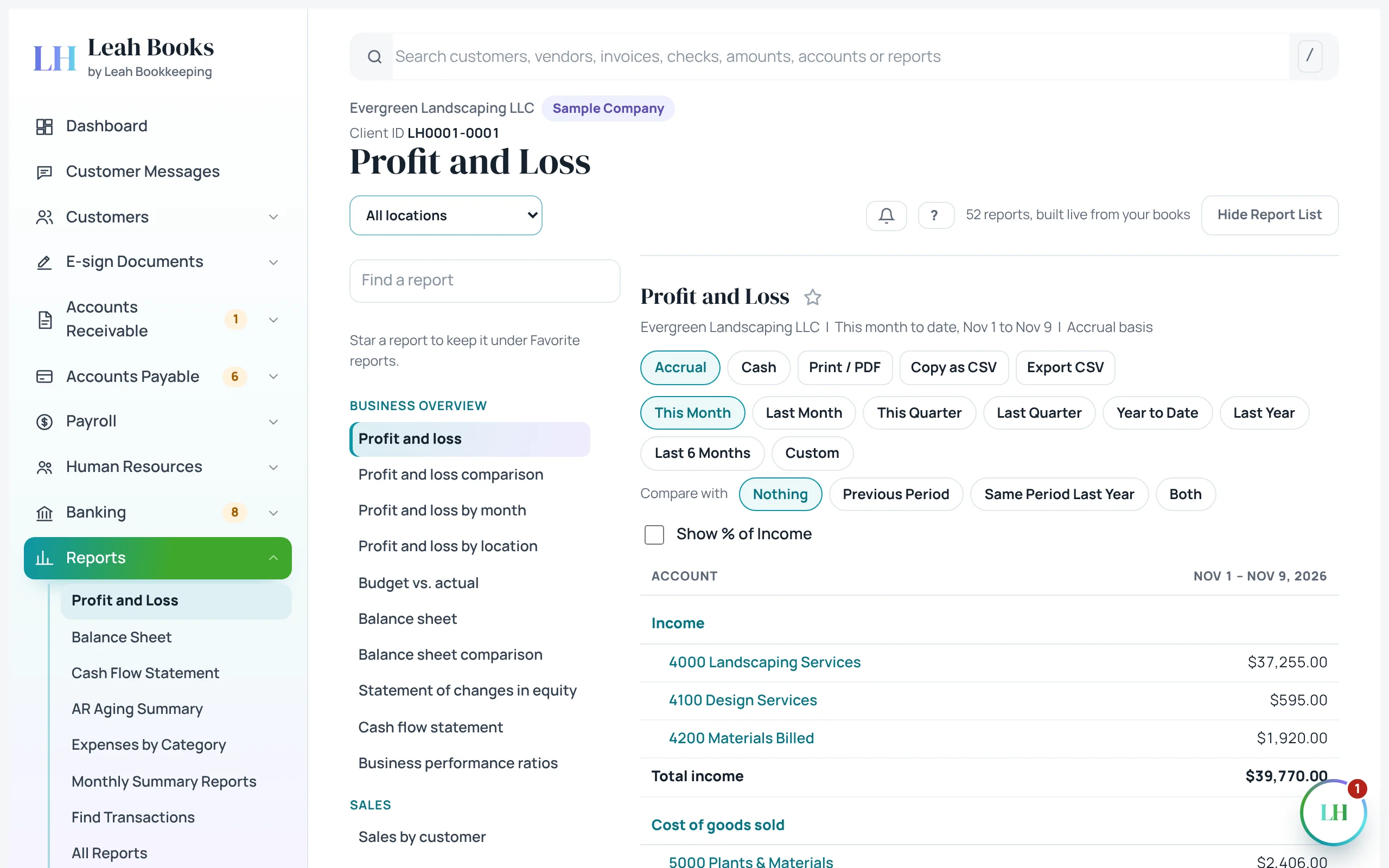 (opens the full-size screenshot)
Single-step vs. multi-step
A single-step income statement puts all revenues in one group and all expenses in another, then subtracts once. It is simple, but it hides the subtotals.
A multi-step income statement, like the one above, shows gross profit and operating income along the way. Both reach the same net income. Multi-step is more useful for analysis because you can see whether a problem is in pricing and job costs (gross profit) or in overhead (operating expenses).
| Single-step view | Amount |
|---|---|
| Total revenues | $360,000 |
| Total expenses ($144,000 + $170,400 + $1,600) | $316,000 |
| Net income | $44,000 |
Reading it as a percentage of revenue
Dividing each line by total revenue makes periods and businesses easier to compare. This is called a common-size income statement.
For Evergreen, COGS is 40% of revenue, so the gross margin is 60%. Operating income is about 12.7% of revenue ($45,600 ÷ $360,000) and net income is about 12.2% ($44,000 ÷ $360,000).
Evergreen is an LLC taxed as a pass-through, so there is no income tax expense on its P&L. The owner pays income tax on the profit personally. A C corporation would show income tax expense before net income. Lesson 4.8 covers this.
Common-size % = Line amount ÷ Total revenue × 100
Try it in Leah Books
- Go to Reports > Profit and loss and choose the period Last 6 months.
- Find Gross profit and Net profit. Divide each by Total income to get the gross and net margin.
- Tick Show % of income and check your math against the percentage column.
- Under Compare with, choose Previous period and note which line changed the most.
Key terms
- Income statement (P&L)
- A report of revenue, expenses and net income for a period of time.
- Cost of goods sold (COGS)
- The direct costs of producing what was sold, such as materials and subcontractors on a job.
- Gross profit
- Net revenue minus cost of goods sold.
- Operating income
- Gross profit minus operating expenses; profit from the core business before interest and other items.
- Net income
- The bottom line: all revenues and gains minus all expenses and losses for the period.
- Contra-revenue account
- An account, like Sales Discounts, that reduces gross revenue and carries a debit balance.
- Multi-step income statement
- A format that shows subtotals such as gross profit and operating income before net income.
- Common-size statement
- A statement where every line is shown as a percentage of a base, usually total revenue.
Check what you learned
Pick an answer to see if it's right and why. Nothing is saved or sent.