Bank reconciliation
You'll explain why the bank and the books differ, work out adjusted balances, and reconcile an account in Leah Books.
- Principles:
- Objectivity
- Time period
Why reconcile
Reconciling compares your books to the bank statement and explains every difference. It proves the cash number in your reports is real.
It also catches missing transactions, duplicates, typos, bank errors and charges you didn't make. Do it every month for every bank and credit card account.
Why the two balances differ
The bank and your books rarely show the same balance on the same day. Most differences are about timing.
- Deposits in transit: money you recorded and deposited, but the bank hadn't posted by the statement date.
- Outstanding checks: checks you wrote and recorded that haven't cleared the bank yet.
- Bank fees and interest: the bank records these first. You add them to your books when you see the statement.
- Returned (NSF) checks: a customer's check that bounced. The bank takes the money back out.
- Errors: on either side, like a transposed number.
The adjusted balances
Fix each side for what it doesn't know yet. When both adjusted balances match, you're reconciled.
Example for Evergreen's Business Checking at the end of the month:
Statement balance + Deposits in transit − Outstanding checks = Book balance − Bank fees + Interest earned
| Bank side | Amount | Book side | Amount |
|---|---|---|---|
| Statement ending balance | $18,420.00 | Balance in the books | $19,842.00 |
| + Deposit in transit (Columbia Dental check) | $1,762.00 | − Monthly service fee | $15.00 |
| − Outstanding check #1204 | $350.00 | + Interest earned | $5.00 |
| Adjusted bank balance | $19,832.00 | Adjusted book balance | $19,832.00 |
Recording what the bank found
Only the book-side items need entries. Deposits in transit and outstanding checks are already in your books; they just haven't reached the bank.
The $15 service fee needs an entry. Interest earned would be a debit to Business Checking and a credit to an interest income account.
| Account | Debit (Dr) | Credit (Cr) |
|---|---|---|
| Bank & Processing Fees | $15.00 | |
| Business Checking | $15.00 | |
| Total Balanced | $15.00 | $15.00 |
Memo: From the bank statement.
Are you Increasing or Decreasing?
| Debit | Credit |
|---|---|
| Liability | Asset |
| Equity | Draw |
| Revenue | Expense |
− To decrease an account, put it on the opposite side.
Business Checking goes down: press − and find Asset on the credit side.
Reconciling in Leah Books
- Open Banking > Reconcile and pick the account.
- Enter the Statement ending date and Statement ending balance exactly as the statement shows them, then click Start reconciling.
- Tick each item that's on the statement. Items you already matched from bank transactions start ticked.
- Use Add a fee or interest for anything on the statement that isn't in your books.
- When the Difference is $0.00, click Finish now. You can Save for later and come back.
- Stuck? If the difference divides evenly by 9, look for two digits swapped, like $63 typed as $36.
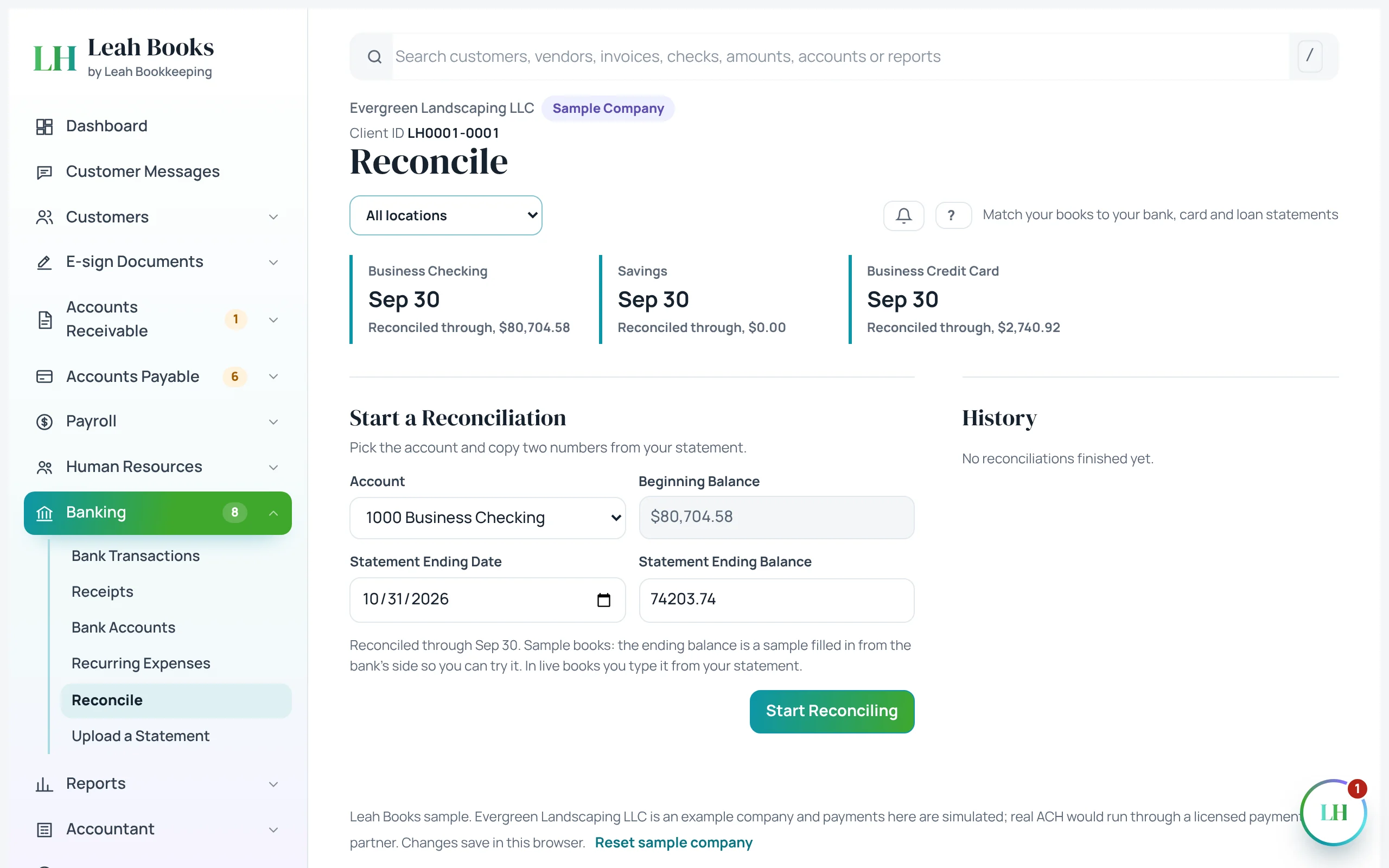 (opens the full-size screenshot)
Try it in Leah Books
- Go to Banking > Reconcile and pick your checking account.
- Enter the Statement ending date and Statement ending balance from a bank statement, then click Start reconciling.
- Tick a few items and watch the cleared balance and the Difference change.
- Find the Add a fee or interest button and see what it asks for.
- When the Difference is $0.00, click Finish now, or click Save for later to keep your ticks.
Key terms
- Bank reconciliation
- Comparing your books to the bank statement and explaining every difference.
- Deposit in transit
- A deposit in your books that the bank hadn't posted by the statement date.
- Outstanding check
- A check you recorded that hasn't cleared the bank yet.
- Cleared
- A transaction that has gone through the bank and appears on the statement.
- Bank service fee
- A charge the bank takes from your account, recorded as an expense.
- NSF check
- A check that bounced because the payer didn't have enough money (non-sufficient funds).
- Transposition error
- Two digits swapped, like 63 for 36. The difference always divides evenly by 9.
Check what you learned
Pick an answer to see if it's right and why. Nothing is saved or sent.