The balance sheet
Read a classified balance sheet, separate current from long-term items, and show how it ties to the accounting equation and to retained earnings.
- Principles:
- Accounting equation
- Historical cost
- Going concern
- Full disclosure
A snapshot on one date
The income statement covers a period. The balance sheet shows the financial position on one date: what the business owns (assets), what it owes (liabilities) and the owner's stake (equity).
It always balances, because every transaction is recorded with equal debits and credits.
Assets = Liabilities + Equity
Classified: current vs. long-term
A classified balance sheet groups items by when they turn into cash or come due.
Current assets are cash and items expected to become cash or be used up within one year (or the operating cycle, if longer): checking, savings, accounts receivable and prepaid expenses.
Fixed assets (property, plant and equipment) are used for more than a year. They are recorded at historical cost and reduced by accumulated depreciation, a contra-asset account. Cost minus accumulated depreciation is net book value.
Current liabilities are due within one year: accounts payable, the credit card, sales tax payable, accrued liabilities and the part of a loan due in the next 12 months. Long-term liabilities are due later.
- Evergreen borrowed $15,000 this year to buy equipment and repaid $3,000. Of the $12,000 left, $3,000 is due next year (current) and $9,000 is long-term.
- Splitting the current portion of a loan matters for liquidity ratios in lesson 4.5.
Evergreen's balance sheet
Here is Evergreen at the start and end of the year. The start-of-year column is after last year's books were closed, so all prior profit sits in retained earnings.
| Account | Dec 31 last year | Dec 31 this year |
|---|---|---|
| 1000 Business Checking | $30,000 | $39,000 |
| 1010 Savings | $10,000 | $15,000 |
| 1100 Accounts Receivable | $32,000 | $40,000 |
| 1200 Prepaid Expenses | $3,000 | $2,400 |
| Total current assets | $75,000 | $96,400 |
| 1500 Equipment | $42,000 | $60,000 |
| 1510 Accumulated Depreciation | ($12,000) | ($20,400) |
| Total fixed assets | $30,000 | $39,600 |
| Total assets | $105,000 | $136,000 |
| 2000 Accounts Payable | $12,000 | $15,000 |
| 2100 Business Credit Card | $2,000 | $2,500 |
| 2200 Sales Tax Payable | $1,500 | $1,800 |
| 2300 Accrued Liabilities | $3,500 | $4,700 |
| Equipment Loan, current portion | $0 | $3,000 |
| Total current liabilities | $19,000 | $27,000 |
| Equipment Loan, less current portion | $0 | $9,000 |
| Total liabilities | $19,000 | $36,000 |
| 3000 Owner's Investment | $70,500 | $70,500 |
| 3100 Owner's Draw | $0 | ($30,000) |
| Retained earnings (prior years) | $15,500 | $15,500 |
| Net income, year to date | $0 | $44,000 |
| Total equity | $86,000 | $100,000 |
| Total liabilities and equity | $105,000 | $136,000 |
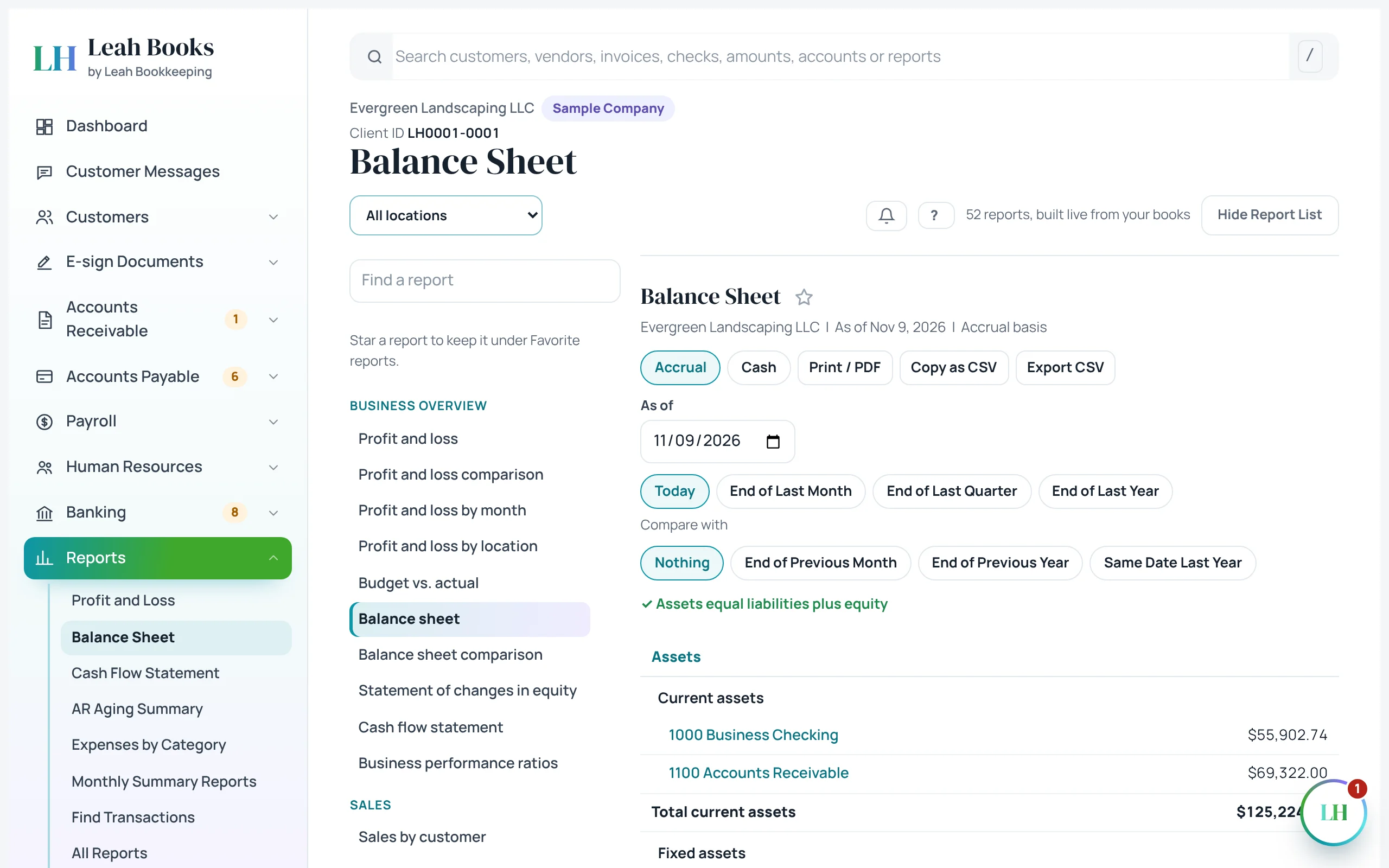 (opens the full-size screenshot)
How it ties to the equation and to retained earnings
End of year: $136,000 of assets = $36,000 of liabilities + $100,000 of equity. Start of year: $105,000 = $19,000 + $86,000.
The equity section is where the income statement lands. The year's net income of $44,000 appears in equity. Owner's draws of $30,000 reduce equity, but they are not an expense, so they never touch the P&L.
When the year is closed, net income and draws are moved into retained earnings. Next year Evergreen will start with retained earnings of $15,500 + $44,000 − $30,000 = $29,500.
Ending retained earnings = Beginning retained earnings + Net income − Draws (or dividends)
Working capital
Working capital is current assets minus current liabilities: the cushion available to run day-to-day operations.
Evergreen's working capital grew from $56,000 ($75,000 − $19,000) to $69,400 ($96,400 − $27,000).
Working capital = Current assets − Current liabilities
Try it in Leah Books
- Go to Reports > Balance sheet.
- Check the badge at the top that says assets equal liabilities plus equity, then add Total liabilities and Total equity yourself to confirm.
- Find Accumulated Depreciation under Fixed assets and subtract it from Equipment to get net book value.
- Under Compare with, choose End of previous month and see which current assets and current liabilities changed.
- Work out working capital: Total current assets minus Total current liabilities.
Key terms
- Balance sheet
- A statement of assets, liabilities and equity on a specific date.
- Classified balance sheet
- A balance sheet that separates current items from long-term items.
- Current asset
- Cash or an asset expected to become cash or be used up within one year or the operating cycle.
- Current liability
- An obligation due within one year, including the current portion of long-term debt.
- Accumulated depreciation
- A contra-asset that totals all depreciation recorded on an asset so far.
- Net book value
- An asset's cost minus its accumulated depreciation.
- Retained earnings
- Cumulative net income kept in the business after draws or dividends.
- Working capital
- Current assets minus current liabilities.
Check what you learned
Pick an answer to see if it's right and why. Nothing is saved or sent.