Bad debts
Record customers who won't pay using the direct write-off and allowance methods, and estimate the allowance with an aging schedule.
- Principles:
- Matching
- Conservatism
When a customer won't pay
Selling on credit means some invoices will never be collected. The question is when to record that loss. There are two methods: direct write-off and allowance.
The direct write-off method
Wait until a specific invoice is clearly uncollectible, then write it off. Suppose a $640 invoice to Northbank Coffee Co. is a year old and the customer has stopped answering.
| Account | Debit (Dr) | Credit (Cr) |
|---|---|---|
| Bad Debts | $640.00 | |
| Accounts Receivable | $640.00 | |
| Total Balanced | $640.00 | $640.00 |
Memo: In Leah Books, the Write off button on an invoice posts this entry.
Are you Increasing or Decreasing?
| Debit | Credit |
|---|---|
| Liability | Asset |
| Equity | Draw |
| Revenue | Expense |
− To decrease an account, put it on the opposite side.
Accounts Receivable goes down: press − and find Asset on the credit side.
- Simple, and it uses real, known losses.
- But the expense often lands in a later period than the sale, which breaks matching. Until the write-off, receivables look better than they are.
- Under GAAP, it's acceptable only when bad debts are immaterial. US income tax generally uses specific write-offs, so ask a tax professional how your write-offs are treated on the return.
The allowance method
Under the allowance method, you estimate at the end of each period how much of today's receivables won't be collected, and record that expense now, in the same period as the sales. The estimate goes into Allowance for Doubtful Accounts, a contra-asset with a credit balance that reduces Accounts Receivable on the balance sheet.
The result is net realizable value: the amount you actually expect to collect.
Net realizable value = Accounts receivable − Allowance for doubtful accounts
Estimating with an aging schedule
The aging method applies a higher uncollectible percentage to older invoices. The percentages come from your own collection history; the ones below are only an example.
| Age | Balance | % uncollectible | Estimate |
|---|---|---|---|
| Current | 18,000 | 1% | 180 |
| 1 to 30 days past due | 6,000 | 3% | 180 |
| 31 to 60 days past due | 2,500 | 10% | 250 |
| 61 to 90 days past due | 1,000 | 25% | 250 |
| Over 90 days past due | 800 | 50% | 400 |
| Total | 28,300 | 1,260 |
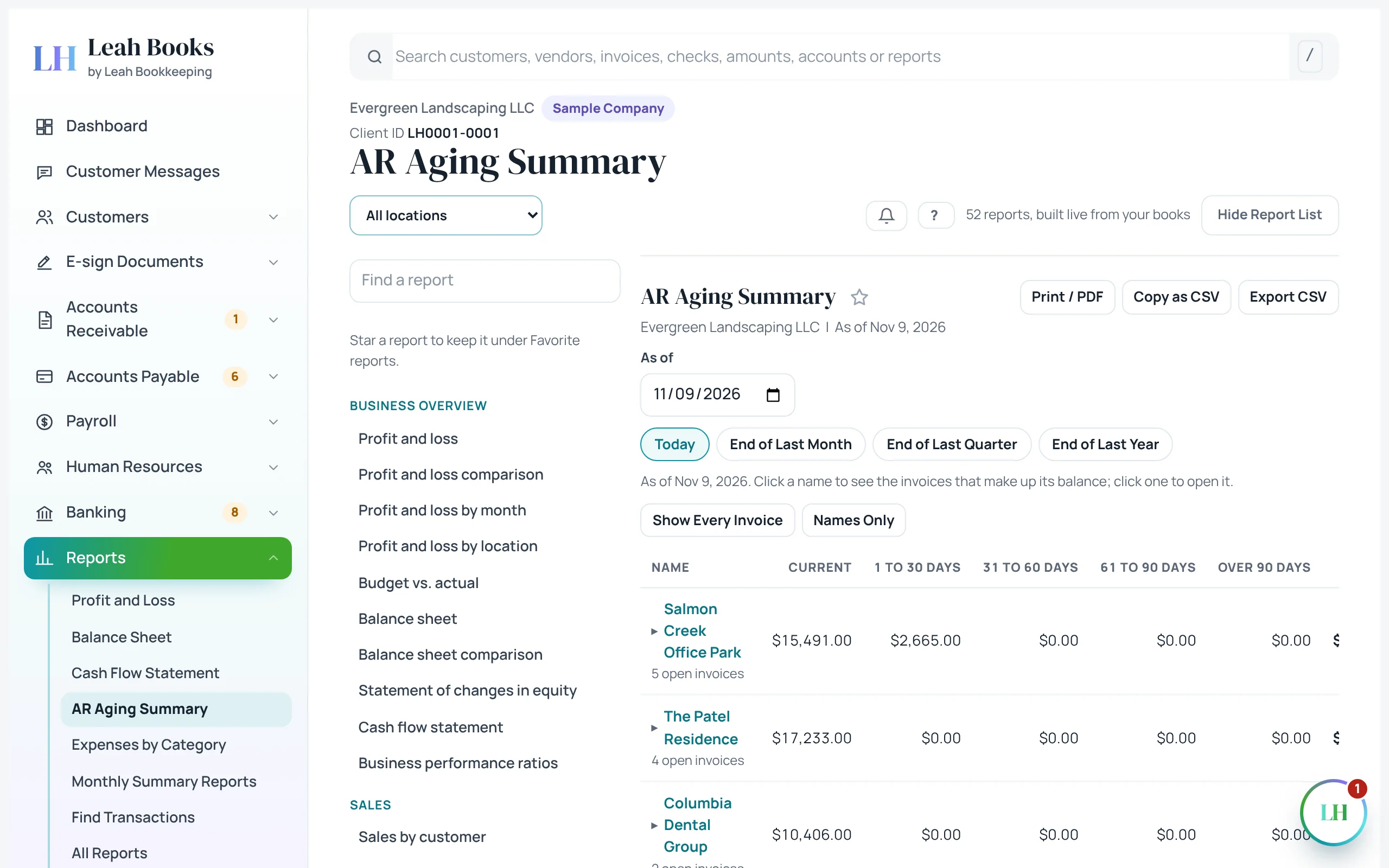 (opens the full-size screenshot)
Recording the allowance
The allowance should end at $1,260. If it already has a $300 credit balance from earlier periods, the adjustment is only the difference: $1,260 − $300 = $960. Net realizable value is then $28,300 − $1,260 = $27,040.
Later, when the Northbank invoice is written off under this method, the entry is debit Allowance for Doubtful Accounts $640, credit Accounts Receivable $640. No expense is recorded then, because it was already estimated.
| Account | Debit (Dr) | Credit (Cr) |
|---|---|---|
| Bad Debts | $960.00 | |
| Allowance for Doubtful Accounts | $960.00 | |
| Total Balanced | $960.00 | $960.00 |
Are you Increasing or Decreasing?
| Debit | Credit |
|---|---|
| Asset | Liability |
| Draw | Equity |
| Expense | Revenue |
+ To increase an account, put it on its normal side.
Bad Debts goes up: press + and find Expense on the debit side.
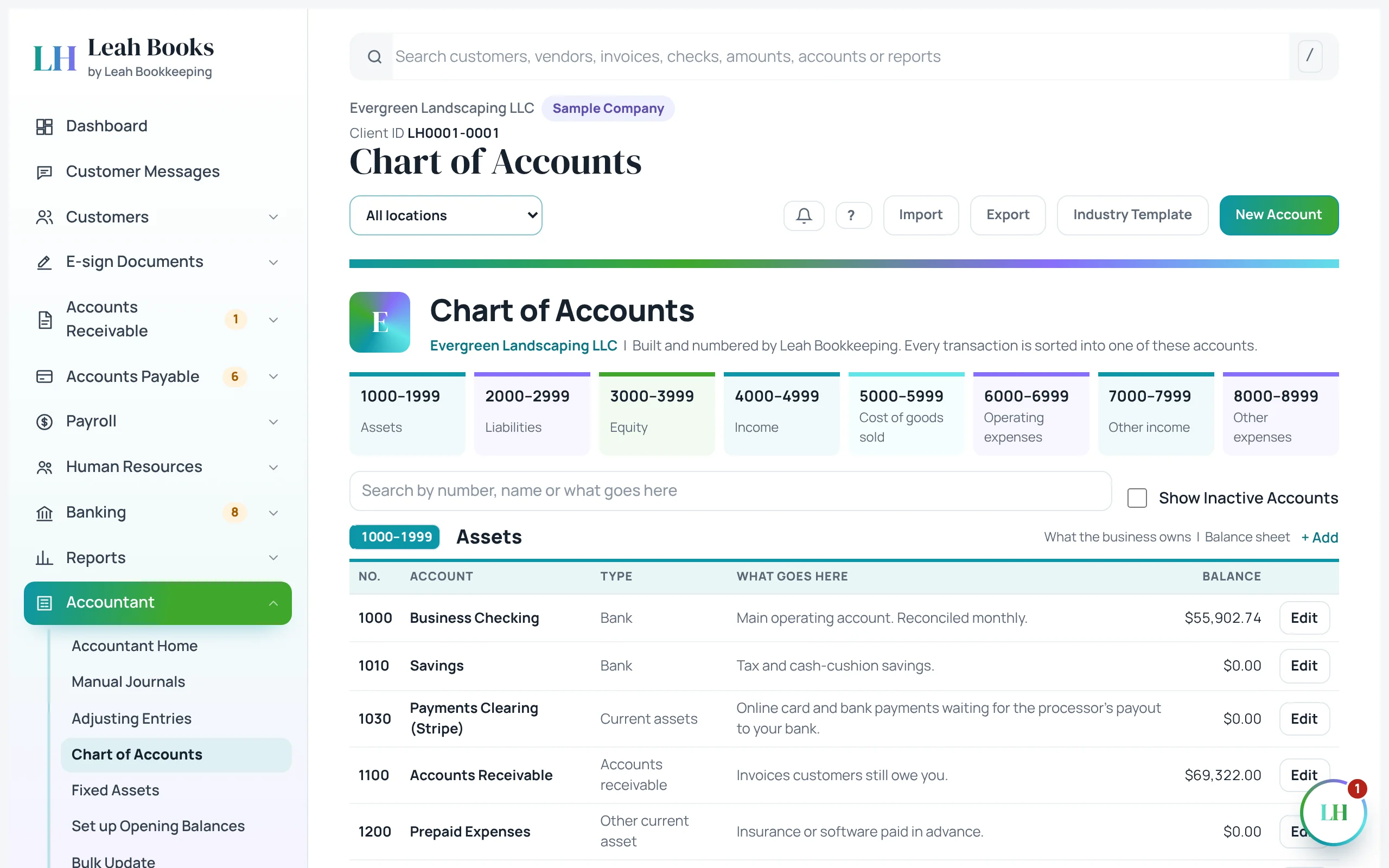 (opens the full-size screenshot)
Try it in Leah Books
- Open Reports > AR aging summary. See which customers have balances over 30 days.
- Go to Accounts Receivable > All invoices, open an overdue invoice and click Write off. Enter the amount, date and a reason. This is the direct write-off method.
- Go to Accountant > Chart of accounts, click New account and add Allowance for Doubtful Accounts as an asset account.
- Go to Accountant > Manual journals, click New journal entry, and debit Bad Debts and credit Allowance for Doubtful Accounts for your estimate. Post it, then open Reports > Balance sheet to see receivables reduced by the allowance.
- Real books use one method consistently. In Test mode you can practice both.
Key terms
- Bad debt
- A customer balance the business won't be able to collect.
- Direct write-off method
- Recording bad debt expense only when a specific invoice is judged uncollectible.
- Allowance method
- Estimating uncollectible receivables each period and recording the expense in the same period as the sales.
- Allowance for Doubtful Accounts
- A contra-asset with a credit balance that reduces Accounts Receivable to what you expect to collect.
- Aging schedule
- A table of receivables grouped by how long they've been outstanding.
- Net realizable value
- Accounts receivable minus the allowance: the amount expected to be collected.
Check what you learned
Pick an answer to see if it's right and why. Nothing is saved or sent.