Managerial accounting: costs, contribution margin and break-even
Separate fixed and variable costs, calculate contribution margin, and find the break-even point and margin of safety for a service.
Managerial vs. financial accounting
Financial accounting reports to outsiders and follows GAAP. Managerial accounting is for decisions inside the business: what to charge, how many jobs you need, whether to add a crew. It doesn't have to follow GAAP, so you can arrange the numbers however helps the decision.
The key managerial tool is sorting costs by behavior: how they change when activity changes.
Fixed, variable and mixed costs
- Variable costs change in total with activity: mulch and plants per job, fuel per visit, hourly crew pay per visit. The cost per unit stays about the same.
- Fixed costs stay the same in total within a normal range of activity: rent, insurance, software, a salaried supervisor, depreciation. The cost per unit falls as volume rises.
- Mixed costs have both parts. A phone plan with a flat monthly charge plus overage is an example. Split them into fixed and variable pieces before you analyze.
Note that the P&L doesn't sort costs this way. COGS isn't the same as variable cost, and operating expenses aren't all fixed. Evergreen's Fuel is an operating expense, but it is variable.
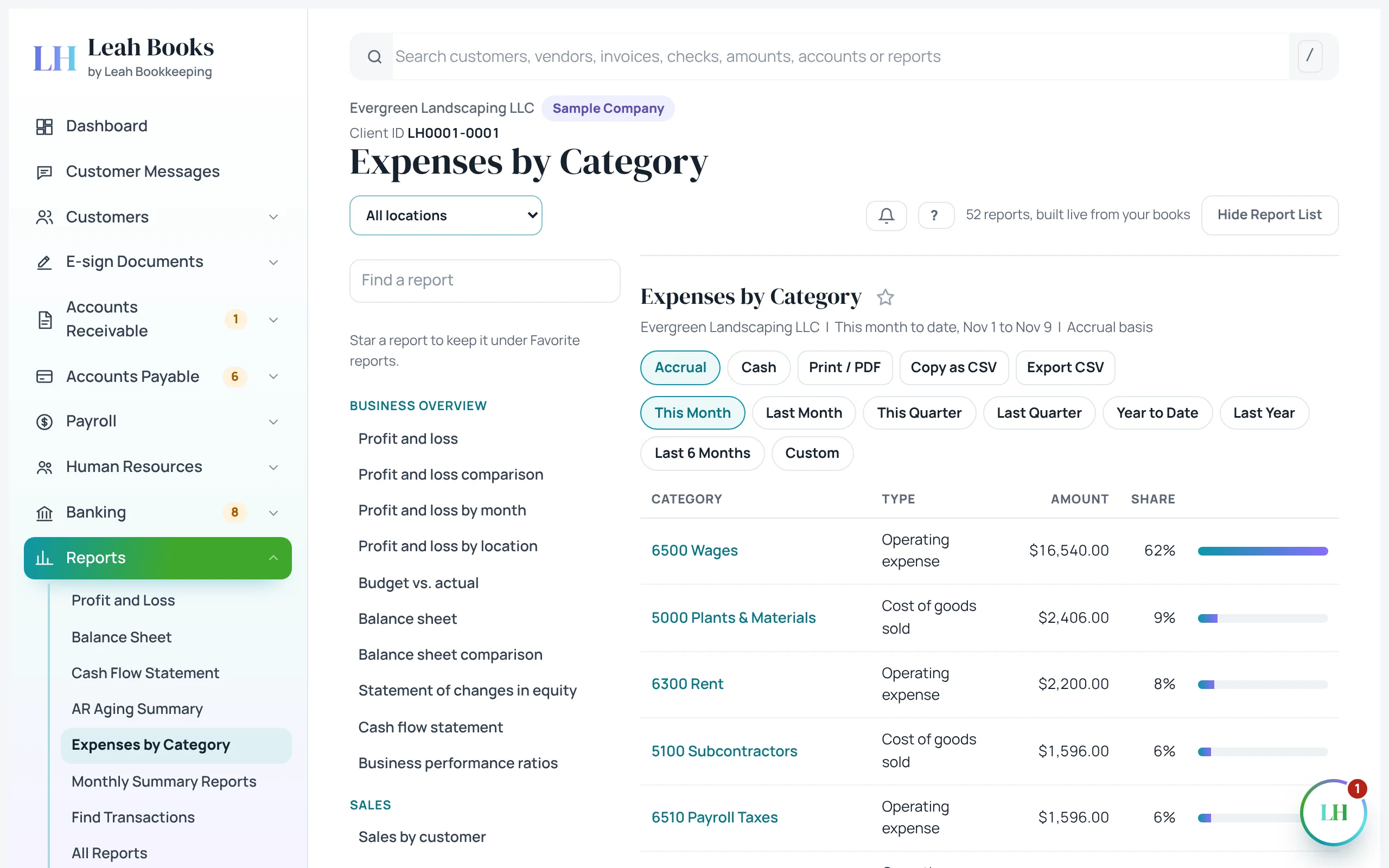 (opens the full-size screenshot)
Contribution margin
Evergreen sells a standard monthly yard-care visit for $250. Each visit uses about $35 of materials, $15 of fuel and $70 of hourly crew pay including payroll taxes. Variable cost per visit is $120.
Contribution margin is what each visit contributes toward fixed costs and then profit: $250 − $120 = $130 per visit. The contribution margin ratio is $130 ÷ $250 = 52%: 52 cents of every sales dollar is left after variable costs.
Evergreen's fixed costs for this service line are $10,400 a month: rent $2,200, insurance $480, a salaried supervisor $6,000, equipment depreciation $700, and software and phone $1,020.
Contribution margin per unit = Price − Variable cost per unit; CM ratio = Contribution margin ÷ Price
Break-even in units and dollars
The break-even point is where total contribution margin exactly covers fixed costs, so profit is zero.
Units: $10,400 ÷ $130 = 80 visits a month. Dollars: $10,400 ÷ 0.52 = $20,000 of sales. Check: 80 visits × $250 = $20,000.
To earn a target profit, add it to fixed costs. For $5,200 of monthly profit: ($10,400 + $5,200) ÷ $130 = 120 visits.
Break-even units = Fixed costs ÷ CM per unit; Break-even sales $ = Fixed costs ÷ CM ratio; Units for target profit = (Fixed costs + Target profit) ÷ CM per unit
| Contribution format income statement | At break-even (80 visits) | Planned (100 visits) |
|---|---|---|
| Sales at $250 | $20,000 | $25,000 |
| Variable costs at $120 | ($9,600) | ($12,000) |
| Contribution margin | $10,400 | $13,000 |
| Fixed costs | ($10,400) | ($10,400) |
| Operating income | $0 | $2,600 |
Margin of safety and operating leverage
The margin of safety is how far sales can drop before the business hits break-even. Planned sales are $25,000 and break-even is $20,000, so the margin of safety is $5,000, or 20 visits, or 20% of planned sales.
Check: $5,000 × 52% CM ratio = $2,600, which is the planned operating income.
Operating leverage measures how sensitive profit is to a change in sales. At 100 visits it is $13,000 contribution margin ÷ $2,600 operating income = 5.0. A 10% rise in sales would raise operating income by about 50%, and a 10% drop would cut it by about 50%.
Margin of safety = Planned sales − Break-even sales; Margin of safety % = Margin of safety ÷ Planned sales; Degree of operating leverage = Contribution margin ÷ Operating income
Try it in Leah Books
- Go to Reports > Expenses by category with the period Last 6 months.
- Label each expense account fixed, variable or mixed on paper. For example, Rent is fixed and Fuel is variable.
- Go to Reports > Profit and loss for the same period. Add Total cost of goods sold to the variable operating expenses you labeled.
- Compute the contribution margin ratio: (Total income − total variable costs) ÷ Total income.
- Divide the fixed costs you labeled by that ratio to estimate break-even sales for six months.
Key terms
- Variable cost
- A cost that changes in total in proportion to activity.
- Fixed cost
- A cost that stays the same in total within a normal range of activity.
- Mixed cost
- A cost with both a fixed part and a variable part.
- Contribution margin
- Sales minus variable costs; the amount available to cover fixed costs and profit.
- Contribution margin ratio
- Contribution margin divided by sales.
- Break-even point
- The sales level where total contribution margin equals fixed costs and profit is zero.
- Margin of safety
- The amount by which planned or actual sales exceed break-even sales.
- Operating leverage
- How much operating income changes for a given change in sales; contribution margin divided by operating income.
Check what you learned
Pick an answer to see if it's right and why. Nothing is saved or sent.