The accounting equation
Use Assets = Liabilities + Equity to track how each transaction changes a business.
- Principles:
- Double-entry
- Monetary unit
One equation holds the books together
Every set of books rests on one equation. Everything the business has came from either a lender or the owners.
Assets are what the business owns or controls. Liabilities are what it owes. Equity is the owner's share, what's left over.
Assets = Liabilities + Equity
Two more ways to write it
You can rearrange the equation to find any missing piece.
Equity is also called net assets: what would be left if you paid off every debt.
Equity = Assets − Liabilities
Five transactions, one running table
Let's follow Evergreen Landscaping through five transactions. Watch both sides of the equation. After every row, they stay equal.
Revenue makes equity go up. Expenses make equity go down. That is because profit belongs to the owner.
- 1. The owner puts in $28,500 cash and $42,000 of equipment to start the business.
- 2. A $1,400 bill arrives from Pacific Nursery Supply for plants used on jobs. It isn't paid yet.
- 3. Evergreen invoices Harbor View HOA $3,600 for grounds maintenance.
- 4. Harbor View HOA pays the $3,600 invoice by check.
- 5. Evergreen pays $2,200 rent to Mill Plain Properties.
| After step | Cash | Accounts Receivable | Equipment | Total assets | Accounts Payable | Equity | Liabilities + Equity |
|---|---|---|---|---|---|---|---|
| 1. Owner invests | $28,500 | $0 | $42,000 | $70,500 | $0 | $70,500 | $70,500 |
| 2. Plants bill | $28,500 | $0 | $42,000 | $70,500 | $1,400 | $69,100 | $70,500 |
| 3. Invoice sent | $28,500 | $3,600 | $42,000 | $74,100 | $1,400 | $72,700 | $74,100 |
| 4. Invoice paid | $32,100 | $0 | $42,000 | $74,100 | $1,400 | $72,700 | $74,100 |
| 5. Rent paid | $29,900 | $0 | $42,000 | $71,900 | $1,400 | $70,500 | $71,900 |
What to notice
- Step 2 raised a liability and lowered equity. An expense was incurred, even though no cash moved.
- Step 3 raised an asset (money owed to us) and raised equity (revenue).
- Step 4 swapped one asset for another. Cash went up, Accounts Receivable went down. Equity did not change.
- Step 5 lowered cash and lowered equity. Rent is an expense.
- Every transaction touched at least two places. That's double-entry accounting.
The equation on a real report
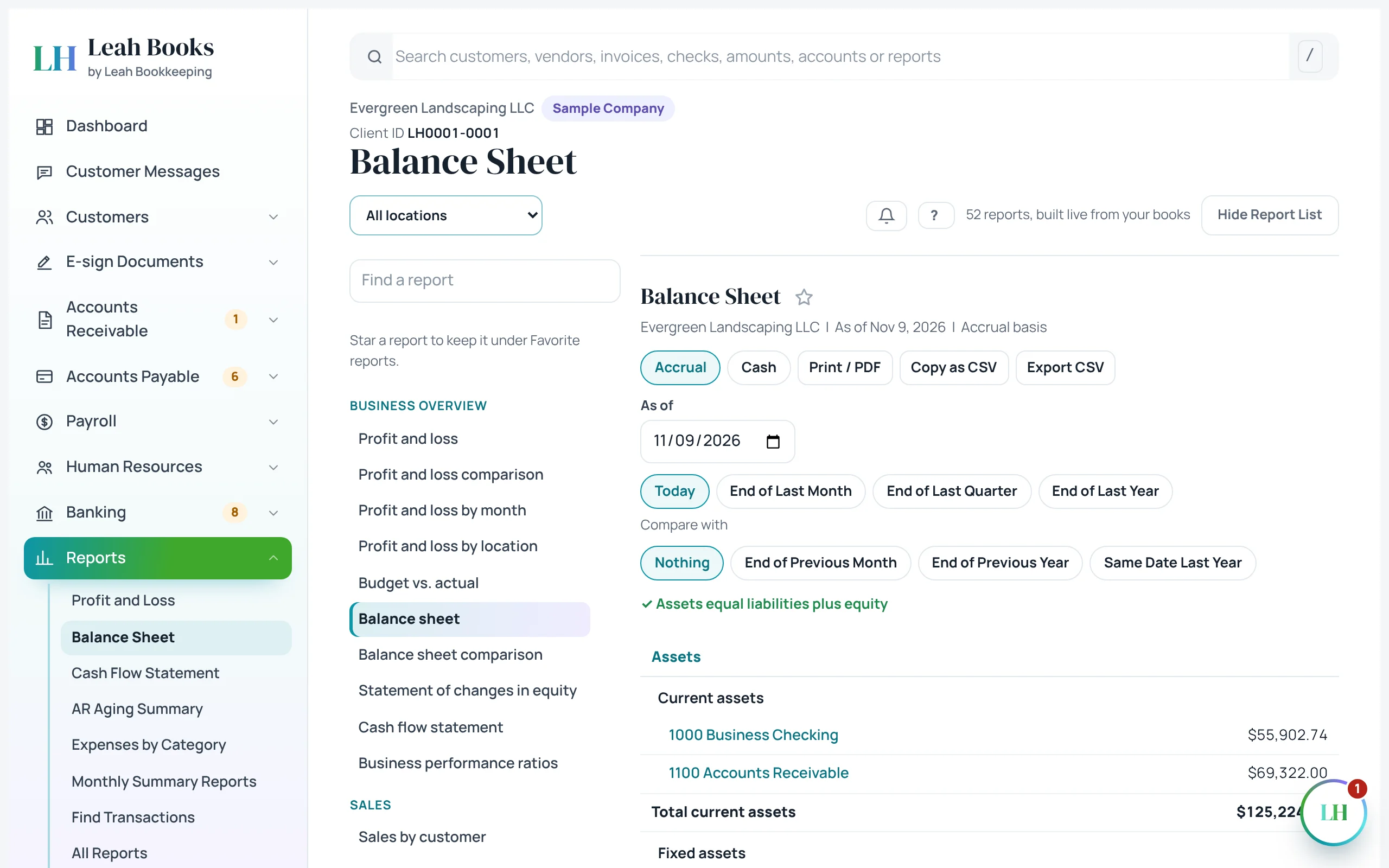
The balance sheet is the accounting equation, laid out as a report. Total assets always equal total liabilities plus equity.
 (opens the full-size screenshot)
Try it in Leah Books
- Go to Reports > Balance sheet. Write down total assets, total liabilities and total equity. Check that assets equal liabilities plus equity.
- Go to Accounts Receivable > Create an invoice. Make a $500 invoice to one of your customers and send it (in Test mode nothing is emailed for real).
- Go back to Reports > Balance sheet. Accounts Receivable went up by $500, and so did equity (through this year's profit). The equation still balances.
Key terms
- Accounting equation
- Assets = Liabilities + Equity. It is true after every transaction.
- Asset
- Something the business owns or controls that has value, like cash or equipment.
- Liability
- Something the business owes, like a vendor bill or a loan.
- Equity
- The owner's interest in the business: assets minus liabilities.
- Net assets
- Total assets minus total liabilities. Another name for equity.
- Double-entry accounting
- A system where every transaction affects at least two accounts.
Check what you learned
Pick an answer to see if it's right and why. Nothing is saved or sent.