Owner money: contributions and draws
You'll record money the owner puts in and takes out, keep personal and business money apart, and handle petty cash.
- Principles:
- Economic entity
- Double-entry
The business is its own entity
The economic entity principle says the business's books cover only the business. The owner's personal money stays out, even if the owner is one person running an LLC from the kitchen table.
Mixing personal and business money (called commingling) hurts in several ways:
- Your reports stop showing the business's real profit.
- Business deductions get harder to prove.
- Reconciling and finding mistakes takes much longer.
- For an LLC or corporation, mixing funds can put the owner's personal liability protection at risk.
Putting money in: contributions
When the owner puts their own money or property into the business, it's a contribution. It raises equity. It is not revenue, because the business didn't earn it.
Evergreen's sample books start this way: the owner put in $28,500 of cash and $42,000 of equipment. In Leah Books, contributions go to Owner's Investment (also called owner's capital).
| Account | Debit (Dr) | Credit (Cr) |
|---|---|---|
| Business Checking | $28,500.00 | |
| Equipment | $42,000.00 | |
| Owner's Investment | $70,500.00 | |
| Total Balanced | $70,500.00 | $70,500.00 |
Memo: Opening balance in the sample books.
Are you Increasing or Decreasing?
| Debit | Credit |
|---|---|
| Asset | Liability |
| Draw | Equity |
| Expense | Revenue |
+ To increase an account, put it on its normal side.
Business Checking goes up: press + and find Asset on the debit side.
Taking money out: draws
When the owner of a sole proprietorship or partnership-style LLC takes money for personal use, it's a draw. A draw lowers equity. It is not an expense, so it doesn't lower profit.
Owner's Draw has a normal debit balance and reduces equity on the balance sheet.
How owners should pay themselves depends on the type of business. For example, an S corporation owner who works in the business generally needs a reasonable wage through payroll. Check with a tax professional.
| Account | Debit (Dr) | Credit (Cr) |
|---|---|---|
| Owner's Draw | $2,000.00 | |
| Business Checking | $2,000.00 | |
| Total Balanced | $2,000.00 | $2,000.00 |
Are you Increasing or Decreasing?
| Debit | Credit |
|---|---|
| Liability | Asset |
| Equity | Draw |
| Revenue | Expense |
− To decrease an account, put it on the opposite side.
Business Checking goes down: press − and find Asset on the credit side.
When personal and business get mixed
Mistakes happen. Fix them in the books so the business's numbers stay right, and keep the receipt or a note explaining it.
| What happened | Debit | Credit |
|---|---|---|
| Personal purchase on the business card | Owner's Draw | Business Credit Card |
| Personal purchase from business checking | Owner's Draw | Business Checking |
| Business expense paid with the owner's personal card | The expense (like Fuel) | Owner's Investment |
| Account | Debit (Dr) | Credit (Cr) |
|---|---|---|
| Owner's Draw | $64.50 | |
| Business Credit Card | $64.50 | |
| Total Balanced | $64.50 | $64.50 |
Memo: Personal, not a business expense.
Are you Increasing or Decreasing?
| Debit | Credit |
|---|---|
| Asset | Liability |
| Draw | Equity |
| Expense | Revenue |
+ To increase an account, put it on its normal side.
Owner's Draw goes up: press + and find Draw on the debit side.
Petty cash, briefly
Petty cash is a small amount of cash kept on hand for little purchases. Set it up by moving a fixed amount from checking, keep a receipt for everything paid from it, and top it back up to the same amount.
When you top it up, record the expenses from the receipts and credit checking for the cash added back. In Leah Books you'd add it as a bank account of the type Cash on hand.
Cash in the box + Receipts for what was spent = The petty cash fund amount
| Account | Debit (Dr) | Credit (Cr) |
|---|---|---|
| Petty Cash | $200.00 | |
| Business Checking | $200.00 | |
| Total Balanced | $200.00 | $200.00 |
Are you Increasing or Decreasing?
| Debit | Credit |
|---|---|
| Liability | Asset |
| Equity | Draw |
| Revenue | Expense |
− To decrease an account, put it on the opposite side.
Business Checking goes down: press − and find Asset on the credit side.
Where owner money shows up
On the balance sheet, Equity shows Owner's Investment, Owner's Draw (as a reduction) and Retained Earnings. None of it appears on the profit and loss.
Ending equity = Beginning equity + Contributions + Net income − Draws
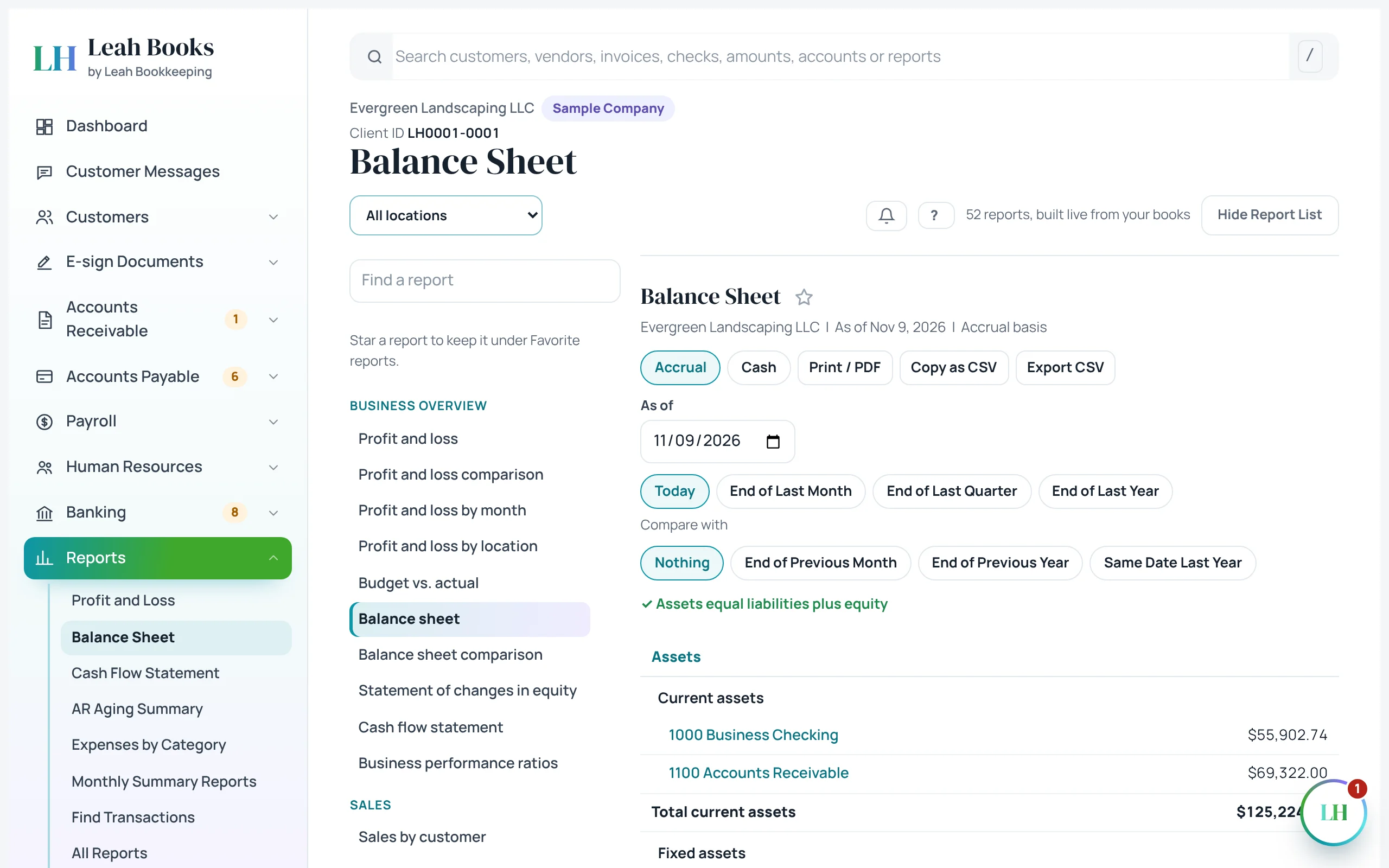 (opens the full-size screenshot)
Try it in Leah Books
- Open Reports > Balance sheet and find the Equity section.
- Go to Accountant > Chart of accounts and find 3000 Owner's Investment and 3100 Owner's Draw. Notice they're equity accounts.
- Go to Accounts Payable > Write a check. Make a check to the owner and pick 3100 Owner's Draw as the category to see how a draw by check is set up.
- Go to Banking > Bank accounts and click Add a bank account. Look at the account types and find Cash on hand, which is how you'd set up petty cash.
Key terms
- Economic entity principle
- The rule that the business's books are kept separate from the owner's personal finances.
- Owner's contribution
- Money or property the owner puts into the business. Raises equity; not revenue.
- Owner's Investment
- The equity account for what the owner has put in. Also called owner's capital.
- Owner's draw
- Money the owner takes out for personal use. Lowers equity; not an expense.
- Commingling
- Mixing personal and business money in the same accounts.
- Petty cash
- A small fund of cash on hand for minor purchases, backed by receipts.
- Equity
- The owner's share of the business: assets minus liabilities.
Check what you learned
Pick an answer to see if it's right and why. Nothing is saved or sent.